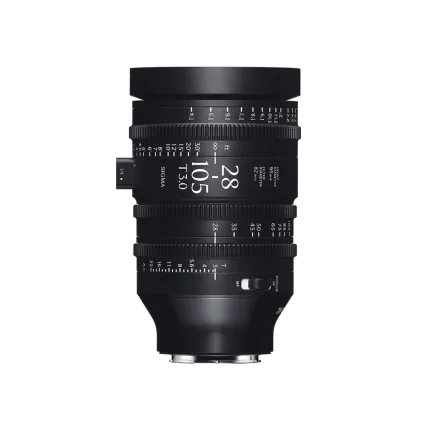
Sigma 28-105mm T3 FF Cine Zoom Lens with AF (Sony E - Feet)

Questions? Ask our experts
Key Features
- Full-frame Sigma Cine AF zoom lens covering a highly versatile 28-105mm range for narrative, documentary, commercial, and run-and-gun production.
- Constant T3 aperture delivers consistent exposure throughout the zoom range while supporting shallow depth of field and strong low-light performance.
- Native Sony E mount design with autofocus support helps streamline solo operation, gimbal work, fast-paced production, and hybrid cine workflows.
- Cinema-oriented mechanical design includes standardized gear positioning, long focus rotation, and professional operability for follow focus and accessory integration.
- Large 95mm front diameter supports common cinema matte boxes and filter ecosystems for easier rigging on set.
- Optical construction is designed for full-frame image capture with high resolution, controlled breathing, and a look suited to modern digital cinema acquisition.
Questions? Ask our experts
OVERVIEW
Compatible With
- Sony E-mount full-frame cinema and mirrorless cameras, including Sony FX3, FX30, FX6, FX9, a1, a7 series, and a9 series
- Other Sony E / FE mount camera bodies compatible with full-frame E-mount lenses
Versatile Full-Frame Cine Zoom for Modern Production
The Sigma 28-105mm T3 FF Cine Zoom Lens with AF is designed for filmmakers who need broad focal length coverage, a constant fast transmission, and cinema-focused handling in a single lens. Spanning from a moderately wide 28mm through portrait-friendly and short telephoto 105mm, this lens is well suited to interviews, documentary capture, narrative scenes, commercial production, music videos, corporate video, and event filmmaking. Its full-frame coverage makes it a strong match for today’s large-format cinema and hybrid mirrorless cameras, while the Sony E mount version integrates naturally into many popular production setups.
Constant T3 Performance Across the Zoom Range
A constant T3 aperture is one of the lens’s biggest advantages in real-world filmmaking. Because transmission remains consistent while zooming, exposure shifts are minimized during shots, making this lens useful for zoom moves and for productions that need reliable continuity across multiple focal lengths. T3 is bright enough for selective focus, subject separation, and low-light operation, while still being practical for controlled studio and location work. For cinematographers, a true cine-style transmission rating is especially valuable when matching exposure across a larger lens package.
Autofocus Meets Cinema Design
One of the most compelling aspects of this Sigma Cine AF lens is its blend of autofocus convenience with cine-oriented physical design. Traditional cinema lenses are prized for repeatability, long focus throws, and standardized control layout, while modern productions increasingly benefit from fast, accurate autofocus for solo operators, gimbal work, live event coverage, and rapidly changing documentary environments. This lens bridges those needs, giving users a more production-friendly operating experience without sacrificing the speed and practicality that AF can bring to certain jobs.
Built for Professional Rigging and On-Set Workflow
The 95mm front diameter is especially important because it aligns with a widely used cinema standard. That makes it easier to integrate the lens with clamp-on or swing-away matte boxes, filter systems, lens support accessories, and other cinema rig components. Standardized gear placement also helps crews swap lenses more efficiently, especially in productions that mix or build around a cine set. Whether mounted on a shoulder rig, tripod, slider, dolly, or gimbal, the lens is intended to support a professional shooting rhythm.
Excellent Focal Range for Single-Lens Production Days
The 28-105mm range is one of the most practical all-around zoom spans for full-frame video capture. At 28mm, you can frame establishing shots, environmental portraits, handheld walk-and-talk sequences, interiors, and wider coverage in tighter spaces. Moving through the midrange, focal lengths around 35mm, 50mm, and 70mm are ideal for classic storytelling perspectives. At 85mm and 105mm, the lens becomes very useful for interviews, detail shots, compressed framing, and flattering portrait work. For many productions, this range can stay on the camera for most of the day, reducing lens swaps and improving efficiency.
Optical Character and Image Quality
As part of Sigma’s cine-focused optical philosophy, this lens is designed to deliver high resolving power suitable for modern high-resolution sensors, while also maintaining a cinematic rendering that works well for motion acquisition. Filmmakers typically look for strong center-to-edge consistency, controlled aberrations, pleasing contrast, and natural color reproduction, all of which contribute to a dependable post-production pipeline. A lens in this class is also expected to control focus breathing and maintain a more motion-friendly image behavior than stills-oriented zooms, helping footage feel more polished and intentional.
Why Choose This Lens Over a Standard Photo Zoom?
Many Sony E-mount users already know the convenience of 24-70mm and 24-105mm still photography zooms, but a cine zoom like the Sigma 28-105mm T3 FF Cine AF is aimed at a different level of production use. Compared with conventional still lenses, cine lenses typically provide more precise manual focus control, industry-standard gearing, better consistency for assistant camera workflows, more dependable physical behavior when rigged, and exposure markings geared toward filmmaking. This makes the lens especially attractive for productions where repeatable pulls, accessory compatibility, and efficient on-set operation matter as much as pure image sharpness.
Ideal Use Cases
This lens is particularly well suited to documentary filmmakers who need a flexible focal range with autofocus support; commercial shooters who want a fast, polished all-purpose zoom; owner-operators working with Sony E-mount cinema bodies; and small crews that need a lens able to transition smoothly between handheld, tripod, and gimbal work. It is also a compelling option for interviews and branded content, where the 70-105mm end offers flattering subject framing, while the wider end can capture environmental context and B-roll without changing lenses.
Handling Benefits for Solo Shooters and Crews
For solo creators, autofocus can reduce missed shots in fast-moving environments, while the cine-style body improves compatibility with follow focus units and support gear when more control is needed. For larger crews, the lens can support a more structured cinema workflow, especially when paired with wireless focus systems, matte boxes, and lens supports. This hybrid approach makes it attractive in today’s production world, where one job may involve a stripped-down operator package and the next may require a fully built-out cine rig.
Recommended Accessories
To get the most from this lens, consider pairing it with a 95mm-compatible matte box, cinema lens support, a geared follow focus or wireless lens control system, and high-quality ND filters if your setup supports front filtration. For Sony E-mount cinema shooting, it also pairs naturally with cage systems, baseplates, rails, and external monitoring tools. If you frequently shoot handheld or documentary footage, a variable ND solution, top handle, and compact shotgun microphone can make the lens part of a highly versatile field kit.
Usage Tips
For narrative work, use the lens near the wider-to-normal focal lengths for immersive, scene-building coverage and move toward the telephoto end for emotional isolation and close-ups. For interview production, 70-105mm is a strong range for flattering framing and softer backgrounds. On gimbals, balance carefully at a commonly used focal length and verify clearance with your focus and zoom ring positions. When using autofocus, test body-specific AF behavior in advance so you can tune settings such as speed and responsiveness for your subject matter. If manual focus precision is critical, pair the lens with a focus motor and external monitor for the most repeatable results.
Where It Fits in Sigma’s Cine Lens Evolution
Sigma has earned a strong reputation among filmmakers by offering cine lenses that combine robust mechanics, strong optical performance, and comparatively accessible pricing within the professional cinema market. The company’s cine lineup has been adopted across independent film, commercial production, and owner-operator workflows because it brings many features associated with high-end cinema glass into a more attainable system. This 28-105mm T3 FF Cine AF model reflects the ongoing evolution of filmmaking tools, where professional cinema ergonomics increasingly intersect with autofocus-enabled camera systems and hybrid production demands.
A Smart Choice for E-Mount Cinema Creators
If you need one lens that can cover a large portion of real-world filmmaking situations without constant lens changes, the Sigma 28-105mm T3 FF Cine Zoom Lens with AF for Sony E is an extremely compelling option. Its full-frame coverage, constant T3 speed, cinema-friendly mechanical design, and autofocus capability make it suitable for both controlled productions and agile shooting environments. For creators building a serious Sony E-mount video kit, it stands out as a practical and professional centerpiece lens.
Brand
lens specification
| Lens Min. Focus Distance | 1.31' (40 cm) |
| Lens Filter Size | 95mm |
| Dimensions | Approx. 6.2 x 6.2 in. (157.9 x 157.9 mm) |
| Minimum Aperture | f/22 |
| Diaphragm Blades | 13 |
| Optical Design | 18 elements in 13 groups |
| Image Stabilization | No |
| Weight | Approx. 3.3 lb / 1.5 kg |
| Tripod Collar | Yes |
| Focal Length | 28-105mm |
| Angle of View (diagonal) | Approx. 75.4° - 23.3° |
| Maximum Aperture | T3 |
| Maximum Magnification | 1:4 |
| Focus Type | Auto / Manual |
| Mount Type | Sony E / FE |
- Sigma 28-105mm T3 FF Cine Zoom Lens with AF (Sony E - Feet)
- Front lens cap
- Rear lens cap
- Lens support foot or support accessory (if supplied by manufacturer)
- Protective packing and documentation
- *Open Box* Sony Alpha a9 II Mirrorless Digital Camera (Body Only)
- Sony Alpha a1 Mirrorless Digital Camera (Body Only)
- Used Sony A9 III Body - Excellent
- Sony Alpha a7 III Mirrorless Digital Camera (Body Only)
- Used Good Sony Alpha a9 III Mirrorless Camera (Body Only) - GOOD
- Used Sony a6400 Body Only - Good Condition
- Used Sony A6000 Mirrorless Camera Body Only (Sliver) - Excellent
- Used Fair Sony Alpha a9 III Mirrorless Camera (Body Only)
- Used Sony A6000 Body Only (Black) - Excellent
- Used Sony A7III Body Only - Excellent
No creators have tagged this product yet.
Articles featuring this product
Sigma Cine Prime Lens Kits Compared: Choosing the Right Full-Frame Set for Your First Serious Prime
Jul 29, 2026
·
Unique Photo
Wide vs. Standard Lenses for Environmental Portraits: A Practical Review of Sigma 24mm F2, Sigma 28-
Aug 31, 2026
·
Unique Photo
Sigma 24-70mm f/2.8 Art Buying Guide: Real-World Tips, Comparisons, and Smart Alternatives
Jul 22, 2026
·
Unique Photo
Best Travel Photography Lens Recommendation: Sigma 28-70mm f/2.8 Contemporary DG DN for Lightweight
Sep 3, 2026
·
Unique Photo
What’s the Best All-Around Travel Lens for My Next Trip? Tamron 28-200mm F/2.8-5.6 Di III RXD Revi
Aug 13, 2026
·
Unique Photo
Community questions about this gear
Ask a question
0
votes
2
answers
309
Can Minolta A/Maxxum AF lenses be adapted to a Canon EOS Rebel T2i/550D?
Photography Stack Exchange contributor
14y ago
0
votes
2
answers
167
0
votes
2
answers
439
0
votes
2
answers
211