OM SYSTEM M.Zuiko Digital ED 75-300mm f/4.8-6.7 II Lens

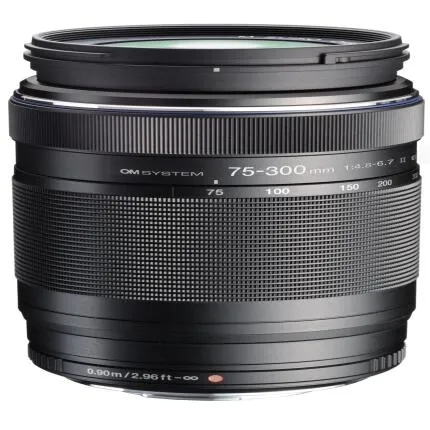

Key Features
- Ultra-telephoto 75-300mm zoom lens for Micro Four Thirds cameras, delivering a 150-600mm full-frame equivalent field of view.
- Compact and lightweight design makes long-reach wildlife, sports, travel, and outdoor shooting more portable.
- ED glass elements help reduce chromatic aberration for clearer, higher-contrast images throughout the zoom range.
- High-speed MSC autofocus system offers smooth, quiet focusing for both stills and video capture.
- Close focusing down to 2.95 ft. enables tight framing of distant details and smaller subjects.
- 58mm front filter thread supports common protective, UV, and polarizing filters.
OVERVIEW
Compatible With
- OM SYSTEM OM-1, OM-1 Mark II, OM-5
- Olympus OM-D E-M1 series, E-M5 series, E-M10 series
- Olympus PEN E-P series, E-PL series, E-PM series
- Panasonic Lumix G Micro Four Thirds cameras including GH, G, GX, and GF series
- And other Micro Four Thirds-mount camera bodies
Long Telephoto Reach in a Travel-Friendly Format
The standout advantage of this lens is its remarkable reach. On a Micro Four Thirds sensor, the 75-300mm zoom range delivers an angle of view equivalent to a 150-600mm lens on full frame, making it possible to fill the frame with faraway subjects while carrying far less weight than larger DSLR-era alternatives. This makes it especially attractive for photographers who hike, travel, or shoot handheld for long periods and need a lens that stays manageable in the field.Optical Performance
The optical construction uses 18 elements in 13 groups, including extra-low dispersion elements designed to suppress color fringing and improve clarity at longer focal lengths. Telephoto lenses are often challenged by atmospheric haze, contrast loss, and chromatic aberration, so the inclusion of ED glass is important for preserving detail and producing cleaner edges around high-contrast subjects such as birds against bright skies or athletes under harsh daylight. The lens is engineered to provide strong sharpness and pleasing contrast across its zoom range, especially when used with good long-lens technique.Quiet MSC Autofocus for Stills and Video
OM SYSTEM's MSC (Movie & Still Compatible) autofocus mechanism is a major practical benefit. It provides fast, quiet, and smooth autofocus performance, making the lens useful not only for still photography but also for video recording where noisy focus motors can be distracting. Whether tracking moving wildlife or acquiring focus on distant subjects at the long end, the lens is designed to focus efficiently while maintaining a compact internal drive system.Ideal Uses
This lens excels in situations where subject distance is the main challenge. Wildlife photographers can frame birds, deer, and other animals from a respectful distance. Sports shooters can isolate action occurring across a field. Travelers can compress distant mountain ridges or photograph architectural details unreachable with a standard zoom. It is also a compelling option for moon photography, candid street details from afar, and nature observation where portability matters as much as focal length.Handling and Portability
One of the most appealing aspects of the M.Zuiko 75-300mm II is how small it is for the reach it delivers. Weighing only about 423g, it balances far better on compact mirrorless bodies than many longer lenses on larger systems. This makes it easier to pack in a shoulder bag or backpack and more comfortable for spontaneous telephoto shooting. The zoom design keeps the system practical for enthusiasts who may not want to commit to the size, weight, and cost of a premium constant-aperture telephoto lens.What the Aperture Range Means in Real Use
The variable maximum aperture of f/4.8-6.7 helps keep the lens compact and lightweight. While it is not intended as a low-light sports specialist, it performs very well in daylight, bright overcast conditions, and outdoor environments where telephoto reach is the top priority. Pairing it with modern OM SYSTEM or Olympus bodies that offer effective in-body image stabilization can further enhance handheld usability, especially when photographing static or slower-moving subjects. For best results at longer focal lengths, photographers should use appropriate shutter speeds and stable technique.Close Focusing and Creative Flexibility
With a minimum focusing distance of 2.95 feet (0.9m) and a maximum magnification of 0.18x, the lens is capable of more than distant-only photography. It can also be used for isolating flowers, insects at comfortable distances, details in nature, and compressed close-up compositions. The long focal length allows attractive background separation and makes small subjects appear larger in the frame without requiring you to move extremely close.Comparison to Other Telephoto Options
Compared with shorter telephoto zooms such as a 40-150mm lens, the 75-300mm II offers dramatically more reach for distant subjects. Compared with premium pro telephotos, it gives up some brightness and weather sealing but rewards users with significantly lower weight, smaller size, and more approachable cost. That makes it especially appealing for hobbyists, travelers, and outdoor shooters who value reach-per-pound and reach-per-dollar. It fills an important place in the Micro Four Thirds system by making 600mm-equivalent framing accessible in a very compact package.Recommended Accessories
A 58mm UV or clear protective filter can help protect the front element during travel and field use. A circular polarizer in 58mm size can improve color and reduce glare for landscape shooting, though users should be mindful of light loss at longer focal lengths. A stable monopod or lightweight tripod is useful for long sessions involving birds, wildlife, or moon photography. Extra camera batteries are also recommended, since extended autofocus use and image stabilization can increase power consumption. A padded telephoto-capable camera bag is a smart addition for travel and storage.
Usage Tips for Best Results
- Use faster shutter speeds at the long end to minimize blur from camera shake and subject movement.
- Enable in-body stabilization if your camera body supports it.
- For birds and wildlife, pre-focus near the expected subject distance to speed up acquisition.
- Stop down slightly when possible for added edge-to-edge crispness and contrast.
- Shoot in good light whenever possible, especially toward 300mm where maximum aperture is narrower.
- Consider a monopod for prolonged sessions to reduce fatigue and improve stability.
System Heritage
The M.Zuiko Digital ED 75-300mm series reflects the long-standing Olympus and now OM SYSTEM philosophy of building high-performance lenses that remain genuinely portable. Within the Micro Four Thirds ecosystem, telephoto reach has always been one of the format's strengths because the smaller sensor allows compact lenses to deliver powerful full-frame-equivalent angles of view. This lens is a clear example of that benefit, giving photographers access to a 150-600mm equivalent range in a lens that remains easy to carry and practical for everyday use.Why Choose the OM SYSTEM M.Zuiko Digital ED 75-300mm f/4.8-6.7 II
Choose this lens if you need maximum reach in the smallest practical package for Micro Four Thirds. It is an excellent fit for enthusiasts who shoot wildlife, birds, aviation, outdoor sports, distant landscapes, or travel subjects and want a versatile telephoto zoom that does not dominate their kit. Its combination of compact size, long equivalent focal length, quiet autofocus, ED optical design, and everyday portability makes it one of the most accessible super-telephoto options in the OM SYSTEM/Olympus lineup.Brand
lens specification
| Lens Min. Focus Distance | 2.95' (90 cm) |
| Lens Filter Size | 58mm |
| Dimensions | 2.7 x 4.6 in. / 69 x 116.5 mm |
| Minimum Aperture | f/22 |
| Diaphragm Blades | 7 |
| Optical Design | 18 elements in 13 groups |
| Image Stabilization | No |
| Weight | 14.9 oz / 423 g |
| Tripod Collar | No |
| Focal Length | 75-300mm |
| Angle of View (diagonal) | 16° to 4.1° |
| Maximum Aperture | f/4.8-6.7 |
| Maximum Magnification | 0.18x |
| Focus Type | Auto / Manual |
| Mount Type | Micro Four Thirds |
- OM SYSTEM M.Zuiko Digital ED 75-300mm f/4.8-6.7 II Lens
- Front lens cap
- Rear lens cap
- Instruction/documentation set
- Used Panasonic GH5S Body Only - Excellent
- Blackmagic Design Micro Studio Camera 4K G2
- Blackmagic Design Studio Camera 4K Plus G2
- Used Panasonic GX8 w/ 12-60mm f/3.5-5.6 - Excellent
- Used Panasonic G85 Body Only (Black)- Excellent
- Used Fair Panasonic Lumix GH5S Mirrorless Micro 4/3 Digital Camera Body Only
- Used Panasonic GM5K w/ 12-32mm (Red) - Excellent
- Used Olympus OM-D E-M1 Mark II Mirrorless 4/3 Digital Camera Body Only (Blac
- Used Panasonic Lumix DC-GX9M Mirrorless Micro 4/3 Digital Camera with 12-60m
- Used Fair Panasonic LUMIX G100 Mirrorless 4K Vlogging Camera with 12-32mm Le
- Used Excellent Panasonic LUMIX G100 Mirrorless 4K Vlogging Camera with 12-32
- Used Olympus OMD E-M1 w/ 12-50mm 3.5-6.3 EZ - Excellent
- Used Fair Panasonic Lumix DC-G9 Mirrorless Micro Four Thirds Digital Camera
- Used Panasonic LUMIX G100 Mirrorless 4K w/12-32mm Lens - Excellent
- Used G85 w/ 12-60mm Lens (Black) - Excellent
- Used Panasonic LUMIX G100 with 12-32mm Lens - Good
- Used Panasonic G9 Body Only - Excellent
- Used Olympus OM-D E-M10 Body Only (Silver) - Good
- Used Olympus E-M1 Body Only - Missing Strap Lug - As Is
- Used Panasonic GH4 - FOR PARTS - As Is
- Used Panasonic Lumix DMC-GF1 Body Only - Excellent
- Used Olympus E-M1 Mark II Body Only (Silver) - Excellent
- USED EXCELLENT CONDITION GX9 SILVER W/12-60MM
- Used Olympus OM-D E-M10 Mark III W/ 14-42 Lens (Black) - Excellent
No creators have tagged this product yet.
Articles featuring this product
Best Affordable All-Purpose Zoom Lens Recommendations: Which Versatile Zoom Is Right for You?
Sep 13, 2026
·
Unique Photo
Community questions about this gear
Ask a question
0
votes
2
answers
161
Is a Canon EF 35-105mm lens compatible with an EOS Rebel T2i?
Photography Stack Exchange contributor
16y ago