Compare five in-stock OM System cameras, from mirrorless lens kits to a waterproof compact, with prices and advice on which one to buy.
Action shooting with an f/2.8 kit zoom
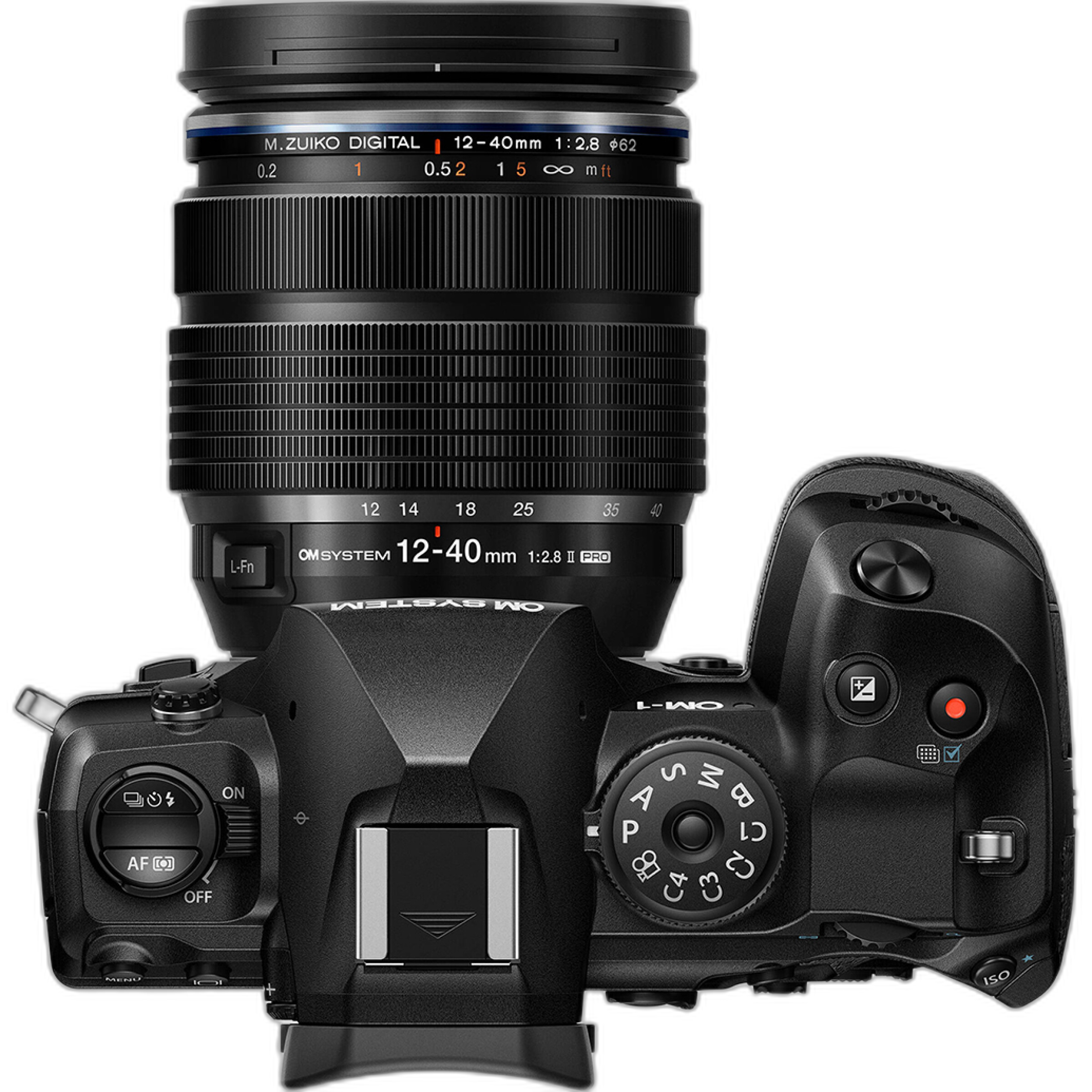
The OM SYSTEM OM-1 Mark II Mirrorless Camera with 12-40mm f/2.8 Lens costs $2,699.99. It is the most expensive kit here, and the choice for action photographers who also want an f/2.8 zoom and dual memory card slots.
Its 20MP stacked BSI Live MOS sensor is paired with 1,053 phase-detection autofocus points and Cross Quad Pixel AF. OM System lists 10 fps shooting and up to 120 fps with the electronic shutter. That maximum rate gives more frames to choose from during a brief movement, but also more files to sort afterward.
The included M.Zuiko Digital ED 12-40mm f/2.8 PRO II has a one-stop larger maximum aperture than the f/4 zooms below. That can help maintain a faster shutter speed without raising ISO as far. Five-axis in-body stabilization addresses camera movement; it does not stop a moving subject.
The 5.76-million-dot OLED viewfinder has the highest listed resolution in this group. Dual UHS-II SD slots distinguish it from the single-slot mirrorless options, while DCI/UHD 4K recording reaches 60p. IP53 weather sealing and a freezeproof design support outdoor work. The body alone weighs 511 g, before adding the lens.
120 fps in a lighter metal body
The OM SYSTEM OM-3 with M.Zuiko Digital ED 12-45mm f/4 PRO Kit costs $2,099.99. It suits photographers who want high-speed stills and computational modes in a lighter body than the OM-1 Mark II, without paying for that kit's f/2.8 lens.
The OM-3 also lists a 20MP stacked BSI Live MOS sensor, 1,053 phase-detection AF points and continuous shooting up to 120 fps at maximum resolution. Its dedicated Computational Photography button gives those functions a specific control. High-Res Shot and Live ND are included, along with composite modes.
The metal body weighs 413 g without the battery and carries IP53 weather sealing. Five-axis sensor-shift stabilization is built in. The included 12-45mm f/4 lens covers a 24-90mm-equivalent range, useful for moving from a wider scene to a tighter composition without changing lenses.
The compromises relative to the OM-1 Mark II are concrete: one UHS-II SD slot rather than two, and a 2.036-million-dot viewfinder rather than 5.76 million dots. The kit lens reaches 45mm instead of 40mm, but its maximum aperture is f/4 rather than f/2.8. For video, OM System lists a two-hour maximum recording duration in 4K.
A smaller travel kit with IP53 sealing
The OM SYSTEM OM-5 Mark II Black with M.Zuiko Digital ED 12-45mm f/4 PRO Kit costs $1,449.99. This is the travel and hiking choice when carrying less camera matters more than reaching 120 fps.
Body-only weight is 370 g, below both mirrorless kits above. The included zoom provides the same 24-90mm-equivalent coverage as the OM-3 kit. Its 20MP Live MOS sensor and TruePic IX processor are accompanied by 121 autofocus points and shooting up to 30 fps at maximum resolution. The price difference buys different shooting and autofocus specifications, not a large difference in nominal megapixel count.
OM System lists IP53-certified sealing and freezeproof operation to -10°C. It also rates five-axis Sync IS at up to 7.5 stops. Treat that as a maximum stabilization rating, not a guarantee for every exposure. For handheld work, stabilization helps counter camera shake rather than subject movement.
USB-C charging is useful on a trip. Video options include UHD 4K up to 30 fps and vertical recording, while the articulating touchscreen allows framing away from eye level. Starry Sky AF gives night-sky photographers a dedicated focusing option, and Live Composite provides another reason to consider it for work after dark.
Two lenses for everyday and distant subjects
The OM SYSTEM PEN Black with 14-42mm f/3.5-5.6 III and 40-150mm f/4-5.6 R Lenses costs $1,299.99. It is the lowest-priced mirrorless kit here and the only package with two lenses. Choose it when getting a longer zoom immediately is more useful than buying a higher-priced body.
The 14-42mm handles wider everyday views, while the 40-150mm allows tighter framing of distant subjects. Both have variable maximum apertures, unlike the constant-aperture zooms in the three kits above. The body includes a 20.4MP sensor with TruePic IX processing and five-axis in-body stabilization.
OM System lists 121-point autofocus with AI subject tracking and continuous shooting up to 30 fps. The buffer specification matters: at that maximum rate, the listed capacity is up to 29 Raw frames or 154 JPEG frames. A headline burst rate is not the same as being able to hold it indefinitely.
A 2.36-million-dot OLED viewfinder and 3-inch vari-angle touchscreen provide two ways to compose. Weather sealing is rated IPX1 rather than IP53, and the operating range starts at 0°C rather than -10°C. Storage is a single UHS-I SD slot. Those distinctions deserve attention if outdoor conditions matter more than the second lens.
Waterproof shooting to 50 feet
The OM SYSTEM Tough TG-7 Digital Camera (Black) costs $579.99. It serves a different purpose from the mirrorless kits: underwater photography and situations where a stated drop rating matters more than interchangeable lenses.
OM System rates the TG-7 as waterproof to 50 feet, or 15 meters, and shockproof from 7 feet, or 2.1 meters. Those are specific limits, not a promise that damage is impossible. Underwater photo modes and anti-fog lens glass support its intended use around water.
The 12MP sensor has a lower nominal pixel count than the mirrorless cameras here. Its built-in lens covers a 25-100mm-equivalent range, and the camera weighs 249 g. There is no separate kit lens to account for in that weight. Macro photo modes make it a candidate for close-up subjects as well.
The rear display is a fixed 3-inch LCD, so it does not offer the adjustable screen angles of the mirrorless options. A built-in flash is included. Video reaches UHD 4K at 25 or 29.97 fps, and the camera also provides time-lapse video and USB-C connectivity.
How to choose an OM System camera
- Action plus 4K 60p: Choose the OM-1 Mark II kit for its f/2.8 zoom, higher-resolution viewfinder and dual UHS-II card slots.
- 120 fps at a lower kit price: Choose the OM-3 if a single card slot and an f/4 zoom fit the job. Its body is lighter than the OM-1 Mark II.
- Travel with IP53 sealing: Choose the OM-5 Mark II if 30 fps is sufficient and lower body weight takes priority.
- Two zooms in one purchase: Choose the PEN kit for the included 40-150mm lens. Its IPX1 rating and 0°C minimum operating temperature are relevant outdoor trade-offs.
- Underwater use: Choose the Tough TG-7 for its stated 15-meter waterproof rating. Weather sealing is not the same thing as an underwater depth rating.
All five configurations are in stock at Unique Photo.
Prices at Unique Photo
- OM SYSTEM OM-1 Mark II Mirrorless Camera with 12-40mm f/2.8 Lens: $2,699.99
- OM SYSTEM OM-3 with M. Zuiko Digital ED 12-45mm F4.0 Pro Kit: $2,099.99
- OM SYSTEM OM-5 Mark II Black w/ M.ZUIKO Digital ED 12-45mm F4.0 Pro Kit: $1,449.99
- OM SYSTEM PEN Black w/ 14-42mm F3.5-5.6 III and 40-150mm F4.0-5.6 R BLK Lens K: $1,299.99
- OM SYSTEM Tough TG-7 Digital Camera (Black): $579.99
Prices as of October 26, 2026. Browse more: OM System Cameras, OM System at Unique Photo.
Frequently asked questions
What is the cheapest OM System camera in this lineup?
The Tough TG-7 Black costs $579.99. The lowest-priced mirrorless option here is the OM SYSTEM PEN two-lens kit at $1,299.99.
Which OM System camera should I buy for travel?
The OM-5 Mark II is the lighter-bodied choice among the three single-lens mirrorless kits here, at 370 g body only. Its $1,449.99 kit includes a 12-45mm f/4 PRO lens, and the camera provides IP53 weather sealing and USB-C charging.
Are OM System cameras waterproof?
The Tough TG-7 is rated waterproof to 50 feet, or 15 meters. The OM-1 Mark II, OM-3 and OM-5 Mark II have IP53 weather sealing; the PEN has IPX1 weather sealing.
What lenses come with the OM SYSTEM PEN kit?
This PEN Black kit includes a 14-42mm f/3.5-5.6 III lens and a 40-150mm f/4-5.6 R lens. The kit costs $1,299.99.