The Sigma FP2 Digital offers 6K Open Gate RAW. Compare its video options and lens kits with the Nikon Z5II and Nikon Z6III at Unique Photo.
Compare kit prices, not just camera prices
The Sigma FP2 Digital Camera is available to preorder at $2,199. The Nikon Z5II Mirrorless Camera with 24-50mm f/4-6.3 Lens is in stock at $1,896.95. The Nikon Z6III with 50mm f1.4 Z Kit is in stock at $2,496.95. Both Nikon packages include a lens, which matters before comparing the prices.
The Sigma FP2 Digital Camera + 50mm F2 DG II (Black) Kit is available to preorder at $2,749. That makes the Z6III package the closer lens-kit comparison: both start with a 50mm prime. The Z5II package takes a different approach, supplying a 24-50mm zoom for $1,896.95.
Sigma FP2, Nikon Z5II, and Nikon Z6III specifications
All three cameras have 24.5MP sensors. Pixel count does not separate them; recording formats and the hardware around the sensor do.
| Specification | Sigma FP2 Digital | Nikon Z5II | Nikon Z6III |
|---|---|---|---|
| Sensor | 24.5MP partially stacked CMOS | 24.5MP BSI-CMOS | 24.5MP partially stacked CMOS |
| Lens mount | L-Mount | Nikon Z | Nikon Z |
| Continuous shooting | Up to 20 fps at maximum resolution | Up to 4.5 fps at maximum resolution | Up to 20 fps RAW; 60 fps JPEG |
| Listed video options | 6K Open Gate RAW; 6048 x 3404 ProRes RAW up to 29.97 fps | UHD 4K up to 59.94 fps | 6K/60p internal RAW |
| Touchscreen | 3.15-inch tilting | 3.2-inch 3-way tilting | 3.2-inch vari-angle |
| Supported memory cards | SD/SDHC/SDXC, UHS-II | SD/SDHC/SDXC, UHS-II | CFexpress Type B, XQD, SD/SDHC/SDXC, UHS-II |
| Maximum flash sync speed | 1/50 second | 1/200 second | 1/200 second |
The burst figures need their format labels. The Z6III's 60 fps JPEG figure is not its RAW shooting rate. For RAW sequences, the Sigma and Z6III both reach a listed 20 fps.
Open Gate reframing versus 6K/60p RAW
The FP2's uncropped 6K Open Gate RAW option is useful when one recording needs to supply different delivery aspect ratios. It leaves room to reframe for horizontal and vertical outputs. Separately, Sigma lists 12-bit ProRes RAW and ProRes RAW HQ at 6048 x 3404 up to 29.97 fps. H.264/H.265 recording at that resolution reaches 59.94 fps.
The Z6III is the more direct choice if the requirement is specifically 6K RAW at 60p, recorded internally. Nikon also lists Full HD/240p capture, compared with the Sigma's 2560 x 1440 recording up to 119.88 fps. That is a choice between a higher listed slow-motion frame rate and a larger recorded frame, not simply one camera being better at video.
The Z5II records UHD 4K up to 59.94 fps and Full HD up to 120 fps. Its listed recording limit is 2 hours, 5 minutes. Sigma lists no recording time limit for the FP2; that describes clip duration, not unlimited storage capacity.
Burst shooting, subject detection, and stabilization
Sigma rates the FP2 at up to 20 fps for as many as 180 RAW frames or 200 JPEG frames at maximum resolution. That gives moving-subject photographers more closely spaced frames than the Z5II's listed 4.5 fps. It does not, by itself, establish an autofocus accuracy advantage.
The FP2 includes tracking for animals, birds, and people, with CNN-driven bird detection. Nikon lists nine automatically detected subject types for the Z5II, including vehicles such as cars and trains, plus autofocus detection down to -10EV. The Z6III also includes multi-subject detection autofocus.
For handheld photographs of stationary subjects, the Z5II's 5-axis sensor-shift stabilization may matter more than burst speed. Nikon rates it at up to 7.5 stops. Stabilization compensates for camera movement; it does not freeze a moving subject. Sigma lists digital stabilization for the FP2, which is a different approach from physically moving the sensor.
The included lenses change the assignment
The Sigma kit's 50mm f/2 is a fixed-focal-length lens. The Z6III kit also supplies a 50mm prime, but its f/1.4 maximum aperture provides about one stop more aperture than f/2. That can help maintain a faster shutter speed in low light or produce shallower depth of field at comparable framing.
The Z5II's 24-50mm f/4-6.3 zoom gives a wider view at 24mm without changing lenses. That is a practical advantage for interiors or group photographs where stepping back is not possible. Its smaller maximum aperture is the tradeoff. Choose the zoom for framing flexibility, rather than expecting it to replace either prime's wider aperture.
Screens, storage, and flash connections
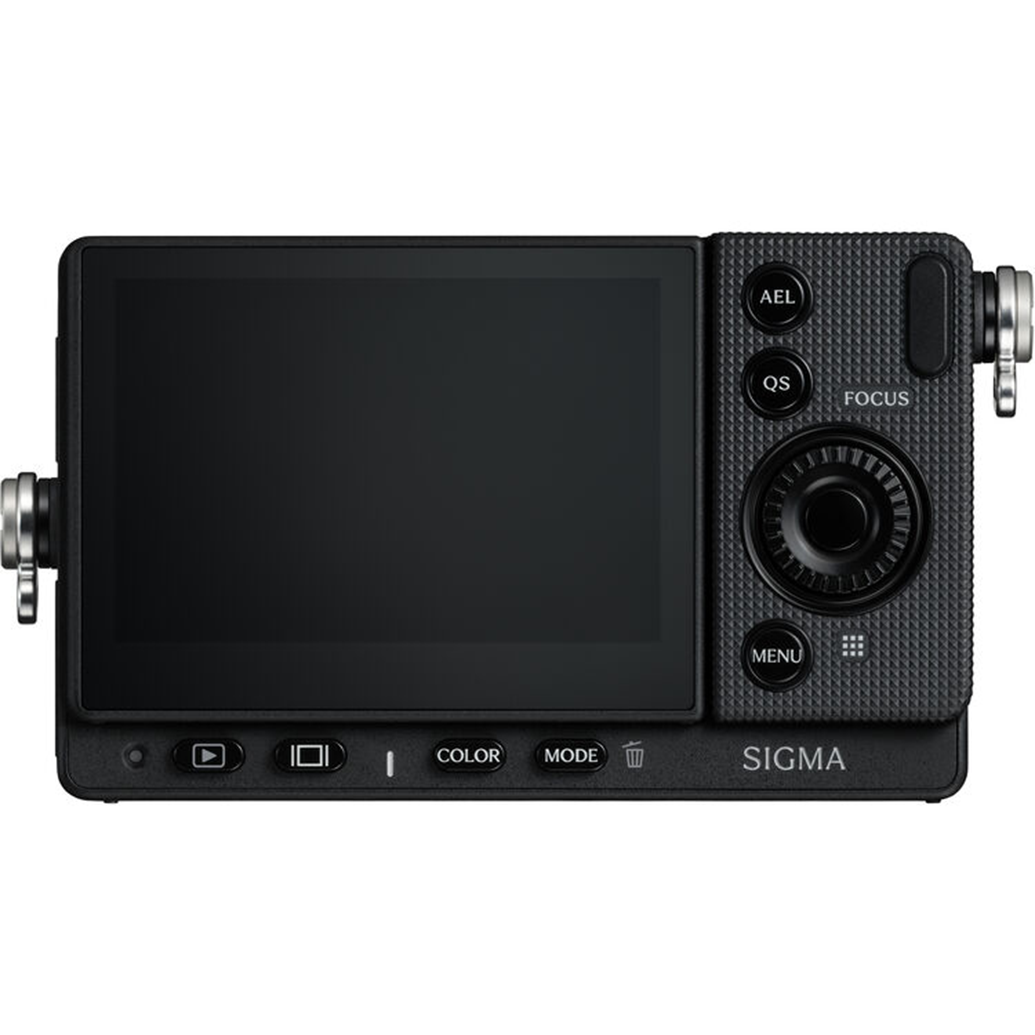
The FP2 uses a modular, compact body architecture. Its 3.15-inch touchscreen tilts 90 degrees up and 45 degrees down. The Z5II has a 3-way tilting touchscreen; the Z6III uses a vari-angle design. Nikon lists a 3,690,000-dot EVF with maximum brightness of 3000 nits for the Z5II, and a 5,760,000-dot, 4000-nit EVF for the Z6III.
Storage is another concrete difference. Sigma includes 70GB of internal storage alongside UHS-II SD card support, plus dual USB-C connections and full-size HDMI output. The Z5II has two UHS-II SD slots. The Z6III has one CFexpress/XQD slot and one SD slot, so its two slots use different card formats.
Flash users should pay attention here. The Z5II has a shoe-mounted external flash connection and 1/200-second maximum sync speed. Sigma lists no external flash connection for the FP2 and a maximum sync speed of 1/50 second. Those specifications make the Z5II the more straightforward option for a shoe-mounted flash setup.
Who should choose each camera
Choose the Sigma FP2 Digital for a modular video setup where Open Gate reframing is a specific requirement. Its internal storage also offers a recording destination apart from removable cards. The 50mm kit makes sense if that fixed focal length suits the planned work and preorder availability fits the schedule.
Choose the Nikon Z5II kit for general still photography that benefits from a wide-to-normal zoom, especially with handheld stationary subjects or shoe-mounted flash. Its slower listed continuous rate is the compromise if closely spaced action frames are important.
Choose the Nikon Z6III kit for 6K/60p internal RAW or a 50mm f/1.4 package that also supports 20 fps RAW stills. It is in stock and costs less than the Sigma 50mm kit. Choose the Sigma instead for a particular workflow requirement, not an expectation of more still-photo megapixels.
Prices at Unique Photo
- Sigma FP2 Digital Camera + 50mm F2 DG II (Black) Kit: $2,749.00 (preorder)
- Sigma FP2 Digital Camera + EVF-21 Kit: $2,749.00
- Sigma FP2 Digital Camera: $2,199.00 (preorder)
- Nikon Z5II Mirrorless Camera with 24-50mm f/4-6.3 Lens: $1,896.95
- Nikon Z6III with 50mm f1.4 Z Kit: $2,496.95
Prices as of October 26, 2026. Browse more: Sigma Cameras, Sigma at Unique Photo.
Related reading: Sigma FP2 Digital Announced With 6K Open Gate RAW.
Frequently asked questions
Does the Sigma FP2 Digital record 6K RAW video?
Yes. Sigma lists uncropped 6K Open Gate RAW, plus 12-bit ProRes RAW and ProRes RAW HQ at 6048 x 3404 up to 29.97 fps.
Is the Sigma FP2 faster than the Nikon Z5II for continuous shooting?
Sigma lists up to 20 fps at maximum resolution, compared with up to 4.5 fps for the Z5II. The FP2's listed burst capacity is up to 180 RAW frames or 200 JPEG frames.
Which cameras are available now?
The Nikon Z5II 24-50mm kit and Nikon Z6III 50mm f/1.4 kit are in stock. The Sigma FP2 Digital Camera and its 50mm F2 kit are available to preorder.