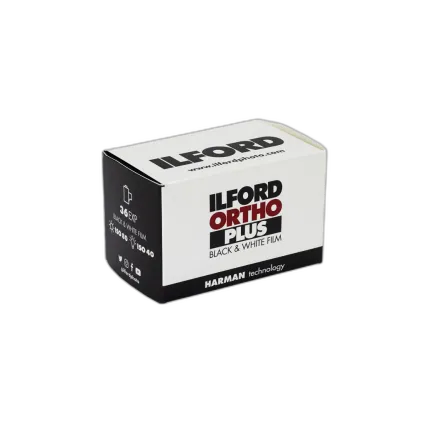
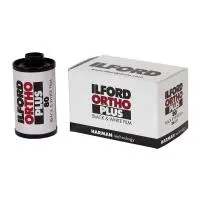
Ilford Ortho Plus 35mm Black and White Film (36 Exposures)
Key Features
- Orthochromatic black-and-white 35mm film with 36 exposures for striking monochrome results.
- Fine grain and high sharpness make it ideal for detailed landscapes, portraits, and studio work.
- Rated at ISO 80 in daylight or ISO 40 under tungsten lighting for flexible exposure control.
- Unique ortho sensitivity renders reds darker, creating distinctive tonal separation and dramatic contrast.
- Suitable for traditional black-and-white processing and darkroom enlargement workflows.
OVERVIEW
Ilford Ortho Plus 35mm Black and White Film is a specialty orthochromatic film designed for photographers who want classic monochrome character with excellent detail, fine grain, and distinctive tonal rendering. Supplied in a 35mm cassette with 36 exposures, it offers a unique alternative to conventional panchromatic films by being less sensitive to red light. This produces darker reds, cleaner separation between colors of similar brightness, and a signature look that can be especially compelling for portraits, architecture, still life, and landscape photography.
With a nominal speed of ISO 80 in daylight and ISO 40 under tungsten illumination, Ortho Plus balances manageable speed with refined image quality. It is well suited to photographers working in controlled lighting, bright outdoor conditions, or anyone seeking a more deliberate, traditional film-shooting experience. The film is processed in standard black-and-white chemistry, making it easy to integrate into established home developing or lab workflows.
Key Features
One of the standout qualities of Ilford Ortho Plus is its combination of sharpness and fine grain. This makes it a strong choice for photographers who scan negatives at high resolution or make enlargements in the darkroom. Its orthochromatic emulsion also handles blue and green wavelengths differently than standard black-and-white films, giving foliage, skies, fabrics, and skin tones a notably different tonal response.
Because the film is not red-sensitive in the same way as panchromatic film, red subjects often reproduce deeper and darker. This can add mood and visual drama to scenes containing red flowers, lipstick, brick, signage, or warm-toned clothing. The result is a black-and-white image style that feels both historical and creatively fresh.
Image Quality and Rendering
Ilford Ortho Plus is appreciated for delivering crisp edge definition and a clean overall image structure. Fine textures, subtle patterns, and architectural lines are reproduced with clarity, while the grain remains restrained enough for high-quality enlargements. This makes the film appealing to photographers who value technical precision as much as expressive tonality.
In portraiture, the film can produce a distinctive look thanks to its rendering of reds and warm tones. Skin tones may appear different from what photographers expect with panchromatic emulsions, often emphasizing shape and tonal structure in a more graphic way. For still life and product-style work, this tonal separation can make objects stand out with impressive clarity.
Exposure and Processing
The film is generally rated at ISO 80 in daylight and ISO 40 under tungsten light. As with many black-and-white films, exposure latitude and developer choice influence the final look. Careful metering helps preserve highlight detail and maintain the balanced tonality this film is known for. Photographers who develop at home can experiment with different developers and agitation patterns to tailor contrast and tonal depth to their preferences.
Ilford Ortho Plus uses standard black-and-white processing rather than a color process, so it works naturally within traditional darkroom and black-and-white lab environments. This makes it convenient for photographers already familiar with monochrome chemistry and negative handling.
How It Compares
Compared with panchromatic black-and-white films, Ortho Plus offers a more specialized tonal response. Where a conventional black-and-white film aims to record the full visible spectrum more evenly, orthographic sensitivity shifts how certain colors translate into grayscale. The most noticeable difference is often the darker rendering of reds and some warm hues, which can create a more pronounced, graphic appearance.
Compared with faster black-and-white stocks, Ortho Plus trades speed for finer grain and higher resolving potential. It is therefore best suited to good light, tripod use, studio flash setups, or photographers who prefer slower film for its precision and classic tonal signature.
Best Uses
This film is especially well matched to landscape photography, botanical studies, architecture, portraits with intentional styling, still life setups, and historical or alternative-process-inspired projects. It is also a strong creative option for photographers who want to move beyond standard black-and-white rendering and explore how spectral sensitivity influences mood and composition.
In the studio, Ortho Plus can be an excellent choice when lighting is controlled and the photographer wants repeatable, highly detailed negatives. Outdoors, it performs best in daylight situations where its ISO 80 rating remains practical without requiring excessive exposure times.
Recommended Accessories
To get the most from Ilford Ortho Plus, consider pairing it with a reliable handheld light meter, a sturdy 35mm film camera with accurate shutter speeds, and high-quality black-and-white chemistry for home processing. Negative archival sleeves are also useful for long-term storage, while a dedicated film scanner can help preserve the film's fine detail in digital form. A tripod can be especially helpful when shooting in lower light or when aiming for maximum sharpness.
Tips for Shooting
Meter carefully, particularly in scenes containing strong red elements, since their tonal reproduction may appear darker than expected. If you're new to orthchromatic film, bracket exposures during your first few rolls to better understand its response. For portraits, test wardrobe and makeup choices beforehand, as reds and warm tones can translate very differently than with standard monochrome film. In landscape work, use the film's high sharpness to your advantage by shooting at apertures and shutter speeds that maximize detail.
About Ilford and Ortho Films
Ilford has long been one of the most respected names in black-and-white photography, with a legacy deeply tied to traditional film and darkroom practice. Orthochromatic films themselves have an important place in photographic history, dating back to earlier eras of emulsions before full panchromatic sensitivity became standard. Modern Ortho Plus brings that classic spectral behavior into a contemporary film product with improved consistency, image quality, and handling for today's film photographers.
Brand
film specifications
| Exposures | 36 exp |
| Film Type | Black & White Film |
| Film Format | 35mm |
| Film Size | 35MM |
| Film Sharpness | Fine |
| Film Speed | 80 ASA |
- Ilford Ortho Plus 35mm Black and White Film roll
- 36 exposures in single 35mm cassette
No creators have tagged this product yet.
Articles featuring this product
Best Ilford Black & White Film: HP5 Plus, FP4 Plus, Delta, XP2, and Pan F Compared
Sep 26, 2026
·
Unique Photo
How to Develop Black & White Film at Home: HP5 Plus and FP4 Plus Step by Step
Sep 26, 2026
·
Unique Photo
Best 35mm Black & White Films for Portrait Photography: Tri-X 400 vs HP5 Plus vs FP4 Plus vs T-M
May 17, 2026
·
Unique Photo
Ilford XP2 Super Profile: Black & White Film You Can Develop at Any C-41 Lab
Sep 26, 2026
·
Unique Photo
Community questions about this gear
Ask a question
0
votes
2
answers
294
How should Ilford HP5 Plus 400 be processed, and is there a black-and-white equivalent to C-41?
Photography Stack Exchange contributor
15y ago
0
votes
2
answers
299
How should I match studio strobe color to film stock?
Photography Stack Exchange contributor
8y ago
0
votes
2
answers
292
How do colored lens filters affect black-and-white film photos?
Photography Stack Exchange contributor
13y ago
0
votes
2
answers
472
0
votes
2
answers
508
Will a few hours of heat damage exposed or unexposed black-and-white film?
Photography Stack Exchange contributor
9y ago