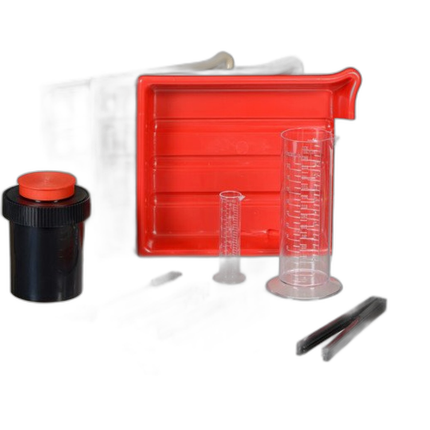
Photographic Darkroom Film and Paper Developing Kit
Key Features
- Complete starter kit for black-and-white film and paper developing workflows in the darkroom.
- Convenient bundled solution designed to help photographers begin processing negatives and making prints with fewer separate purchases.
- Suitable for traditional analog photography enthusiasts, students, educators, and home darkroom users.
- Supports hands-on development and printing practice for learning classic photographic techniques.
- Ideal for assembling a foundational darkroom setup for processing black-and-white materials.
OVERVIEW
The Photographic Darkroom Film and Paper Developing Kit is a practical all-in-one starting point for photographers exploring traditional black-and-white darkroom work. Designed for users who want a more streamlined path into analog processing, this kit brings together essential components used in developing film and processing photographic paper, helping simplify the setup of a home, classroom, or small studio darkroom.
Whether you are developing your first roll of black-and-white film, teaching darkroom fundamentals, or returning to classic silver gelatin printing after years away, a bundled kit like this can reduce guesswork and make it easier to begin. It is especially useful for students, hobbyists, and photographers who appreciate the tactile, deliberate craft of analog image-making.
Built for Traditional Black-and-White Workflow
This kit is centered around black-and-white processing, making it relevant for photographers working with black-and-white film and darkroom paper. Black-and-white chemistry remains one of the most approachable entry points into film photography because of its relative simplicity, forgiving handling characteristics, and the high degree of creative control it offers over contrast, tonality, grain, and print interpretation.
By combining film and paper development essentials into a single package, the kit supports a complete analog path: expose film, develop negatives, and move toward producing physical prints in the darkroom. This can be especially appealing to photographers who want to experience the full photographic process rather than outsourcing development or scanning alone.
Why a Developing Kit Matters
Purchasing darkroom items individually can be time-consuming and confusing, especially for beginners who may not yet know which tools are needed first. A film and paper developing kit helps reduce that complexity by grouping together foundational darkroom items that typically work together in a standard black-and-white environment. This kind of package can save time during setup and help users focus more on technique and less on sourcing each part separately.
For educators and community darkrooms, a kit format can also simplify equipment planning and standardization. For home users, it can make the transition into analog processing more approachable and cost-effective compared with piecing together a system from scratch.
Ideal Users
The Photographic Darkroom Film and Paper Developing Kit is well suited to a wide range of analog photographers. Beginners can use it as an entry point into processing and printing. Intermediate users can employ it as the basis for a compact personal darkroom. Schools and workshops may find it useful as a teaching tool for demonstrating the sequence of film development and print production. Enthusiasts who shoot 35mm or medium format black-and-white film and want more control over their final image can also benefit from a kit-based setup.
Creative Benefits of Developing Your Own Film and Prints
Processing your own film and paper opens up a level of artistic control that many photographers find deeply rewarding. Development time, agitation, temperature, dilution, exposure under the enlarger, and paper contrast choices all influence the final result. Rather than relying on standardized lab output, you can refine your look through experimentation and consistent darkroom practice.
Black-and-white darkroom work also encourages a slower, more intentional way of creating photographs. Many photographers value the direct connection between capture, development, and final print, as well as the archival and aesthetic qualities of silver-based imaging.
Use Cases
This kit can serve in several practical scenarios. It is useful for photographers building a compact home darkroom in a bathroom, utility room, or spare workspace. It can support classroom instruction in film development and printing techniques. It is also a good match for artists seeking a hands-on photographic process for fine art work, documentary practice, or personal projects rooted in traditional materials.
Workflow Tips
For best results, organize your darkroom into separate dry and wet areas whenever possible. Keep chemicals clearly labeled, mix solutions carefully according to manufacturer directions, and maintain proper temperatures for consistent development. Use a timer for each processing step, and keep notes on film stock, chemistry, dilution, and time so you can repeat successful results. When making prints, work methodically with test strips to determine the right exposure and contrast before producing a final enlargement.
Ventilation is also important in any darkroom. Even black-and-white chemistry should be handled with care, and gloves, aprons, or protective eyewear may be helpful depending on your workflow and frequency of use. Clean working habits will improve both safety and print quality.
Recommended Accessories
To get the most from a film and paper developing setup, photographers often pair it with a few core accessories. Useful additions can include a safelight, darkroom timer, measuring graduates, storage bottles for mixed chemistry, thermometers, drying clips, print tongs, contact printing accessories, archival negative sleeves, and a reliable enlarger setup for printing. A changing bag or dedicated darkroom loading space can also be valuable when working with light-sensitive film before development.
How It Compares to Buying Individually
Compared with assembling a darkroom from separately purchased components, a bundled kit offers convenience and a more guided starting point. Individual purchasing may provide greater customization for advanced users, but a kit is often the better solution for new photographers who want a functional baseline without needing deep prior knowledge of darkroom equipment categories. It helps reduce compatibility uncertainty between common workflow items and encourages faster setup.
Historical Context
Darkroom kits have long played an important role in photographic education and home image-making. Before the rise of digital photography, many photographers learned the fundamentals of exposure, chemistry, and print control through compact darkroom bundles and classroom lab systems. These kits helped generations of users understand how latent images become negatives and how negatives become finished prints. Today, they continue to support the revival of film photography and the renewed appreciation for handmade photographic processes.
Overall Value
The Photographic Darkroom Film and Paper Developing Kit is a strong choice for anyone seeking a more accessible path into black-and-white film and paper processing. Its bundled format supports learning, experimentation, and workflow efficiency, while preserving the craft-oriented appeal of traditional analog photography. For photographers who want to move beyond exposure alone and participate in the full image-making journey, a kit like this offers a solid foundation for darkroom practice.
Brand
developer attributes
| Chemistry Type | Black & White |
film specifications
| Film Type | Black & White Film |
- Photographic Darkroom Film and Paper Developing Kit
- Included components for film and paper developing workflow
- Documentation or instructions if supplied by manufacturer
No creators have tagged this product yet.
Articles featuring this product
Home Developing Tips for Beginners: Avoiding Common Mistakes With the Right Starter Gear
Sep 12, 2026
·
Unique Photo
First Time Developing B&W at Home: Essential Tips for a Mistake-Proof Process
Aug 26, 2026
·
Unique Photo
Community questions about this gear
Ask a question
0
votes
2
answers
142
0
votes
2
answers
176
0
votes
2
answers
183
How can negative film or paper be processed to produce a positive image?
Photography Stack Exchange contributor
8y ago
0
votes
2
answers
109
Can Kodak T-Max film developer be used for black-and-white photo paper?
Photography Stack Exchange contributor
9y ago
0
votes
2
answers
121
What alternative photosensitive materials can be used to make photographic images?
Photography Stack Exchange contributor
16y ago