
Please leave comments! I want to hear from you! I know a lot of people are viewing this page, but I want you speak up. Go ahead; bash, praise, or critique me . . . I appreciate all of it. Hearing back from you, the readers, helps us make better posts!
It was only a few years ago when I first walked into the Unique Photo showroom as a confused photography student with a crumpled list of supplies I needed.
 I had no clue what I needed or how any of it worked. In fact, I initially signed up for the photography course because I assumed it was going to be a digital photography class and that I wouldn't need to buy anything. Boy was I wrong! All of the stuff added up to more than books would for any other class. Now that I am on the other end working in the Unique Photo showroom, I often get asked, "Why do they still make us use film? Isn't digital better?"
Honestly, I could have a whole series of articles and discussions about the merits of shooting film, but the answer I usually give is that shooting black and white film is a different animal than using a digital camera. Trust me when I say that I love my digital SLR and the benefits of a secured instant image that doesn't rely on being possibly ruined in development are tremendous. However, I wouldn't be the same kind of photographer that I am today without learning black and white film first. And I still use it all of the time. Here is a picture I snapped just last night of my 4x5 view camera that operates on technology from the 1800's.
The anticipation, frustration, and patience that comes with exposing, developing, and printing my own negatives built a strong creative and technical foundation that I still rely on to this day. Additionally, the sense of community and camaraderie that forms between people in the darkroom is amazing. I have met some of my best friends under glowing orange lights. There is a certain smell that you won't like at first from the chemicals; it lingers on your clothes, but eventually, it reminds you of home.
So what are all of the numbers about?
 If you are in a beginning photography course, you want to purchase 35mm film. 35mm refers to the format (size) of the camera you are using. It is still the most popular and best selling format of film because of the ease of use.
The 400 on the box to the upper left indicates film speed (ISO/ASA). This is how sensitive the film is to light. You will understand this better once you get into the whole mess of exposing and making mistakes, but your instructor will explain it as well. 400 is a safe film to start with because it can be used hand-held in a variety of lighting conditions and is usually more forgiving than a slower speed film.
35mm film rolls also come in two different lengths: 36 or 24 exposure. 24 exposure rolls are slightly less expensive, but I'd recommend paying a quarter or so more for 12 more exposures. If you're a photo "newbie", you're going to need the extra exposures to really get a grasp on how this stuff works!
 So there seem to be mounds upon mounds of 35mm film, which do I need?


Your professor will give you a list of required materials and usually specify which film you'll need for the class. However, if you don't have a list, here are three film stocks you can't go wrong with as a beginner: Kodak Tri-X 400, Ilford HP5+, or Fuji Neopan 400. In case you want to know more about this film or you want to purchase some right now, I included a direct link to each of the film's pages on our website. I would recommend purchasing extra rolls because you are bound to mess up a few and running out of film when you really want to photograph something is one of my worst nightmares!
**WARNING THERE ARE TWO PRODUCTS YOU CANNOT USE FOR YOUR CLASS! **
KODAK BW400CN & ILFORD XP2 SUPER.
KODAK BW400CN & ILFORD XP2 SUPER.

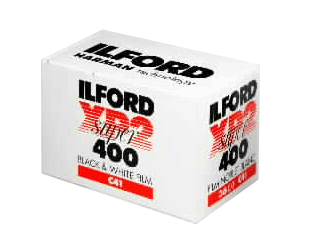
These two films are great! If I wanted to shoot black and white and get my negatives developed here at Unique Photo or at a pharmacy, I would use either one of these films; however, part of a darkroom course is developing your own film and prints. The Kodak film has an orange base to it, so it will look gray and flat if printed in a black and white darkroom. I work as an assistant in a University darkroom and I often see students angrily throwing away their negatives because they bought these products thinking it would develop in the black and white chemicals the school supplies. It doesn't work! Even though it says 35mm 400 B/W film (which covers all of the specs you are looking to purchase for your class), it is developed in totally different chemistry that is used mainly in photo labs. Again, it's great stuff, especially for scanning and archiving, but not for a traditional black and white darkroom. STAY AWAY! (For now.)
Ok phew, that was a lot to take in. So I see this expensive paper is also on my list and there are piles of this stuff all over. Which one should I buy for my class?
 Just like film, there is a wide variety of printing papers available for you to choose. It may be confusing and again, your instructor will probably specify which paper they want you to purchase, but you absolutely cannot go wrong with a 100 sheet box of 8"x10" Ilford RC Pearl.
Papers come in different sizes ranging from 4"x6" up to 30"x40". They also come in different quantities such as 25, 100, or 250 sheet boxes. If you're on a budget, a 100 sheet box will be enough to get you started, but you will probably end up using a lot more. So if you have the money to spend, go for the 250 sheet box. It's always more efficient to buy in larger quantities with this stuff and your wallet will thank you later. (You will thank yourself later as well because you won't be in the darkroom reaching into an empty Ilford box.)
 Papers also come in two different bases. You will notice some packages say FB (Fiber). I use fiber paper all of the time because of the rich tonal qualities it can deliver and I like the heavier weight of the paper, but it is also more expensive and tricky to use. Once you get the hang of RC (Resin Coated) paper, then I would recommend trying a fiber based paper.
There are also different finishes to the papers. Above, I recommended Pearl because it is my personal favorite Resin Coated paper. It is not too glossy and it isn't a complete matte or textured paper either. Basically, I think it's a good product to learn on and most instructors will as well. However, if your list has Glossy or Satin as options, you may want to check a smaller package of those out as well to see what you like.
There are also warm & cool tone papers. If you are a beginner, these papers will work fine just like any other RC paper, but until you understand why you would want to use these papers, stick with a neutral paper like the ones I linked to above.
Alright, so I am going to be developing all of my film and prints. I don't want to ruin them by just shoving them in my bag, how can I protect them?
 It may seem silly at first to buy dedicated plastic sleeves for storing your film and paper, but trust me, you don't want to just cram your negatives into a binder. Film is very sensitive and will scratch easily. The prints you want to keep are precious and you don't want to bend or rip those either. Printfile makes negative and print preservers that fit right into a 3-Ring binder. You're going to be investing a lot of your free time into photography now. Scratching a negative happens to everyone at some point, but you can minimize the chances of it happening by put ting them in protective sleeves.
Film, paper, and sleeves. Is there anything else I absolutely need?
 This is a tricky question. I don't know every University's darkroom setup. You should reference the list your professor handed out on the first day. Some darkrooms have plenty of printing filters to use in the darkroom while others don't. You won't have to purchase any of your own chemistry in a beginning course and processing tanks/reels should be provided as well. Both filters and processing tanks/reels are some items you may decide you want to purchase so you won't have to share the community items. There's nothing wrong with sharing, but people really beat the heck out of this stuff and all universities are on a pretty tight budget, so they're going to hang onto this stuff until it is absolutely unusable.
 Unlike the physically invisible files (you can't jam them in a sleeve or drop them on the floor) that you end up with in digital photography, your negatives are bound to get dirty! Dust is everywhere and is one of the most annoying aspects of photography! There are a couple ways to fight dust, the first being protective sleeves (see above). An anti-static cloth is a special cloth with magical powers that you can use to wipe your film safely. Do not try to use a paper towel or you will regret it dearly. A good ol' can of Dust Off can't hurt either; just make sure to follow the instructions so you don't squirt any of the liquid accidentally.
 Some dust just won't go away and will show up in your prints as little white hairs that are distracting. Black and white darkroom work is a messy process and even the most dedicated neat freaks are bound to have some dust specks on their prints. If you can live with it, God bless you because it bothers me to no end. Retouching pens will help you clean up the little imperfections on your prints. Before marking up your final print, I would try these on a throw away or a test strip, just to see how they work.
I can't think of anything else right now that you would need for an introductory course. Photography is an expensive, but rewarding hobby. I hope this little write up helped you beginners out there. Please leave any questions or comments right here on the blog and I will be happy to answer them. If you have a more detailed question, don't be shy. Post it right here or shoot me an email: [email protected]
Happy Printing!