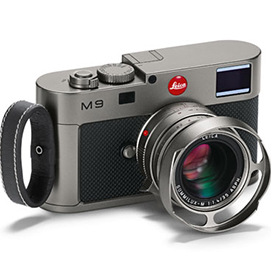
[caption id="attachment_3164" align="alignright" width="300" caption="The Leica Digital M9 Rangefinder"] [/caption]
This is my first review of a Leica camera as Unique Photo has recently started to carry Leica products. The Leica M9 is not the first Leica I have used; for a brief period of time, I used a Leica film camera. It is also not the first rangefinder I have used; I've put a good number of rolls through a Mamiya 7 II, a Hasselblad X-Pan, and even a Linhof Super Technika IV with a 6x7 roll film back. So while I don't necessarily think a rangefinder style camera fits my photographic style or preference, I can appreciate rangefinders and why some people love them. This review is based on all of my photographic experience and my intent is to provide an unbiased and objective review of an already highly touted and very expensive piece of photography equipment.
For some strange reason, I was allowed to take the Leica M9 with me to WPPI in Las Vegas, Nevada. Now unlike many people attending the WPPI show, I didn't find anything on the tradeshow floor interesting enough to be walking around with thousands of dollars of photography equipment dangling off my shoulder. The Strip in Vegas was a sight to see, but a night out on the town while carrying around a $9,000 piece (body and lens) of kit just didn't seem to mesh together too well. So what did I do? Well, of course I brought the M9 out to the desert at 4AM! During WPPI, I was fortunate enough to meet a wonderful photographer named Serena Jetelina. (Check out her photographs!) She had a car and again, for some bizarre reason, she decided it was a good idea to drive Bob (See the blog post on snowboard photography we did together) and me to beautiful Red Rock, a National Park near Las Vegas. It's amazing how driving only a short distance from the greed of Sin City will put you in one of nature's most beautiful spectacles. We set up our tripods and waited for the sun to rise, taking some nice night exposures as well. Here are my results and impressions from using the Leica M9 Digital Rangefinder.
Handling and Controls
I found the M9 to be a bit bulky compared to its sleek film counterparts, such as the M6 or M7, but I suppose that is part of the territory. Just like a Nikon D700 is bigger than an F100, the digital guts of the camera probably account for the added bulk. Still, the M9 is significantly thinner than any other full-frame DSLR. For me, that is the beauty of the M9. You have a full-frame sensor camera with very photographer-oriented controls/menus in a relatively small size. Just like any other Leica I've used, the M9 is very easy to shoot with. The odd lack of modern ergonomics didn't bother me because the camera is light and sits naturally in the hands. If you are used to the method of focusing a rangefinder, the M9 will be a breeze to focus. For those new to the craft, don't get too frustrated. Practice makes perfect and eventually you'll have it down. And not to sound too cliche, but it will be an extension of your eye, a gut reaction. However, if you don't have the desire to learn how to manually focus, don't waste $7,000 on a camera you won't end up using. Using a rangefinder requires a lot of dedication. The same goes for manually setting the aperture on the lens instead of with a knob on your camera. Eventually you will memorize your "clicks" on the lens and know what aperture you're shooting at. (Or you can just be a normal person and check!) The shutter speed dial on the top is classic Leica, or any classic film camera really. The shutter button has a loose feel to it in a not-so-pleasing way. It's hard to explain, but it feels almost springy and not what I'd expect, but this isn't a huge deal. I do appreciate the fact that Leica made a standard screw-in cable release socket on the shutter button. The shots I took out at Red Rock were taken on a tripod using a simple Kalt cable release. (Leica could have made a proprietary cable and charged $500 for it, and you'd better believe people would buy it!)
[caption id="attachment_3166" align="aligncenter" width="300" caption="Leica M9 Side-View. As you can see, the M9 is a little fatter than its film ancestors."] [/caption]
So what about the menus? Simplicity is a hallmark of the Leica brand and it continues with the M9. There is a direct button for ISO and a few others for display, deletion, info, and set. Another menu button on the right side brings up the only real menu on the camera. Thankfully, there are only a few options within the menu for controlling things like the shutter sound. There are a few modes for making the shutter softer and/or quieter, but the darn thing is already so quiet I didn't bother with these at all. However, it is good for those who need it. My only gripe on the menus or controls would be the lack of a direct WB button. If you've used any kind of digital camera in the past, the Leica M9's menu system will be therapy for your soul that has certainly been bruised by obnoxious Canon and Nikon menus that tend to be longer than the Bible.
[caption id="attachment_3171" align="aligncenter" width="614" caption="One of my first shots from Red Rock. The sun was only starting to rise in the distance. I processed the file using Adobe Lightroom 3 and NIK Viveza 2. ISO160 180s f/4"] [/caption]
I know keeping the tradition of a slim body is paramount to the M series, so I understand why Leica used a rather slim battery. However, that being said, the battery life is still poor for a camera released in 2009. Leicaphiles will argue that the spirit of shooting with an M9 isn't the same fast-paced and sloppy mentality that comes with using an SLR. There is some truth to their claims, but when it comes to battery life, just give me a better battery so I can stretch those carefully contemplated and composed shots out for an even longer period of time. Plus, when I was shooting at Red Rock at 4AM, it was pretty darn cold out. Throw in the inability to turn off in-camera noise reduction (read more about that later) and you have an energy crisis on your hands. If you're going on any kind of extended trip, bring another battery. For casual street photography (which is what many people use this camera for), a battery should last you at least 2 or 3 days. I guess it isn't awful, but again for $7,000, we should be getting a better product.
[caption id="attachment_3168" align="aligncenter" width="300" caption="The simple controls of the M9 and the sub-par LCD"] [/caption]
Speaking of a better product, the LCD screen is abysmal. I read online somewhere that when the M9 was spec'd out by Leica, the LCD screen was top of the line, but by the time it went to production, it was dated and Leica was unable to switch to a higher resolution LCD. Leica fans will come rushing to the M9's defense again saying that intuitive and creative M series photographers don't need to constantly peek at the LCD screen. To be honest, I don't either… I learned on film and there is no LCD screen in analog photography. Any excuse for the lack of a higher resolution LCD screen is just that: an excuse. When I think of Leica, I think of the highest quality product in every aspect. The LCD doesn't even need to be bigger (although it could be), just higher resolution. The ability to check focus and see a relatively accurate representation of your exposure can be very helpful. Additionally, images shot at higher ISOs look much worse on the M9's LCD screen than they do on the 27" iMac that I'm looking at right now. I know they won't mess this up again and somewhat understand the production issue. An M9 with a garbage LCD screen is still better than no M9 at all.
So I hope I haven't spoiled your appetite for the M9 yet. If you're already a Leica fan or M9 shooter, you've probably closed this window a long while ago! However, if you haven't and you're looking for more hatemail material out of pure spite… Just be patient (like I was with the camera). I ended up really enjoying the M9 for a few very specific reasons.
Image Quality
Sharpness
It is unmatched and the best I've seen from a 35mm digital camera. The M9 easily puts my Nikon D3 and Bob's Canon 5D Mark II in their places when it comes to image sharpness. This is partially due to the high resolution 18 Megapixel sensor sans Anti-Aliasing filter, but also because of the lenses. The lens I used was a Leica 28mm f/2.8 Elmarit-M ASPH, which carries a small price tag of $2,000. Hey, for a Leica lens, that is not so bad. I really enjoyed using this lens as it is very compact, lightweight, and the level of sharpness is what you would expect from Leica optics. You can easily end up spending upwards of $3,000 on a single Leica lens, but the little 28 f/2.8 Elmarit-M did the job just fine because I was on a tripod for my shots in low light. If you're going to be working in low light without a tripod, or just need faster shutter speeds, a faster lens (and probably a bunch of messy divorce paperwork) is in order for you. The one thing I have to mention is the lens hood design. It is very poor and will fall off with the slightest bump or inadvertent touch. About 50% of the time, the lens hood will also come off when you remove the rubber lens cap that covers the hood. Again, this has nothing to do with your final photographic result, but it seems like something that you shouldn't have to worry about when spending this much money on a product. Of course, the lens has an infinity hard stop, which made focusing images in the dark very easy.
[caption id="attachment_3176" align="aligncenter" width="409" caption="Another shot from Red Rock. The sharpness of the M9 really blew me away. I didn't apply any post-production sharpening to any of my images. This image was processed in Lightroom 3 and NIK Viveza 2. ISO160 2s f/4"] [/caption]
As I mentioned, the lack of an Anti-Aliasing filter provides for very sharp images. For an awesome explanation of what an Anti-Aliasing filter does, check this out. They explain it far better than I could. Some photographers who demand the ultimate level of sharpness for their work will neuter their DSLR and have the Anti-Aliasing filter removed. This provides for much sharper images. For example, if you take a Nikon D3 (12.3 Megapixels) and strip the AA filter, you would have an incredibly hard time distinguishing the files from a D3x (24.5 Megapixels with an AA filter.) So if sharpness is so much better without an AA filter, why would any camera use one? Again, please check out the link above as an explanation for how Anti-Aliasing filters work.
If you want to skip a lot of excessive technical information, here is what I understand. The main function of an Anti-Aliasing filter on a digital camera is to prevent Moire patterns from appearing in images by creating a slight blur over the image, thus reducing sharpness. You've probably seen Moire before. Without an Anti-Aliasing filter, patterns such as denim jeans (and other fabrics) or a brick wall will sometimes end up having a series of "rings" overlaying this part of the image. Medium format digital cameras can also suffer from this phenomenon because they don't have Anti-Aliasing filters either. There is apparently software to correct for Moire, but it is a pain throwing another step into your workflow, especially when the problem isn't entirely predictable. Additionally, correcting for something so complex in post production will have an end result that will not look as good as an original image without Moire.
[caption id="attachment_3180" align="aligncenter" width="614" caption="While there are patterns in nature, they tend to be random and usually won't cause Moire. ISO160 16s f/4"] [/caption]
So, did I see significant Moire in images from the Leica M9? Generally speaking, no. In normal shooting situations, I didn't run into any Moire patterns. However, when photographing in the studio, I noticed Moire on a couple images. Bob has a better example of Moire in an M9 image and I will post it here after he sends me it. For now, I have included another sample of what Moire looks like. To me, the significant gain in sharpness is worth the cost of running into this odd/rare problem of Moire.
[caption id="" align="aligncenter" width="691" caption="credit: nofilmschool.com"] [/caption]
Dynamic Range and Color
Some people will probably rave about the smooth tones and natural looking feel to images from the M9. I believe there is some truth to these claims, but in all honesty, the dynamic range seems to be about the same as a Canon 5D Mark II or Nikon D700. This isn't a bad thing at all; both of those cameras put out incredible files, so the M9 is right up there with the top full frame cameras in this category. I slowly learned over time that the M9 needs precise exposures to get the most out of each image. I guess you could say this about any run of the mill DSLR, but the M9 seemed slightly more picky to work with. Still, when the exposure was nailed, there was a lot of highlight/shadow information to work with in post production. The JPEGs seemed OK, but I noticed that some colors seemed to be blowing out pretty easily. When you put the effort into learning the digital M-system, you should put the effort into shooting RAW. If I just want some JPEGs to throw up online, I'm bringing my point-and-shoot and not an M9.
[caption id="attachment_3183" align="aligncenter" width="614" caption="The range of tones I was able to capture and "recover" were impressive. As the sun started to rise, more of the ground was illuminated. ISO160 1/12s f/11"] [/caption]
Auto White Balance is far from perfect. Some of my longer exposures came out very green. I'm sure the roar of "YOU SHOULDN'T USE ANYTHING AUTO ON A LEICA" will be heard in my ear shortly after posting this. OK, I get it. It really isn't a big deal and I can live without AWB. When I shot with the M9, I left everything on Standard or Neutral. The beauty of the files that I got from the M9 was their "flatness". I know you may be reading this and thinking I'm crazy because all of the photos in this review have quite a bit of pop and vibrancy, but just like any other digital camera, I try to shoot flat and add contrast and saturation later. Just in case I want a more "natural" looking scene, it is much easier to enhance a digital image than it is to take away contrast/saturation and still have a high quality image. Again, shooting DNG negates most of this, but it's just how I've taught myself to shoot over the years.
Noise/High ISO Performance
This is one area where the M9 really falls short of the competition. The Sony a850/900 and Canon EOS 5D Mark II beat out the M9 in high ISO performance and the Nikon D700 totally wallops it. It is important to note that Leica is the only Full Frame camera manufacturer that still uses CCD sensors in a non-medium format camera. Everyone else uses CMOS sensors which are better at high ISO settings. Apparently, CCD sensors are sharper/provide better image quality at lower ISO settings than CMOS sensors. I haven't seen enough data or sample photos to verify this. The 18 Megapixel CCD is made by Kodak, specifically for the M9. Don't be fooled by the lackluster LCD screen on the back; it makes the noise appear much worse than it actually is. Still, I was shocked to see how much noise was showing up in the photos I shot.
I would say shooting up to ISO 1000 or 1600 is safe if you are shooting properly exposed DNGs (not underexposed!) and adjusting noise reduction in Lightroom afterward. The aggressive but intelligent Noise Reduction in LR3 will help to hide some of the noise in M9 files. At the end of the day, the Leica M9 is no better or worse than a Nikon D3100 or Rebel t2i when shot at high ISO settings. To me, this is disappointing. One of the benefits of a full frame sensor is supposed to be superior high ISO performance. The M9 deserves to be nitpicked down to the feel of the shutter button because it is a $7,000 camera body. However, my grievance with the high ISO performance is not nitpicking at all. In a world where full frame cameras can be found used for under $1,000 (i.e. Original Canon EOS 5D), Leica needs to do a better job separating themselves from the rest of the field. Whether it's a new CMOS sensor or new processor, Leica needs to be much more competitive in this key area when they decide to release a successor to the M9. The Leica M series digital camera should have the absolute best high ISO performance of any full frame camera, not the worst.
[caption id="attachment_3186" align="aligncenter" width="614" caption="This was my longest exposure. It was a pain to wait for the M9 to do its magical in-camera Long Exposure Noise Reduction, but it was worth it. I see hardly any signs of texture smoothing or loss of detail. ISO160 250s f/4"] [/caption]
Another side note in regards to noise is that Long Exposure Noise Reduction cannot be disabled. This will rekindle fond nightmares for photographers in the early days of DSLRs. For any exposure greater than 1 second, the camera must "countdown" the entire exposure again. So for example, here is a shot I took at Red Rock as the sun was beginning to glow on the horizon. The exposure time was 180 seconds (3 minutes). In order to do anything else with the camera, I had to wait another 3 minutes. This is not only an annoyance in conditions with rapidly changing light, but also a killer to battery life. To Leica's credit, the Long Exposure Noise Reduction works very well. I shot at base ISO (160) and was very satisfied with the results. Some cameras I have used have horrendous Long Exposure Noise Reduction, still showing many "hot pixels" and texture smoothing which is annoying, especially when printing. So even though this can be seen as a nuisance because of the time you have to wait to take another exposure, I was highly impressed with how well the M9 handled long exposures. There seems to be little to no loss in image sharpness or definition/detail, meaning the long exposure noise reduction algorithm in the M9 is very advanced.
Verdict
The M9 is a camera that I want to absolutely love without any reservations, but logically, I can't. However, that won't stop me from saying that the M9 is a very powerful photographic tool that produces some of the best images that I've seen from a digital camera. There are many drawbacks that I have mentioned here and I wouldn't have posted them unless I thought they were fair criticisms. In some ways, the positives won't outweigh the negatives for many photographers. However, for those who are incredibly picky about image quality and sharpness, there is probably no better tool. Using a camera like the M9 is an experience and it is still a little early for me to make a full judgment on the camera based on only a few days with it. At some point in the future, I will be posting a follow-up with my thoughts about using the M9 for both studio (indoor controlled lighting) and street photography. I was highly critical at times while I learned to use it, but in the end, if you can appreciate a fully manual camera, you will understand the simplistic beauty of the Leica M9.