
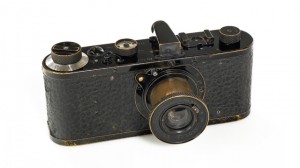
Last week we all saw an article floating around about an old Leica "o" series camera that sold for $1.9 Million to an Asian collector in an auction. We can sit here and make all the typical "that's ridiculous!" or "haha the Panasonic version sold for $150 on eBay" type comments, but I really wonder why someone would pay that much for an antique camera. I suppose this happens in every segment of geekdom, most notably, automobiles. I learned that only 25 of these special Leica "o" cameras were made and that this one in particular had "GERMANY" inscribed on it, as it was being shipped to the US for a patent. So the word "GERMANY" made this the world's most expensive camera of all time. I'm all for cool collectibles and historical pieces, but this Leica just isn't doing for me. It looks like a nice shelf piece, but it really doesn't stand out and besides the story of the word "GERMANY" being on the camera, I am not sure what is supposed to make it cool. It looks like a million other old cameras that I have seen over the years. So that got me thinking of what I would rather have instead... Here is a list I came up with some other historical camera/image making relics that I would rather have over the $1.9 Million Leica "O. " Most are functional pieces. I'm sorry, maybe it's because my lack of having $1.9 Million to throw around, but if I spent that much on something so rare, I would want to show it off and use it. (Click "MORE")
[caption id="attachment_4228" align="alignleft" width="300" caption="Buzz Aldrin's self portrait on the moon. You can also see some really cool panoramic shots from the lunar landings at the Muesum of Natural History in New York"]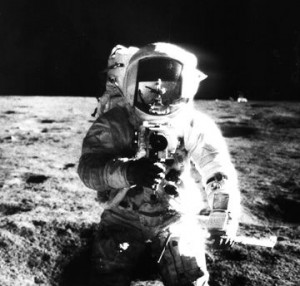 [/caption]
Hasselblad 500EL Space Camera and Negatives from First Lunar Lending
This one is a no-brainer. How cool would it be to have the original negatives from the first lunar landing? The United States has gone back to the moon a bunch of times, but the first Lunar Landing by Apollo 10 in 1969 was one of the greatest historical achievements of all-time. Having the negatives from the landing would be incredible. Although NASA has used many Nikon F's and D's over the years to document space, a modified Hasselblad 500 EL was the first camera ever used on the moon. Here is a cool link to Hasselblad's website that covers all of their space cameras. I am a big fan of analog photography and darkroom printing, yes I am a cave troll according to some people's standards. So all that considered, I would probably put both to good use. I know it may sound like historical blasphemy to use such an important camera, but that's the whole point of my post. If I planned on spending some serious $$$ on some historical photo gear, I would want it to be functional. Granted the modified 500 EL may be a hassle to use (bad pun intended). However the negatives would be cool and I imagine there would be some selling power behind silver-gelatin prints made from the original Lunar Landing negatives.
Nikkor 13mm f/5.6 AI-s and Canon EF 1200mm f/5.6L
[caption id="attachment_4229" align="alignright" width="300" caption="Ken Rockwell was lucky enough to know someone who let him test a 13mm f/5.6 AI-s Nikkor. Here's an image from his website where you can see the lens dwarfing a Nikon D300"]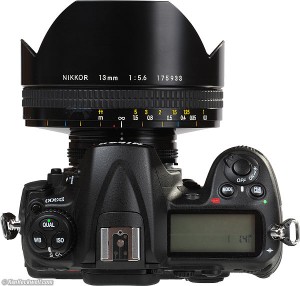 [/caption]
So on this list of supremely historical and rare items, why would I include two simple lenses? Well these two lenses aren't you're everyday wide-angle or telephoto. The Nikon 13mm f/5.6 AI-s was an extremely limited production lens. It is one of the widest angle rectilinear lenses with a staggeringly low amount of distortion. At f/5.6 it isn't the fastest lens for sure, but it is optically at least as good as the class leading Nikkor 14-24 f/2.8G and with much less distortion. Wide and slow reminds me of myself. Forget about trying to find one used, they are almost impossible to find. Of course as I write this, there happens to be one on eBay now. If you have a spare $30,000 to blow on lenses, I would highly recommend this lens. :) The Canon 1200mm f/5.6L is another very rare lens. Sports Illustrated, the US government, and National Geographic are a few of the known owners. It's initial price was $89,579, almost triple that of the super-rare 13mm f/5.6 AI-s Nikkor. While I can't say I'd have a practical use for either of these lenses, I'd sure have a lot more fun with them than an old dusty Leica rangefinder.
Henri Cartier Bresson and Garry Winogrand's Leica Cameras
[caption id="attachment_4233" align="alignright" width="300" caption="The 1200mm f/5.6L is no joke, but for most people the 800mm f/5.6L IS is a better choice for practical applications"]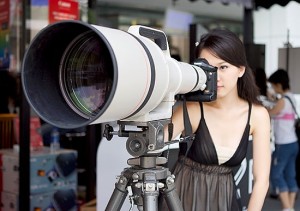 [/caption]
To many, Henri Cartier Bresson was the god father of street photography. He took his Leica rangefinders to the streets of Paris and influenced generations ahead with his technique of catching the "Decisive Moment". Cartier Bresson had little interest in post production and rarely made his own prints, but always made sure his prints were made with the black film border around them to prove that they were made straight from the negative and not cropped at all. However it turns out a lot of his photos were cropped and the black border was just added in during printing for effect. Oh well I can't kill him for that, he was still a major positive influence on many photographers, myself included. To the same token, but with a slightly different style, Garry Winogrand was an avid street photographer who patrolled the streets around the United States (mainly in NY) with his Leica. He so many street photographs that there were over 2,500 rolls of undeveloped film found in his New York City apartment. Additionally there were over 300,000 developed negatives that he never had the chance to go through. If I had to pick out a Leica camera for my collection, I would gladly take either one of these photographer's cameras. What a conversation piece that would be and of course the good karma of a legendary photographer's camera. To me either of these Leicas would be far cooler than one that simply says "GERMANY" on it.
[caption id="attachment_4236" align="alignleft" width="300" caption="This is a shot I found on Leicarumors.com It is supposedly Garry Winogrand's Leica M4. You can see that he ran so many rolls of film through the camera that the 35mm film sprocket holes "burned" in on the camera's pressure plate"]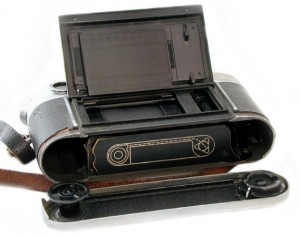 [/caption]
Lady Gaga's Polaroid Camera
If you've been reading our blog for a while, you know that I was not a fan of Polaroid's "partnership" with Lady Gaga. The introduced products were cheesy and needless to say they haven't exactly caught on in the imaging industry. So for her sins (Judas anyone?), Lady Gaga should give me her Polaroid camera. I would be torn between selling it on eBay so I could buy one of the above Nikon or Canon lenses or just making an execution video smashing it to pieces with one of her songs playing in the background. Maybe I'm being a little bit (or a lot bit) too harsh on the fleeting Pop-Queen (her "Born This Way" record sales dropped more than 80% in week 2 since its release), but I don't think so. Edwin Land is probably rolling in his grave somewhere and this would do him justice. That alone is worth it.
[caption id="attachment_4242" align="alignright" width="216" caption="Lady Gaga's Polaroid camera glasses, coming to a garbage dump near you"]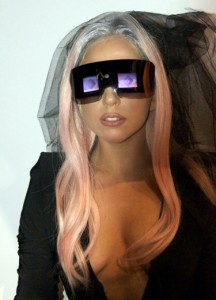 [/caption]
Weegee's Darkroom on Wheels
If Henri-Cartier Bresson was the godfather of street photography, Arthur Felig aka WeeGee, was the godfather of the paparazzi. Felig used a 4x5 Speed Graphic Camera with a giant flash bulb (which was only good for one shot). He usually shot at ISO 400 at f/16, pre-focused to 10 feet. He would intercept police radio transmissions and often arrive on scene before the authorities. Thus the nickname "Weegee" which originated from the popular/taboo Ouija board game. Well there was no Digital Photography back in the 30's and 40's so Weegee set up a "darkroom" in the trunk of his car. This let him quickly develop film on the scene. Again I am an analog photography aficionado, so having a portable darkroom would be absolutely incredible, especially if it was modified to be able to work with antique processes, such as ambrotypes.
[caption id="attachment_4245" align="alignleft" width="238" caption="Arthur Felig aka "Weegee" was way ahead of his time in terms of press photographers."]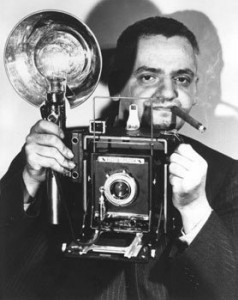 [/caption]