If we look back only a few years ago we'd see a massive whirlwind around the mirrorless camera. This new wave of technology looked promising for those in search of a lightweight interchangeable lens system, but ultimately left some a little damp. While mirrorless cameras are becoming better and more of a commonplace, it also seems like most of its surrounding intrigue is dying. Canon has finally made their triumphant belly flop into the mirrorless market with the EOS-M, including its dated sensor/molasses-slow AF combo that has surely put people in a coma. So where does that leave us? In early September, three full frame cameras were announced within days of each other: Sony's A99, Nikon's D600 and Canon's 6D. Even more curious is their pricing under the $3000 mark and Sony, who's usually on the cheaper side, being the most expensive of the lot. It would seem that the "full frame for the rest of us" is becoming the next big thing, but Sony is already attempting to break away from the pack by mixing an SLR design with a mirrorless twist. How will Sony's SLT camera stack up against the current contenders in the lightweight division of this ever-growing full frame market?

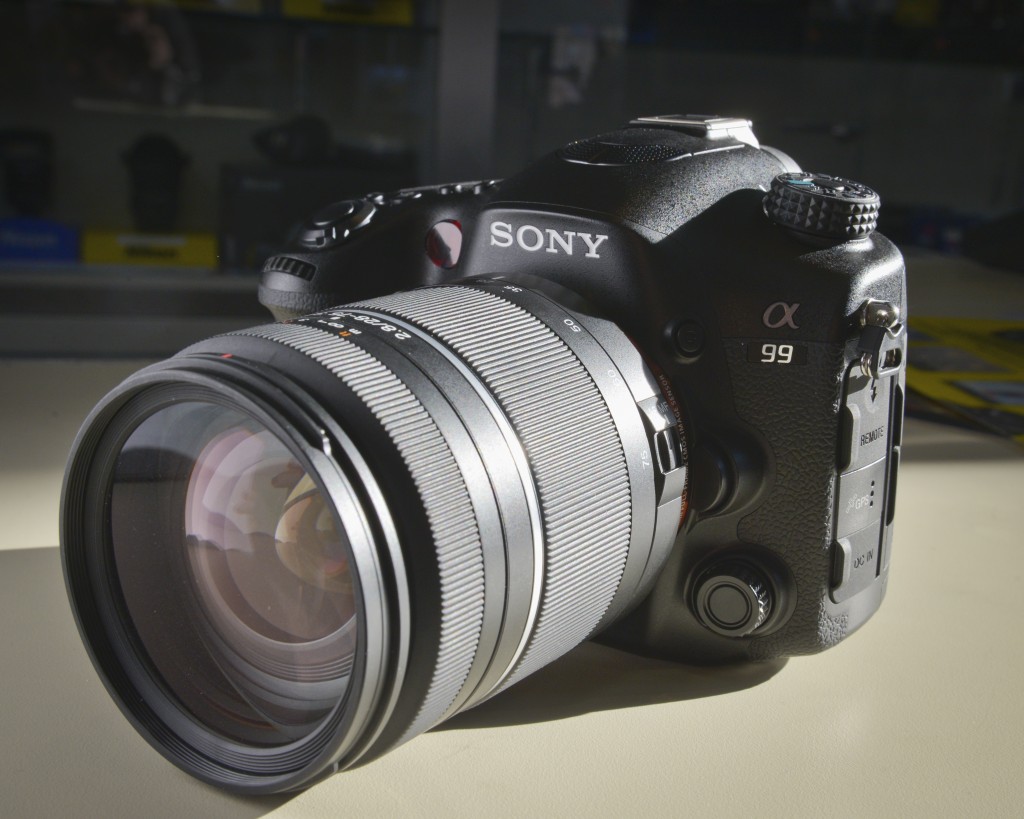
Behold: The A99. Sony's Translucent Mirror Full Frame. Way back:
In 2008 Sony unveiled the A900, their first flagship full-frame camera. At the time it was billed as a traditional DSLR as it lacked features such as live-view and video capture, which more or less became a standard after Canon's 5D Mark II came out. The A850 was released a year later with a smaller viewfinder coverage and slower buffer. By sacrificing the costly 100% coverage viewfinder, it would become the least expensive full frame available. The major criticism of these cameras came from their poor performance at higher ISOs and lack of "frills". Flash forward four years to the present time as Sony releases the proper follow up to the A900 and it's about as frilly and non-traditional as it can get.
The jump from the A900 to A99 is quite a large gap. Although they're both full frame SLR type cameras, the technology that divides them can't really compare. To give a more fair comparison we should look at the A77: A camera with very similar specs but a smaller crop sensor. These cameras rely on a technology that Sony has coined SLT. The Single-Lens Translucent camera is kind of a hybrid between an SLR and mirrorless as it utilizes an electronic viewfinder instead of an optical one. Although it does have a "mirror", it's semi-translucent and in a fixed position. This means that light is always reaching the sensor while also reflecting some light (approximately 1/2 EV) to a phase detect AF. Basically this allows the camera to operate on live-view at all times so you can shoot seamlessly using the EVF and its fancy articulating LCD screen. Getting more technical, it also means simultaneous use of a traditional 19 point AF system and a phase detect AF sensor at the same time. The major difference between the A77 and A99 is obviously a larger sensor. This full-frame may offer the same pixel count, but it boasts wider dynamic range and an emphasis on video-heavy features.

The Van Vleck House at Sun Down: 1/125 f/8 ISO 400 A Brief Introduction:
The A99 is a midsize SLR-style camera that features a 24.3 MP, 35.8 x 23.8 mm full frame sensor and a fixed translucent mirror allowing a two part auto-focusing system: 19pt AF (11 cross type) as well as 102 additional points with its phase detect sensor (available only with select lenses). Other features include ISO range from 100-25,600, 6 FPS continuous shooting, XGA eye detecting electronic OLED viewfinder, 3 way articulated LCD screen, top panel LCD, multi-interface hot shoe and dual slots for SD/MemoryStick.

"Bokehlicious": 1/125 f/2.8 ISO 400. That extremely shallow DOF is easy to achieve with its large sensor.
Build Design: If we were to judge a book by its cover, this camera might give off some mixed signals. The A99 is an interesting looking camera. It's kind of stout in comparison to other bodies, which tend to be a little more angular. I wouldn't go as far as saying it's ugly... but it's different for an SLR type camera. Looks aside, I've never felt a grip that agreed with my hands more than this one. It's almost like it was melded by the photo gods to be lovingly embraced by my previously unsatisfied digits. OK, I'm exaggerating a little. I wouldn't say it's perfect, but for my medium sized hands, it's damned near it. The grip guides both your middle finger and palm to support most of the weight, leaving your pointer finger comfortably on the shutter while the thumb can adjust settings with ease. Its layout is made so that you can hit most of the buttons without have to use your left hand, which is kind of a good and bad thing. The button organization at first seems like a mishmash, and it sort of is. It makes sense that the control dial is nearest the thumb, but then playback is way at the bottom while zoom is at the top. Not the end of the world, but still a minor inconvenience.
As of September 12th (when it was announced) the A99 was the lightest full frame...Then the D600 and 6D came out a couple days later. Is it worth it to squander over an extra 50 grams? Perhaps it is when you put on a battery grip and something like the Zeiss 24-70...it's sharp, but damn that guy adds some heft. Not only is it heavy but its focus motor sounds like a dentist drill (especially with tracking focus, ahhh). Anyway, the body itself isn't all that bad in terms of weight when you consider that it's fully made of magnesium alloy and weather sealed. On top of that, the build quality is actually pretty solid. The A99 feels like a tank and gives the indication that it can take a decent beating.
Aesthetically, what seems kind of out of place for me is the mode dial. It has a locking feature on top but it just sticks out as if it didn't want you to miss it. It's not so jarring in the sense that it's a neon colored narwhal horn, but it still juts out from the otherwise cohesive design. Featuring a similar style as the mode dial is a tiny little silent control dial near the lens. You can assign it a custom function that allows you to adjust settings even during video recording (if you were so inclined to mess with the camera while it was rolling). From the top you have a nice LCD that has become a given for full frame cameras. The ISO and exposure comp are right next to each other, along with other buttons like drive and white balance. Take note that Sony did not include a pop-up flash and instead opted to use the space for a stereo mic. The need for pop-up flash on "professional" cameras seems to be an ongoing argument of necessity. If a camera has flash, it's always an added bonus when you're in a pinch, but if you're ponying up for an expensive camera you might as well get a decent flash.
Speaking of flash, Sony did the right thing and finally ditched the Minolta hot shoe. They didn't keep it too conventional, but it's a hot shoe that doesn't require an adapter for most of your standard flash needs. Took them long enough! This hot shoe is a little different as it's specifically made to accept accessories like adapters that takes XLR cables for balanced mic inputs. All that's left is the LCD screen and it's probably one of the less aggravating articulated screens I've used. Oh the angles you will achieve! The screen's orientation adapts without delay and the resolution is pretty brilliant. The mount locks nicely but the hinge doesn't give me the same assurance of durability that the rest of the body does.

Imitation Tourist, Thankgiving Eve: 1/100 f/3.2 ISO 1250. Still pretty clean for a relatively high ISO. Operation
Powering it on, you're greeted with a live view representation and a variety of different display options. You can allow only AF points and basic exposure settings, electronic X-Wing style level guide, histogram, or a QuickNavi guide. Since I mostly used the EVF to compose, I found the QuickNavi menu to be the easiest way to change settings on the fly. Sony's navigation and overall controls are awkward at first, but like anything else it has a learning curve. Putting your eye up to the electronic viewfinder switches from the LCD to EVF, with options for e-level or histogram. There's a slight lag with the automatic eye sensor, but I never had a problem with it not responding. The subtle lag is something to complain about at first, but after using it for some time it becomes unnoticeable. Adapting to an electronic viewfinder after being well accustomed to optical ones can be a little strange. They're getting better despite the misfiring in my brain trying to tell me that what I'm seeing isn't real... One advantage I can see is that these are a little helpful when you're shooting in bright light or in pitch black. For the most part your adjustments act as a "live filter" for your exposure. I noticed that it starts to get less accurate in lower light or when trying to underexpose and that the color in the viewfinder can be a little more saturated from the back LCD. I think most importantly, what helps keep shooting seamless between typical live view to viewfinder is that there is no wobbly screen lag that most EVF's are plagued with. This is definitely a plus and almost helps you forget that you're looking at a tiny screen.
Navigating the menus felt like a custerfluff for me. You can use the directional joystick to navigate and press for options or scroll with the front wheel to make a selection. Hitting the Fn button brings up your typical shooting settings, both on the back screen and in the viewfinder. It's helpful that you can bring these up without manically going back and forth, but it can be a little awkward using the thumbstick right next to your nose. Shooting settings are lined up in rows on the left and right of the screen in no order of importance so it takes a while to figure out where everything is. One physical button I found myself missing was a focusing mode button that would save you the pain of scrolling through the hectic menu layout. Thankfully you can designate the silent wheel in front to change focusing as well as AF area, exposure comp, ISO and metering mode. The camera's setup menu isn't much of a joy to go through either. They give you a tabbed setup and you find yourself scrolling for a few eons until you're going nuts trying to figure out how to invert the control dials. I'm not some frustrated old guy who's easily befuddled by technology, but playing word search when you're trying to shoot can get old fast. I still can't figure out how to turn off the AF confirm beep. Grr. I guess that's what manuals are for folks, so read up.
One of the Sony's showboating features is the dual AF system. It has a typical 19 point AF with 11 cross type sensors that are all in the center of the frame with additional phase detection data being collected. With a select few lenses, the camera can utilize up to 102 points from its overlaying phase detect sensor; all these points clustered together don't make much use of the expanded frame. Considering the camera is always in live view, it doesn't perform in the sluggish nature that they usually do with contrast detection. At certain points I did struggle with the focus searching back to front in shade or subdued lighting, which might be caused by the SLT design splitting the light coming in from the lens. It can be a pain, but another innovative feature on this camera is that you can set an AF range so the camera wont focus past your restrictions. The sensor is using the phase detection sensor so it's relatively strong in tracking moving subjects. Much of these focusing features like the Depth Map Assist are a little more helpful for video than stills. Focusing speed was pretty swift when it wasn't getting confused in low light. Coupled with tracking focus, you could have a blast with its snappy continuous shooting. Drive modes allow up to 6fps at full resolution and 10 or 8fps with in a cropped mode. One thing I was very surprised with was the in camera stabilization. The Steadyshot technology was very impressive. I got sharp images with slow shutter speeds down to 1/10th of a second. Even some VR lenses can't do that good of a job hand-held. This is also a great feature for videographers with lenses that don't have stabilization.
Last to note was the battery life which I thought was one of its weak points. With live view/EVF and dual Auto focus constantly capturing phase detect data, it's no wonder that the A99 gets drained quickly. Although it's rated for about 500 shots, I found myself running to recharge sooner than that. In comparison to other full frames that shoot 700-800, this is considerably lacking.

Shot Through a Green House: 1/125 f5 ISO 400. Highlights starting to lose some detail with overexposure. Image Quality
One of the major criticisms that Sony's first flagship full frames received was their capability in low light. At ISO's up to 800, images look pretty stunning. Gradually increasing to ISO 1600 you begin to notice an increase in shadow noise, but these images can still hold their weight up to 6400. Pushing to it's limit of 25600 produces messy, but usable images as expected. The image stabilization on the sensor works exceptionally well so shooting at lower shutter speeds can help you keep the sensitivity down a bit. Default noise reduction settings help in cleaning up the image without going overkill and causing blur. The Auto ISO option in manual does a good job at choosing adequate sensitivity while still allowing you change exposure settings. Shadow recovery is very good, but I found the highlight dynamic range to be less forgiving. Overall detail rendering is fair in JPEG and colors are represented more accurately in the lower ISO range. Overall, the A99 produces very good stills, but doesn't quite match up in low light compared to some of the other full frames in its price range.
Sony jam-packed this camera with all sorts of bells and whistles that "enhance" your pictures. There's a sweep panorama, in-camera HDR, and 13 creative filter styles that you would find in any camera. At this point of the game, it's kind of expected that any camera comes with quirky gimmicks that often get overlooked. One feature that is far from hokey is its video capability. Thanks to the full frame sensor, video does look pretty snazzy at both 1080 60p and 24p resolutions. I'm partial to the 24p look as it makes everything so much more smooth and cinematic for lack of better term. Again, that sensor stabilization works wonders here. This doesn't go without saying that it doesn't suffer from the rolling shutter with motion which is especially prominent in full frame cameras. The tracking autofocus is well suited for shooting video and focus peaking works well. Sound from the camera's mic was decent for most applications, but if you wanted real quality you'd probably go for an off-camera mic that would attach to its handy-dandy hot shoe. What's more is the inclusion of a headphone input for monitoring and the much coveted uncompressed output via HDMI that are only usually available in high end cameras. Although I shot more stills than video with my trial, I found it easy to achieve quality footage straight out of the camera. If you're looking for an SLR to shoot video, the A99 might be something to look into.

Hollywood Pizza/Unique Photo's Go-To Lunch Spot: 1/500 f/4 ISO 400. Nice dynamic range at lower ISOs. More Samples Available Here Wrap Up What I Liked
- Solid Build/Comfy Ergonomics
- Stills/Video Quality
- Improved ISO Range
- Steadyshot Image Stabilization
Not So Much
- Menu System/Button Layout
- Limited Lens Selection with AF-D
- Battery Life
- Debatable Price
Truth be told, I came into this review thinking I was going to hate the A99. Seeing its unique translucent mirror design and lack of optical viewfinder was enough for the traditional in me to be weary. Maybe I also have an unwarranted stigma with Sony products since I've shot mostly Nikon/Canon and haven't been exposed to what they have to offer. This is a shame apparently... if the A99 is anything like the rest of Alpha line, they are not to be ignored.
The A99 is one well built machine that feels great in the hands. With all the gripes about no optical viewfinder, the EVF performs fairly well without lag and provides a close to accurate preview of what you're about to take. The dual auto-focus system is an interesting concept and offers a variety of focusing features that can be useful, but takes a little patience to utilize effectively. Does it do any better than a normal AF system? The problem is that it's still a relatively new technology that's going against something Nikon and Canon have been doing well for a while now. Give them time and I'm sure Sony will have it down... when the next fad of sensor technology swings around. That's the thing: Mirrorless was meant to be a stride forward, but it's almost become a side-step simulation of what we know works. You're not going to re-invent the wheel, so the question becomes why not just use the one that we know works? ::End Rant:: The A99 takes great stills and video at a standard ISO range, but starts to reach limitations where most cameras seem to fall.
I wasn't so excited about the cluttered menu setup, although the QuickNavi feature is nifty. The button layout was a pain at first, but Sony offers you a lot of customization at your fingertips which is always a good thing. To fully utilize the phase detect's 102 lung looking array of focus points, you need one of a select few SSM lenses. Even at that you have to wonder about practicality when they're all mashed helplessly in the center frame. All this tech is nice, but it comes at the price of battery life. Lastly with the competition having an ongoing limbo competition to see who can go lower in price, the A99 is starting to feel a little pricey. Considering the D600 has the same highly regarded sensor, one would think they would produce very similar results, but due to different image processors it looks like dynamic range is a little better with Nikon. It would be useful to put those two against the 6D, alas I haven't gotten my hands on one yet. Could be a fun shoot out in the future!
Overall I was genuinely impressed with the A99. It's an interesting take at the same model that has only been given marginal improvements for years now. Although it may not be perfect, this is a well-rounded full frame camera that offers a lot, especially for the potential videographer. If you're looking for a straight forward camera, this might not be your safest bet. Maybe it's not the perfect choice for someones first full frame, but if you're looking for a plethora of features in a versatile package this might be up your alley.
Is hybrid technology the path of things to come? My Magic 8-Ball is telling me ask again later. Either way, you have to give it to Sony for being ambitious.