Compare the Sigma AF 50-120MM F/2.8 DC OS Contemporary Lens with five alternatives by camera mount, focal range, aperture and price.
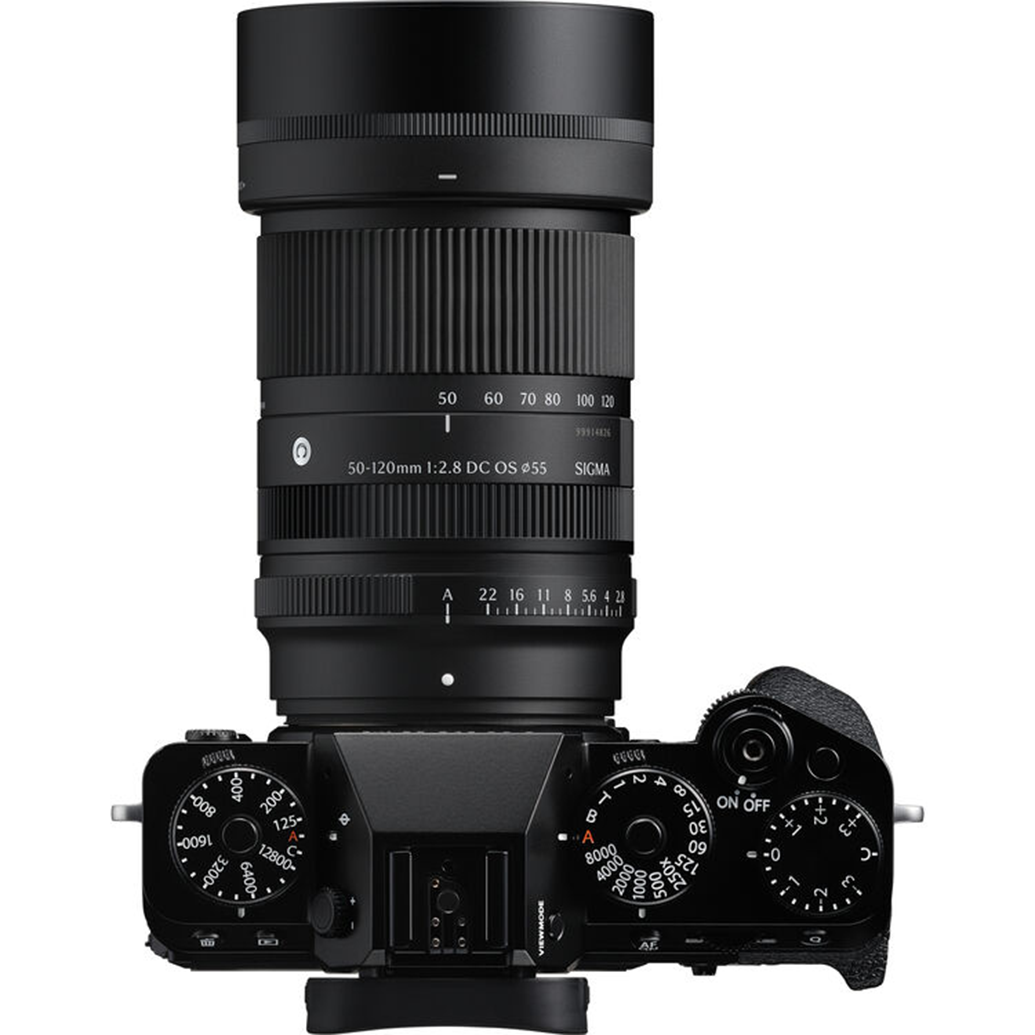
50–120mm f/2.8: telephoto reach for $799
Best fit: extending an APS-C kit beyond a standard zoom. The 50–120mm range suits tighter portraits and distant details, while the constant f/2.8 maximum aperture stays available throughout the zoom range. This is an addition to a standard zoom, not a replacement when wider views matter. All three mount versions cost $799 each and are available to preorder.
| Mount version | Weight | Diameter × length |
|---|---|---|
| Sigma AF 50-120MM F/2.8 DC OS Contemporary Lens for Fuji X Mount | 390g | 66.8 × 99.3mm |
| Sigma AF 50-120MM F/2.8 DC OS Contemporary Lens for Canon RF | 410g | 69 × 97mm |
| Sigma AF 50-120MM F/2.8 DC OS Contemporary Lens for Sony E | 390g | 66.8 × 99.0mm |
Sigma describes OS2 optical stabilization with 6.5 stops of shake compensation at 50mm and 4.5 stops at 120mm. Stabilization addresses camera movement, not subject movement, so shutter speed still matters for action. The HLA autofocus motor is designed for fast subject tracking, and Sigma also describes reduced focus breathing for video.
Each version takes 55mm filters and has dust and splash protection. Minimum focus distance changes from 9.1 inches at the wide end to 21.7 inches at the telephoto end. The mount determines which version to buy; the small weight differences are not a reason to change camera systems.
18–50mm f/2.8: the everyday Fujifilm X zoom
The Sigma 18-50mm f/2.8 DC DN Contemporary Lens for Fuji X Mount costs $499 and is in stock. It is the better starting point for general photography if a standard zoom is missing from the bag. Its 27–75mm full-frame equivalent range includes wider views that the 50–120mm cannot provide.
The constant f/2.8 aperture is useful indoors and does not narrow as the lens zooms toward 50mm. Weight is 285g, length is 76.8mm, and the stepping motor handles autofocus. Minimum focus distance runs from 12.1cm at the wide end to 30cm at the long end, useful for photographing small details without switching lenses.
There is no optical image stabilization. The mount has a dust- and splash-resistant structure. Its 55mm filter size matches the 50–120mm, allowing the same filter size across a two-zoom Fujifilm X kit.
50mm f/2: a smaller full-frame Sony E option
The Sigma 50mm f/2 DG DN Contemporary Lens (Sony E) is $719 and in stock. Choose it for a compact full-frame prime rather than telephoto flexibility. Unlike the APS-C 50–120mm, this lens is designed for full-frame coverage.
Its f/2 maximum aperture is one stop brighter than f/2.8. That can support a faster shutter speed at the same ISO in the same light, or shallower depth of field under comparable shooting conditions. The trade-off is fixed framing at 50mm: there is no longer end to turn to when the subject is farther away.
The lens weighs 12.2 ounces and measures 2.8 × 2.8 inches. Sigma lists an all-metal barrel with dust and splash resistance, plus a fast internal focusing system. It takes 58mm filters and focuses as close as 17.7 inches.
50mm f/1.2: prioritize aperture on Sony E
The Sigma 50mm f/1.2 DG DN ART Lens (Sony E) costs $1,399 and is in stock. This is the choice for the widest maximum aperture in this comparison. It covers full-frame Sony E cameras and provides a 75mm equivalent focal length on APS-C models.
The f/1.2 aperture offers more room to work with shallow depth of field and low-light shutter speeds than either f/2 or f/2.8. It does not add reach. For someone who regularly needs focal lengths beyond 50mm, the zoom solves a different problem.
At 740g and 110.8mm long, this is a larger commitment in the bag than the 50mm f/2. It uses 72mm filters. Sigma lists dual HLA focusing, a rounded 13-blade diaphragm and an aperture ring with a de-click function. Reduced focus breathing is part of the design, while dust and splash resistance and a water- and oil-repellent coating address outdoor use.
XF 50mm f/2: the light Fujifilm X portrait option
The Fujifilm FUJINON XF 50mm f/2 R WR Lens (Black) costs $449 and is in stock. It is the lowest-priced and lightest lens here. At 200g, it makes sense for a Fujifilm X photographer who wants a compact portrait option without carrying a telephoto zoom.
Fujifilm lists a 76mm full-frame equivalent focal length. The f/2 maximum aperture is one stop brighter than f/2.8, but the focal length stays fixed. Choose it when that angle of view already suits the photographs being made, rather than as a cheaper way to obtain the entire 50–120mm range.
The lens uses 46mm filters. Fujifilm describes dust and weather resistance, with operation in temperatures as low as −10°C.
XF 16–50mm: wider coverage and internal zoom
The Fujifilm FUJINON XF 16-50mm f/2.8-4.8 R LM WR Lens is $849 and in stock. Choose it over the Sigma 18–50mm when wider coverage and internal zoom matter more than a constant aperture. Its 24–76mm equivalent range starts wider than the Sigma standard zoom’s 27–75mm equivalent range.
The maximum aperture changes from f/2.8 to f/4.8 across the zoom range. At the long end, it therefore gives up maximum-aperture light gathering compared with either f/2.8 zoom. That trade-off matters more for moving subjects in dim light than for stationary scenes where a slower shutter speed is practical.
Weight is 240g and length is 7.14cm. The internal zoom mechanism keeps the lens length consistent while zooming, and the construction is weather-resistant. Minimum focus distance is 0.24m, with maximum magnification of 0.3x. It takes 58mm filters.
Choose by mount, then by the shot being missed
Start with mount and sensor format. The 50–120mm versions are APS-C lenses, while the two Sigma 50mm Sony E primes offer full-frame coverage. For Canon RF, the 50–120mm is the only RF-mount option in this selection. A lower price on an X-mount lens does not make it an RF alternative.
Then check the focal lengths used in existing photographs. If framing is regularly too tight, prioritize a wider starting focal length. If subjects remain too small at 50mm, prioritize reach. If framing is already right but shutter speeds are too slow, a wider maximum aperture may be the more useful purchase. Make that decision before comparing barrel materials or diaphragm blade counts.
Prices at Unique Photo
- Sigma AF 50-120MM F/2.8 DC OS Contemporary Lens for Fuji X Mount: $799.00 (preorder)
- Sigma AF 50-120MM F/2.8 DC OS Contemporary Lens for Canon RF: $799.00 (preorder)
- Sigma AF 50-120MM F/2.8 DC OS Contemporary Lens for Sony E: $799.00 (preorder)
- Sigma 18-50mm f/2.8 DC DN Contemporary Lens for Fuji X Mount: $499.00
- Sigma 50mm f/2 DG DN Contemporary Lens (Sony E): $719.00
- Sigma 50mm f/1.2 DG DN ART Lens (Sony E): $1,399.00
- Fujifilm FUJINON XF 50mm f/2 R WR Lens (Black): $449.00
- Fujifilm FUJINON XF 16-50mm f/2.8-4.8 R LM WR Lens: $849.00
Prices as of November 24, 2026. Browse more: Sigma Mirrorless Lenses, Sigma at Unique Photo.
Related reading: Sigma AF 50-120MM F/2.8 DC OS Contemporary Lens: Specs and Price.
Frequently asked questions
Is the Sigma AF 50-120MM F/2.8 DC OS Contemporary Lens full-frame?
No. It is designed for APS-C mirrorless cameras, with Fujifilm X, Canon RF and Sony E mount versions.
How much does the Sigma 50–120mm f/2.8 cost?
Each mount version costs $799. All three are available to preorder.
Which Sony E alternatives in this guide cover full-frame cameras?
The Sigma 50mm f/2 DG DN Contemporary and Sigma 50mm f/1.2 DG DN ART both cover full-frame Sony E cameras. They cost $719 and $1,399 respectively, and both are in stock.
Does the Sigma 18–50mm f/2.8 for Fujifilm X have image stabilization?
No. The Sigma 18–50mm f/2.8 DC DN Contemporary Lens for Fuji X Mount does not have optical image stabilization.