The Sigma AF 50-120MM F/2.8 DC OS Contemporary Lens is available to preorder for $799 in Fujifilm X, Canon RF and Sony E mounts.
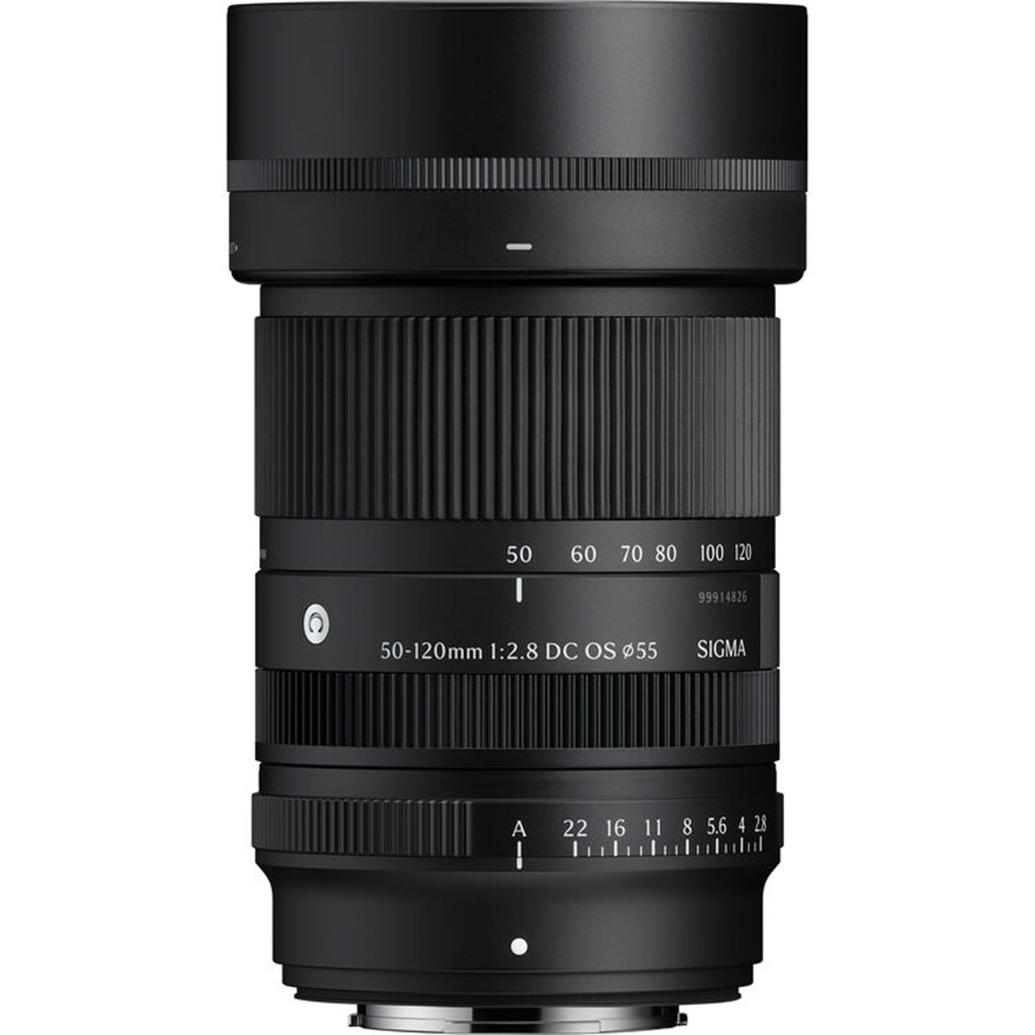
An APS-C telephoto zoom for portraits and travel
The Sigma AF 50-120MM F/2.8 DC OS Contemporary Lens is a telephoto zoom for APS-C mirrorless cameras, with a constant f/2.8 maximum aperture and a body less than four inches long. This launch covers three mount versions, each priced at $799 and available to preorder.
The range makes sense for portraits and tighter views while traveling. At 50mm, there is more room around a subject; at 120mm, framing gets tighter without moving closer. This is a lens for picking out a person or a detail rather than taking in a broad interior. Its APS-C designation matters: the lens is designed around that sensor format.
Constant f/2.8 from 50mm to 120mm
The maximum aperture stays at f/2.8 throughout the zoom range. Zooming therefore does not force a smaller maximum aperture at the long end. That is useful when maintaining an exposure during an event or keeping shutter speed up for a moving subject.
An f/2.8 aperture also gives scope for separating a portrait subject from the background. The amount of blur still depends on framing and subject-to-background distance; aperture alone does not determine the result. The diaphragm uses 11 blades and can close to f/22. Stopping down provides more depth of field, at the cost of less light reaching the sensor.
HLA autofocus and reduced focus breathing
Sigma lists a High-Response Linear Actuator (HLA) autofocus motor, describing quiet operation and rapid, precise tracking of fast subjects. Its practical job is to move focus as subject distance changes. That is relevant to photographing people in motion as well as following a subject during video.
Sigma also says the lens minimizes focus breathing. This is the apparent change in framing as focus shifts between distances. Reduced breathing can make a transition from a nearby subject to a distant one less visually distracting. It is not the same as a claim that framing never changes.
OS2 stabilization and handheld shutter speeds
Sigma describes an optical stabilizer powered by its OS2 algorithm, rated at 6.5 stops of shake compensation at 50mm and 4.5 stops at 120mm. The rating changes with focal length; the 50mm figure should not be treated as applying across the entire zoom range.
Optical stabilization counters camera movement during handheld shooting. That can help with stationary subjects in low light, where a slower shutter speed may be useful. It does not freeze a moving person. For motion, shutter speed still needs to match the subject, even with stabilization active. The constant f/2.8 aperture and stabilization address different parts of the low-light problem.
Close focusing and the 18-element optical design
The optical construction comprises 18 elements in 13 groups, including one FLD element, three SLD elements and four aspherical elements. Specialized glass and aspherical surfaces help control optical aberrations within a lens design.
Minimum focusing distance changes with zoom position. Sigma lists 9.1 inches at the wide end and 21.7 inches at the telephoto end. Those figures matter for small details photographed at close range: the lens can focus substantially closer at 50mm.
Maximum magnification is 1:3 at the wide end and 1:4.7 at the telephoto end. In practical terms, the wide end gives the larger reproduction of a small subject. The longer focal length does not automatically mean the strongest close-up capability.
Under a pound, with dust and splash protection
Depending on mount, the lens weighs 390 g or 410 g. Both stay below a pound. Length ranges from 97 mm to 99.3 mm, so the mount changes the dimensions slightly rather than changing the basic size of the lens. That keeps the carrying burden modest for a telephoto zoom.
Sigma lists a weather-sealed build for dust and splash protection. That is relevant to outdoor travel, but splash protection should not be read as permission to submerge the lens. All three versions use a 55mm filter thread, so filter diameter is not a deciding factor between mounts.
Three mount versions, all available to preorder
The choice is primarily camera mount, not a different aperture or focal-length range. The Canon RF version is slightly wider and heavier, but shorter, than the other two. Dimensions below are diameter × length.
| Lens version | Dimensions | Weight | Price | Availability |
|---|---|---|---|---|
| Sigma AF 50-120MM F/2.8 DC OS Contemporary Lens for Fuji X Mount | 66.8 × 99.3 mm | 390 g / 13.8 oz | $799 | Available to preorder |
| Sigma AF 50-120MM F/2.8 DC OS Contemporary Lens for Canon RF | 69 × 97 mm | 410 g / 14.5 oz | $799 | Available to preorder |
| Sigma AF 50-120MM F/2.8 DC OS Contemporary Lens for Sony E | 66.8 × 99.0 mm | 390 g / 13.8 oz | $799 | Available to preorder |
All three mount versions are available to preorder from Unique Photo for $799 each.
Prices at Unique Photo
- Sigma AF 50-120MM F/2.8 DC OS Contemporary Lens for Fuji X Mount: $799.00 (preorder)
- Sigma AF 50-120MM F/2.8 DC OS Contemporary Lens for Canon RF: $799.00 (preorder)
- Sigma AF 50-120MM F/2.8 DC OS Contemporary Lens for Sony E: $799.00 (preorder)
Prices as of October 17, 2026. Browse more: Sigma Mirrorless Lenses, Sigma at Unique Photo.
Frequently asked questions
How much does the Sigma 50-120mm f/2.8 DC OS Contemporary cost?
The Fujifilm X, Canon RF and Sony E versions each cost $799. All three are available to preorder.
Is the Sigma 50-120mm f/2.8 designed for APS-C cameras?
Yes. Sigma describes it as a telephoto zoom designed for APS-C mirrorless cameras.
Does the Sigma 50-120mm keep f/2.8 throughout the zoom range?
Yes. Its maximum aperture remains f/2.8 from 50mm through 120mm, and its minimum aperture is f/22.
What filter size does the Sigma 50-120mm f/2.8 use?
All three mount versions use 55mm filters.