DJI Osmo 360 Adventure Combo vs DJI Osmo 360 Standard Combo: compare shared 8K specs, current prices and the Insta360 GO 3S option.
Current prices and availability
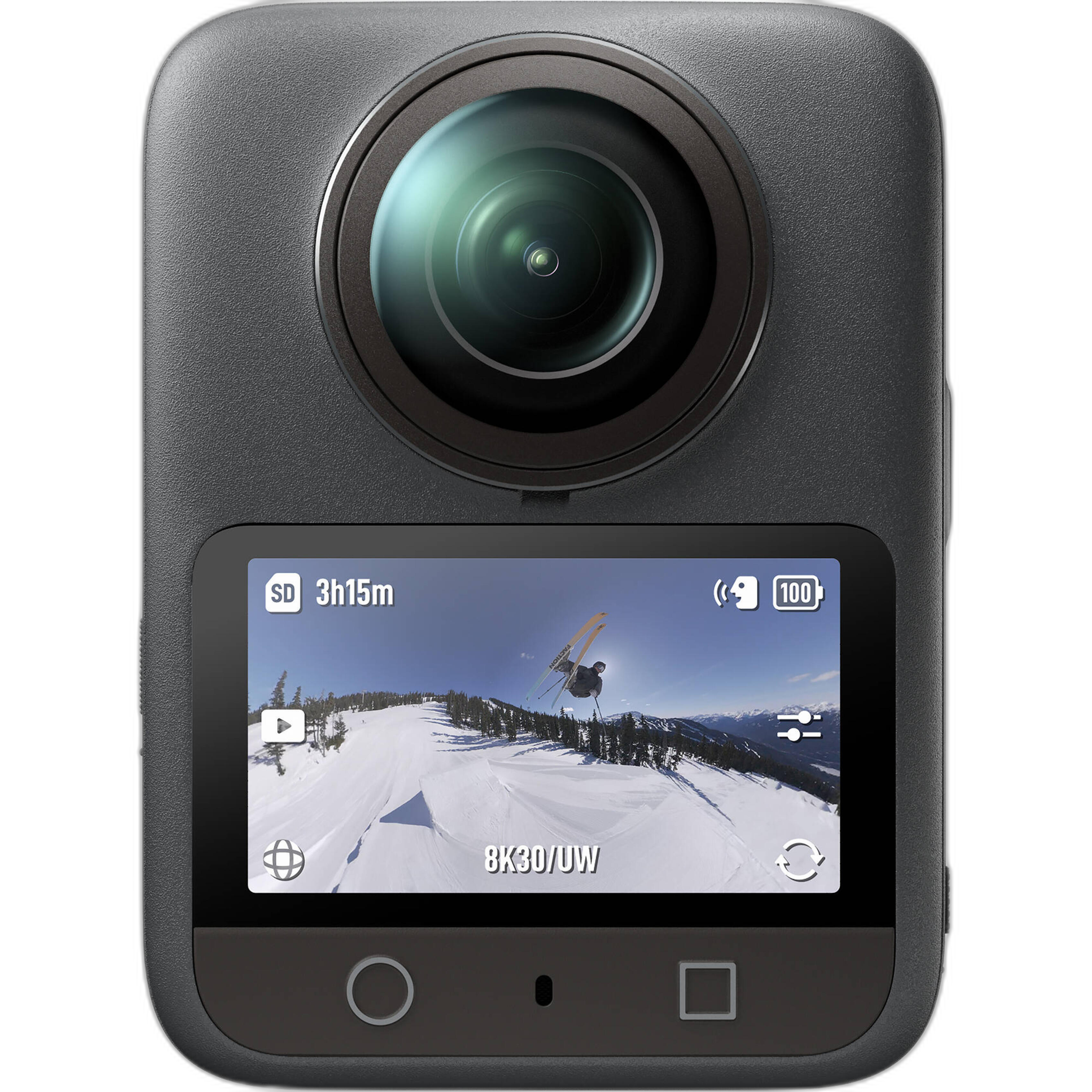
The DJI Osmo 360 Adventure Combo is $531.99, previously $699.99. The DJI Osmo 360 Standard Combo is $417.99, previously $549.99. Both are in stock. Their camera specifications match, so the higher Adventure Combo price should not be mistaken for a higher-resolution camera.
The Insta360 GO 3S Standard Edition - Midnight Black 128GB is the lower-priced option at $299.99, previously $379.99, and is orderable. That is a different availability status from the two in-stock Osmo combos. For someone deciding on purchase price first, it belongs in the comparison; price alone does not establish equivalent recording capabilities.
Osmo Adventure vs Standard: shared camera specifications
The two DJI combos match across these capture and camera-body specifications.
| Specification | Osmo 360 Adventure Combo | Osmo 360 Standard Combo |
|---|---|---|
| Maximum 360° video | Native 8K, up to 50fps | Native 8K, up to 50fps |
| High-frame-rate 360° video | 4K/100fps | 4K/100fps |
| Boost video | 4K/120fps, 170° | 4K/120fps, 170° |
| 360° photos | 120MP, JPEG | 120MP, JPEG |
| Continuous recording rating | 100 minutes at 8K/30fps | 100 minutes at 8K/30fps |
| Color features | 10-bit, D-Log M | 10-bit, D-Log M |
| Maximum aperture | f/1.9 | f/1.9 |
| ISO range | 100 to 51,200 | 100 to 51,200 |
| Display | Fixed touchscreen LCD | Fixed touchscreen LCD |
| Camera body weight | 183.2 g / 6.5 oz | 183.2 g / 6.5 oz |
| Camera dimensions | 81.0 x 36.0 x 61.3 mm | 81.0 x 36.0 x 61.3 mm |
8K 360° capture is different from 170° Boost video
Both Osmo combos offer native 8K 360° recording at up to 50fps. An 8K spherical recording spreads its resolution around the surrounding scene, rather than concentrating it in one forward-facing view. That matters when cropping a conventional frame from a 360° recording: the 8K designation applies to the complete recording, not every possible crop.
Keep the two high-frame-rate specifications separate. DJI lists 4K/100fps for 360° video and 4K/120fps with a 170° view for Boost video. The latter is not a 120fps spherical recording mode. Higher frame rates provide more captured moments for slow-motion playback, but the coverage changes between these modes.
Still photography is also matched. Both support 120MP 360° photos and record JPEG images. As with spherical video, that resolution describes the surrounding image rather than a single narrow composition. Neither combo has an advantage in the stated still-photo resolution.
Sensor design, dynamic range and D-Log M
DJI describes its square HDR sensor as maintaining the same 360° image field as a traditional 1-inch sensor, with 25% higher sensor utilization. The maker also lists 2.4μm pixels and 13.5 stops of dynamic range for both combos. Those are shared imaging characteristics, not reasons to select Adventure over Standard.
Dynamic range concerns the span between dark and bright detail a camera can capture. It is relevant to scenes containing bright sky and shaded foreground, where exposure involves more than simply making the whole image brighter. DJI's 13.5-stop figure is a manufacturer specification, not a guarantee that every high-contrast scene will fit within one exposure.
Both have an f/1.9 maximum aperture and an ISO range of 100 to 51,200. A high selectable ISO is an exposure option, not a promise of clean results at that setting. Both also offer 10-bit capture and D-Log M. These matter for color adjustment after recording; the Adventure name does not add a different color workflow.
Recording time, memory cards and microphone connection
DJI rates each Osmo combo for 100 minutes of continuous recording at 8K/30fps. The recording setting is part of that specification. Use 8K/30fps as the reference when comparing endurance rather than treating 100 minutes as a blanket rating for every mode.
Both accept microSD, microSDHC and microSDXC cards, with a maximum supported capacity of 1 TB. DJI recommends U3/V30 or faster cards. Capacity and speed serve different purposes: capacity determines how much a card can hold, while its speed rating concerns how quickly it can sustain writing. A large capacity alone is not the whole card-selection decision.
Video is recorded as MP4 using H.265/HEVC, so codec support belongs on the editing-workflow checklist. Audio recording is AAC 4.0 surround at 16-bit/48 kHz. Both combos also support OsmoAudio direct microphone connection. For someone planning to record speech, that connection feature is relevant, but it does not distinguish the Adventure Combo from the Standard Combo.
Body size, fixed screen and quick-release mounting
Each Osmo camera body weighs 183.2 g and measures 81.0 x 36.0 x 61.3 mm. Paying for the Adventure Combo does not buy a smaller or lighter camera body. Those dimensions matter when considering where the camera will sit on a mount, particularly if space around the screen is limited.
The fixed touchscreen LCD does not tilt independently of the camera body. Screen orientation therefore deserves attention when positioning the camera. Both support the Osmo Magnetic Quick-Release Ecosystem, which is relevant when planning compatible mounting arrangements. Each also has one USB-C connection for data and power input/output, plus Bluetooth 5.1. These connection specifications are the same across the two combos.
Who should choose the Standard, Adventure or GO 3S?
Choose the Standard Combo for the lower-priced route to DJI's 8K 360° capture. At $417.99, it matches the Adventure Combo's recording modes and 120MP photo resolution. Someone buying primarily for those camera features has a concrete reason to favor Standard.
Choose the Adventure Combo as a package preference, not an imaging upgrade. Its $531.99 price does not change the stated capture specifications or the 100-minute 8K/30fps recording rating. A buyer expecting better image specifications from the more expensive name should instead favor Standard.
Consider the Insta360 GO 3S when purchase price is the first filter. The Midnight Black 128GB edition is $299.99 and orderable. If in-stock availability is the deciding factor among these options, both Osmo combos meet that requirement.
Prices at Unique Photo
- DJI Osmo 360 Adventure Combo: $531.99
- DJI Osmo 360 Standard Combo: $417.99
- Insta360 GO 3S Standard Edition - Midnight Black 128GB: $299.99
Prices as of November 24, 2026. Browse more: DJI Ronin/Osmo, DJI at Unique Photo.
Frequently asked questions
Does the DJI Osmo 360 Adventure Combo record better video than the Standard Combo?
Both have the same stated video capabilities: native 8K 360° recording up to 50fps, 4K/100fps 360° recording and 4K/120fps with a 170° Boost view. Both also offer 10-bit capture and D-Log M.
How long can the DJI Osmo 360 record at 8K?
DJI rates both the Adventure Combo and Standard Combo for 100 minutes of continuous recording at 8K/30fps.
What memory card does the DJI Osmo 360 support?
Both combos support microSD, microSDHC and microSDXC cards up to 1 TB. U3/V30 or faster cards are recommended.
What are the current prices and availability of these three options?
The DJI Osmo 360 Adventure Combo is $531.99 and the Standard Combo is $417.99; both are in stock. The Insta360 GO 3S Standard Edition - Midnight Black 128GB is $299.99 and orderable.