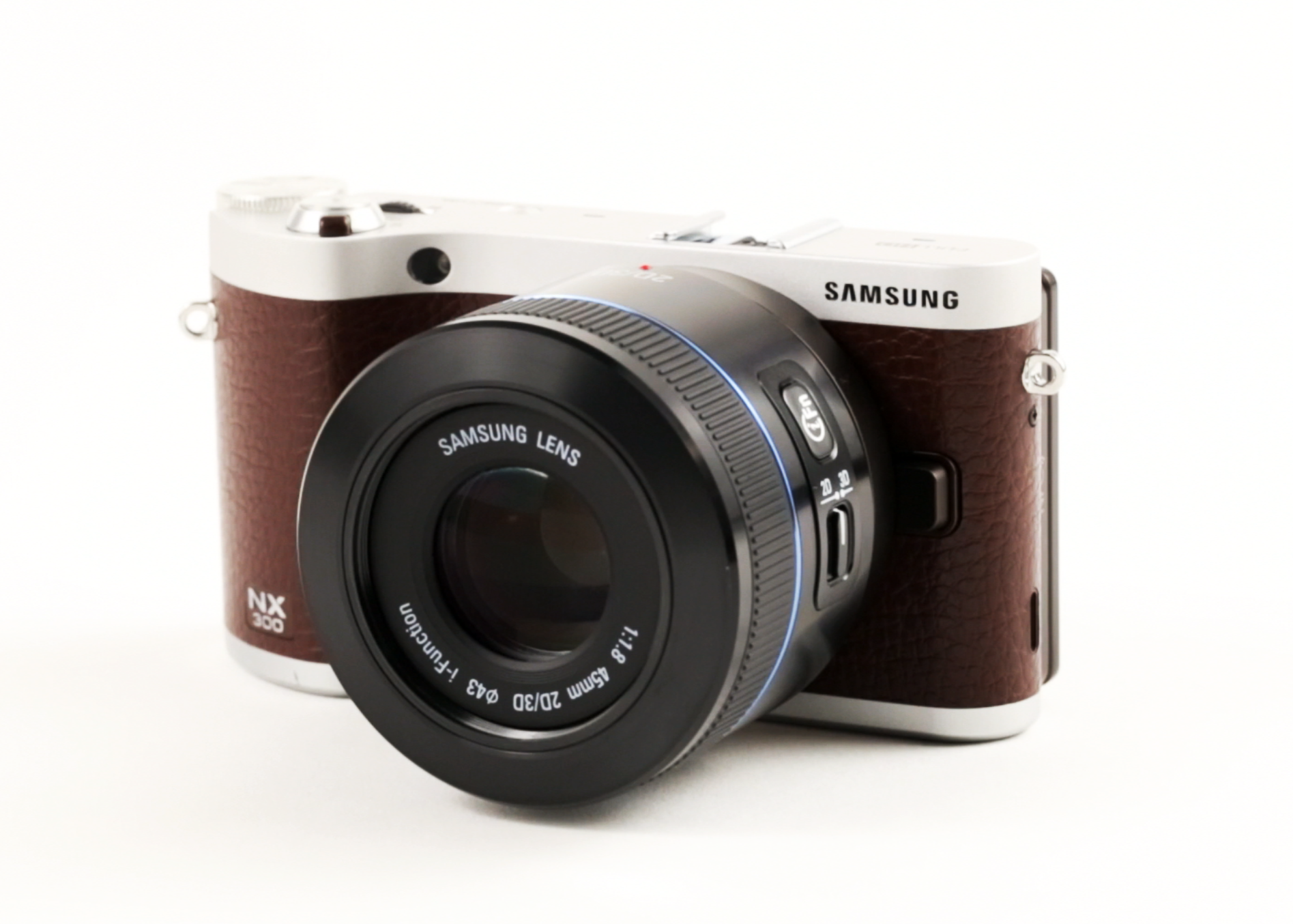
To answer your first question: Yes, Samsung makes legitimate cameras. It might be fairly difficult to convince the easily dismissive readers otherwise, but let's humor the notion anyway. Recently the Big S announced an interesting 3G/4G Android-based interchangeable lens camera. While that looks somewhat intriguing, I'm currently testing out the NX300. This mirrorless camera came out earlier in the year and happens to have many similar features including touch screen, WiFi, 3D capture and other quirks some traditionalists might even tinker with. So much to offer and never, never enough time.
As the wise Jessie Spano once said: "There's not enough time...there's never enough time."
Specification:
The Samsung NX300 is a mirrorless rangefinder-style camera built around a 20.3MP APS-C CMOS Sensor. It uses a Hybrid focusing system which utilizes both a contrast detect sensor and phase detect system. Other features include a tilting 3.3 inch AMOLED touch screen, 8.6 FPS for continuous shooting, top shutter speed of 1/6000th of a second, ISO range of 100-25600, 1080p (60p/30p) HD video recording and your expected wireless connectivity which connects easily to your smart phone.

The Look
The NX300 is certainly well put together... While trying out the camera it got a few compliments and even a "That must be expensive" observation. This is most likely thanks to the brushed metal and brown leatherette exterior of the tester I was trying out. Aesthetically, not much has changed from the previous x210/200 in terms of it's geometric shape. It's not quite a spaceship like the Hasselblad Lunar, but it has a retro-looking forward aesthetic. Overall there's a sense of finesse in its styling that challenges the typical skinny rectangle design of compact cameras.
The Feel
To gauge its size, one could place the NX300 somewhere between a typical micro four thirds camera and a larger compact APS-C. It's not so small that it feels like a toy, yet considerably lighter than your average DSLR with lens. It has an agreeably solid build, almost as if the body is sculpted from one solid form giving a sense of durability. The grip is pretty wide and should fit those with even gorilla hands. Although comfort is often subjective, there's nothing that stands out saying that this has a bad ergonomic design. If anything maybe it's the neck strap clips, which always seem to be located in the worst spots for my natural grip. Overall the material and build give you your money's worth.
Lets take a look at the Layout: The top panel has a shutter with on/off switch around it and mode dial which sits embedded to the top right...Perhaps not the best spot since it would accidentally change settings a little too easily when packed away, leading to the question "Why am I on WiFi mode?" For exposure control, scrolling through settings and preview zooming there's only one wheel...This is kind of a let down considering the previous version had an additional dial on the back. Although more experienced photographers might lament having only one small wheel, the average NX300 user might not feel it necessary for a full pro setup when it's all about ease of use and sharing. Speaking of spreading the love, the last button on the top is the new Direct Link button which starts the auto share function...This is when the camera starts to feel more like a gadget than anything else. You get a popup that tells you to download an app and it allows the camera to share images with a smartphone or directly to one of many social outlets. Have a Samsung phone? With just a tap to the side of the camera you can use the NFC feature, allowing you to share it instantly. A nice poker trick at first, but it could be very useful if want to shoot "tethered" or if you don't have a computer handy.
My main gripe with the NX300 is that it doesn't have a viewfinder and lacks support for an optional EVF...This might be a deal breaker for those who are accustomed to composing with their eye to the camera. However, if you're a live view shooter you'll be more happy with its large 3.3 inch AMOLED screen which angles upwards at 90 degrees, and downward 45 degrees. This offers a little more mobility when trying to frame up shots or when attempting to defend yourself from glare. The screen itself is a nice size, bright and easy to see outdoors. Pushing it into "smart" territory is its touch sensitivity. By tapping the screen anywhere can set it to focus on a certain point, set an AF point, initiate tracking or just mash the screen to take a picture. In your display you can access the menu, fn quick menu or turn on auto share. It's not as practical to try and navigate the traditional menu because you'll be hitting all the wrong things, but for the quick menu the interface is a little more friendly with scrolling "dials", making up for having one physical wheel. Of course, if you hate all of this you can always turn off the touch screen altogether and pretend that it doesn't exist.
Lastly we have the back buttons: most notable at the top is a small red dot next to the thumb grip which activates video capture. Simple as that. Under the thumb grip is exposure comp/alternate action for the dial, menu, and fn menu. Directional buttons offer your standard fare of display, burst, AF mode and ISO, playback and delete. Nothing too fancy, seems relatively straight to the point.

Of Cotton (Operation)
The camera turns on in less than a second and controls, including touch screen, are very responsive. Shutter lag is virtually non-existent until you decide to see what the buffer is like for burst shooting. The only snag I encountered was while turning the mode dial. It's automatically set to give you a brief description of what each mode does and takes a few seconds before it'll let you shoot. Sure this is great if you're one who is naturally inquisitive, but I'm sure even a beginner would get annoyed if it did this all the time. Thankfully you can turn this feature off.
The AF on this thing was surprisingly disappointing at first. Normally this would set me off on a rampage. No one likes a slow, unresponsive AF, especially on a system that excludes a viewfinder. Just ask the EOS-M before it got fixed. For all the talk of an advanced on-chip hybrid AF system, I was really getting a headache. It was fast, but there was also a lot of jolting even during optimal lighting. To my delight (and disbelief of sorts) Samsung put out a firmware update to remedy this, while adding some new touch features (part of the reason why I took my time with this review). Often you'll buy a new product, find an issue that people are going crazy about on the internet... a year passes and users become frustrated with a problem until they just accept it as an unfortunate feature. Instead Samsung observed the problem and addressed it. Although it would have been nice if they ironed out the wrinkles before they put it out, how is that for service? Well, the AF works much better than it did. It's just as fast, but now accurate without all the searching.
New to the Samsung NX series is an updated 45mm lens. Not only does it offer additional control via the "i" button on the barrel, it offers single lens 3D shooting; Samsung's first venture into this territory. Single lens you say? Heresy! Put down your pitchfork dude. The way they did it is equal parts impressive and dark magic...By switching the lens from 2D to 3D, two magical twin liquid crystal lenses come out like automatic doors at a grocery store, spliting the lens into two halves. When you take a picture it blacks out one side of the lens at a time creating a "3D" composite. The two pseudo-lenses in the front of the shutter does slow things down quite a bit to f/6...Come to think of it you can't really change exposure settings. Even after taking it off "3D Auto" you can only change white balance, picture wizard and exposure comp. Switching it on and off is impressive engineering, but I'm uncertain if the world is on the same boat as Samsung who believes 3D will become a staple for the modern home. Practical? No, but if you want to impress your friends with 3D vacation images and video, this might be it.
For those who entertain the idea of a pop-up flash, you'll notice that there isn't one on board. It does come bundled with a small external flash that fits on the hotshoe. Although it tends to blow out things even when dialed down, it's nice to have the option. Lastly: Battery life was OK, not great considering you're chained to live-view and a big bright screen. To charge the battery, you use the mini-usb on the side of the camera; the same cable you would charge a smartphone. Some might find this annoying if they're used to charging a battery separately, but I found it convenient. Now it's a game of who needs juice the most. Your phone or camera?

IQ Test
I was very impressed with the image quality out of the box. At first it's surprising to see such fine detail and then you remember that there's an APS-C sized sensor in an otherwise micro 4/3 body. Resolution holds strong while there is a sense that images are getting a little noise suppression at default. If this concerns you, be mindful to dial it down or turn it off for high ISOs. Color reproduction is good, Low light more than decent. At higher ISOs you'll get some leverage up to 3200. Delving into the files I didn't see an overwhelming amount of noise in the shadows. At 6400 you'll start seeing it in the midtones, but images are still usable. 12800 starts to get weird color shifts and then 25600 is just a mash of inaccurate colors and noise. Shooting RAW will give you a little more leeway as expected...highlight recovery . At base ISO, highlights aren't forgotten, shadows much more forgiving. Overall it's pretty strong in low light with the exception of color shifts.
Video on the NX300 was very good at it's higher resolutions. I tested out 24fps and 60fps, both were sharp with great colors. There's no in-body stabilization so you'll see lots of shaking unless you have a lens with vibration reduction. Sound quality out of its in-body mic isn't spectacular even with "wind suppression" on. The lack of an mic input is kind of a downer, but at least there's an option with the EM-10 external microphone.
Lastly there's all sorts of image "smart" modes that will help you get quirky images: Beauty Face (which kind of sounds like butter face) smooths out skin when it recognizes a face, Best Face takes a quick burst and allows you to choose the...best face out of the bunch. Other modes are landscape, macro, action freeze, rich tones, panorama, waterfall, silhouette, sunset, night, fireworks, light trance and creative shot for when you have no idea. Aside from that they have another picture wizard which is basically like setting up Lightroom presets before you even take the picture. All of this is extremely customizable to which, if you're looking to do as much in camera without fussing on your computer, is always a good thing.
Click here for some test shots:
Bottom Line
Samsung has an undoubtedly heavy-handed approach in storming the electronics market at every angle imaginable. This is either admirable or somewhat obnoxious depending on what kind of consumer you are...Perhaps those looking at cameras doubt Samsung because they're not X or Y and this one, like many others, just flew under the radar.
The NX300 has a lot to offer. Almost too much, but this is very much in the realm of what they do and who they're trying to cater to. Someone who wants a bit of everything and is on the leading edge of what's hot. Sure, there were certain things about the experience that might be more conventional as a gadget than a camera, but overall design and image quality left me impressed. What they do right is provide a solid camera that performs well, operates swiftly, and takes great images...then there's everything else they offer which is WiFi, tilting touch screen, 3D and a great amount of customization. Although its lack of optional viewfinder was disappointing, I found it to be a powerful system in a small, sleek design especially suited for enthusiasts or street photographers.
So what is the next logical step beyond the NX300? The Galaxy NX certainly has ears perked, but they might have to differentiate themselves from creating cameras with the "We added ___ because we could" mentality...Maybe what the consumer is really ready for is a full-fledged DSLR with the same connectivity...Just a thought Samsung ;)
Thanks for reading and stay tuned for more reviews!