The Nikon NIKKOR Z 120-300mm f/2.8 TC VR S Lens adds a built-in converter. Compare its reach and price with Nikon F and Canon RF zooms.
Three mounts, two native zoom ranges
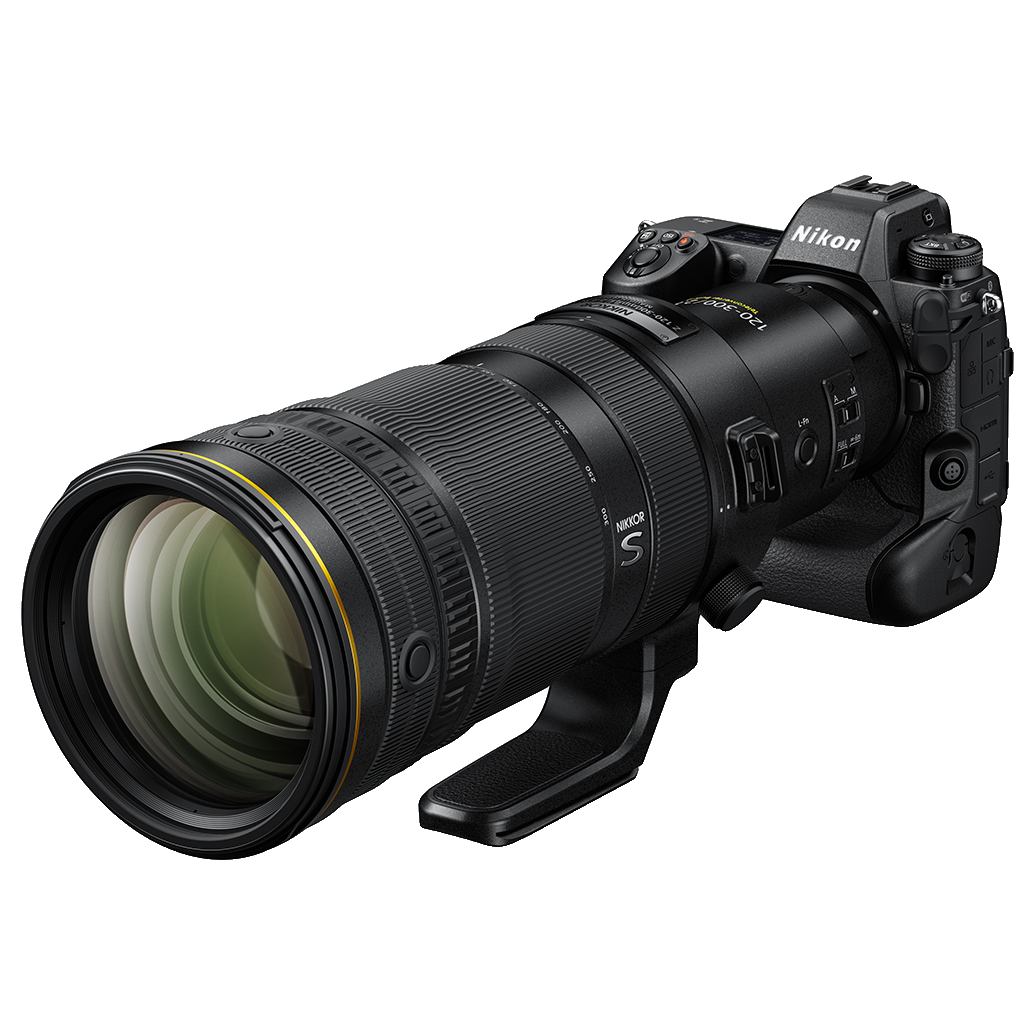
The Nikon NIKKOR Z 120-300mm f/2.8 TC VR S Lens (Z Mount) combines a constant f/2.8 aperture with an integrated 1.4x teleconverter. The Nikon AF-S NIKKOR 120-300mm f/2.8E FL ED SR VR Lens covers the same native focal range for Nikon F mount. The Canon RF 100-300mm f/2.8 L IS USM Lens starts wider, at 100mm, and uses Canon RF mount.
Start with the camera mount. These are not three interchangeable purchases for the same mount. For someone keeping an existing camera system, that distinction comes before the differences in reach or controls.
| Specification | Nikon Z 120–300mm | Nikon AF-S 120–300mm | Canon RF 100–300mm |
|---|---|---|---|
| Mount | Nikon Z | Nikon F | Canon RF |
| Native focal range | 120–300mm | 120–300mm | 100–300mm |
| Maximum aperture, native range | Constant f/2.8 | Constant f/2.8 | Constant f/2.8 |
| Minimum aperture | f/22 | f/22 | f/22 |
| Minimum focus distance | 3.2 ft wide to 6.6 ft tele | 6.56 ft | 5.9 ft |
| Front filter size | 112mm | 112mm | 112mm |
| Focusing | Autofocus | Autofocus | Autofocus |
| Optical stabilization | Yes | Yes | Yes |
The Z lens reaches 420mm; the Canon starts at 100mm
The Z lens's built-in converter changes its operating range from 120–300mm f/2.8 to 168–420mm f/4 with a lever. That is its clearest buying distinction: longer framing without attaching a separate converter. For wildlife moving farther away, or action across a field, the 420mm setting can matter more than the shared 300mm native endpoint.
The trade-off is one stop of maximum aperture. Shooting wide open at the same shutter speed in the same light requires a higher ISO at f/4 than at f/2.8. The converter adds reach, but it does not retain the lens's f/2.8 maximum aperture.
Canon offers flexibility in the other direction. Its 100mm starting point fits more of a nearby subject into the frame than 120mm from the same position on the same sensor format. That matters beside a court or at an event where stepping backward is not an option. Both Nikon lenses start at 120mm before any conversion.
Stabilization ratings do not replace shutter speed
Nikon rates the Z lens at up to 6.5 stops of optical stabilization via Synchro VR. The F-mount lens also has Vibration Reduction. Canon rates its optical IS at up to 5.5 stops, increasing to up to 6 stops of coordinated IS when paired with an EOS R-series camera featuring in-body stabilization.
The pairing condition matters for Canon's higher figure. Its coordinated rating should not be treated as the lens-only rating. Likewise, the Nikon Z figure is specifically a Synchro VR rating.
Stabilization reduces the effect of camera shake; it does not freeze a moving player or bird. For action in low light, shutter speed remains a separate requirement. That is why the Z lens's change to f/4 with its converter engaged deserves attention alongside its stabilization figure.
Close focus, carrying weight and tripod support
The Z lens focuses from 98 cm at the wide end to 2 m at the telephoto end, measured from the camera sensor. Nikon lists 2 m for the F-mount lens, while Canon lists 5.9 ft. The Z lens's short minimum distance is therefore a wide-end benefit, not a distance available throughout its zoom range.
Nikon lists maximum magnification of 0.18–0.25x for the Z lens, compared with 0.16x for the F-mount lens. The higher magnification can help fill the frame with smaller subjects at close range.
The Z lens weighs 2,735 g against the F lens's 3,250 g, but it is longer: 353.5 mm versus 303.5 mm. Both measure 128 mm in diameter. Less weight does not mean a shorter space in the bag.
Support hardware differs too. The Z lens has a removable, rotating collar and an integrated Arca-type compatible tripod foot. The F lens has a fixed, rotating collar. Collar removal and the foot interface are practical distinctions for packing and support setup.
Autofocus motors, controls and filters
Nikon uses a Silky Swift Voice Coil Motor in the Z lens and a Silent Wave Motor in the F lens. Canon specifies two Nano USM motors. Those motor descriptions do not, by themselves, establish which lens will track a particular subject more accurately.
The Z lens provides a programmable Fn Ring alongside a Click Control Ring. The F lens has assignable function buttons. Canon supplies a programmable control ring with click-stop operation and a function/focus preset selector. The distinction is how settings are accessed at the lens: ring-based controls on the Z lens, compared with assignable buttons on the F model.
All three accept 112mm front filters. The Z lens additionally offers a 46mm drop-in slot. That gives it a filter-handling option away from the large front threads, which may affect the filter accessories included in a purchase.
Who should choose each lens
Choose the Nikon Z lens for its integrated reach on Nikon Z. At $13,996.95, it is available to preorder. Its strongest case is a need to switch between 120–300mm f/2.8 and 168–420mm f/4 without attaching a separate converter. The lower weight relative to the F lens and the Arca-type compatible foot also matter for carrying and support.
Choose the Nikon AF-S lens for an F-mount purchase. It is available to order for $6,646.95, reduced from $9,496.95. It retains the native 120–300mm range and constant f/2.8 aperture. For a photographer buying for Nikon F mount, those shared exposure and framing specifications come at substantially less cost than the Z lens.
Choose the Canon for Canon RF and the wider 100mm starting point. It is in stock at $10,599. Its case is strongest where closer action makes 120mm too tight, while 300mm f/2.8 remains the desired long-end setting. Budgeting for a different camera mount simply to obtain another lens's features is a separate system decision.
Prices at Unique Photo
- Nikon NIKKOR Z 120-300mm f/2.8 TC VR S Lens (Z Mount): $13,996.95 (preorder)
- Nikon AF-S NIKKOR 120-300mm f/2.8E FL ED SR VR Lens: $6,646.95
- Canon RF 100-300mm f/2.8 L IS USM Lens: $10,599.00
Prices as of November 1, 2026. Browse more: Mirrorless Lenses, Nikon at Unique Photo.
Related reading: Nikon NIKKOR Z 120-300mm f/2.8 TC VR S Lens Announced.
Frequently asked questions
Does the Nikon NIKKOR Z 120-300mm have a built-in teleconverter?
Yes. Its integrated 1.4x teleconverter changes the range from 120–300mm f/2.8 to 168–420mm f/4.
How much does the Nikon NIKKOR Z 120-300mm f/2.8 TC VR S cost?
It costs $13,996.95 and is available to preorder.
What mount does the Nikon AF-S 120-300mm f/2.8E use?
It uses Nikon F mount and is designed for FX-format cameras. Nikon also lists DX-format compatibility with a 180–450mm equivalent focal-length range.
How much stabilization does the Canon RF 100-300mm offer?
Canon rates optical stabilization at up to 5.5 stops. Coordinated IS reaches up to 6 stops with an EOS R-series camera featuring in-body stabilization.