Compare the DJI RS 5 Gimbal and other in-stock DJI gimbals by price and payload, with buying advice for camera and phone video.
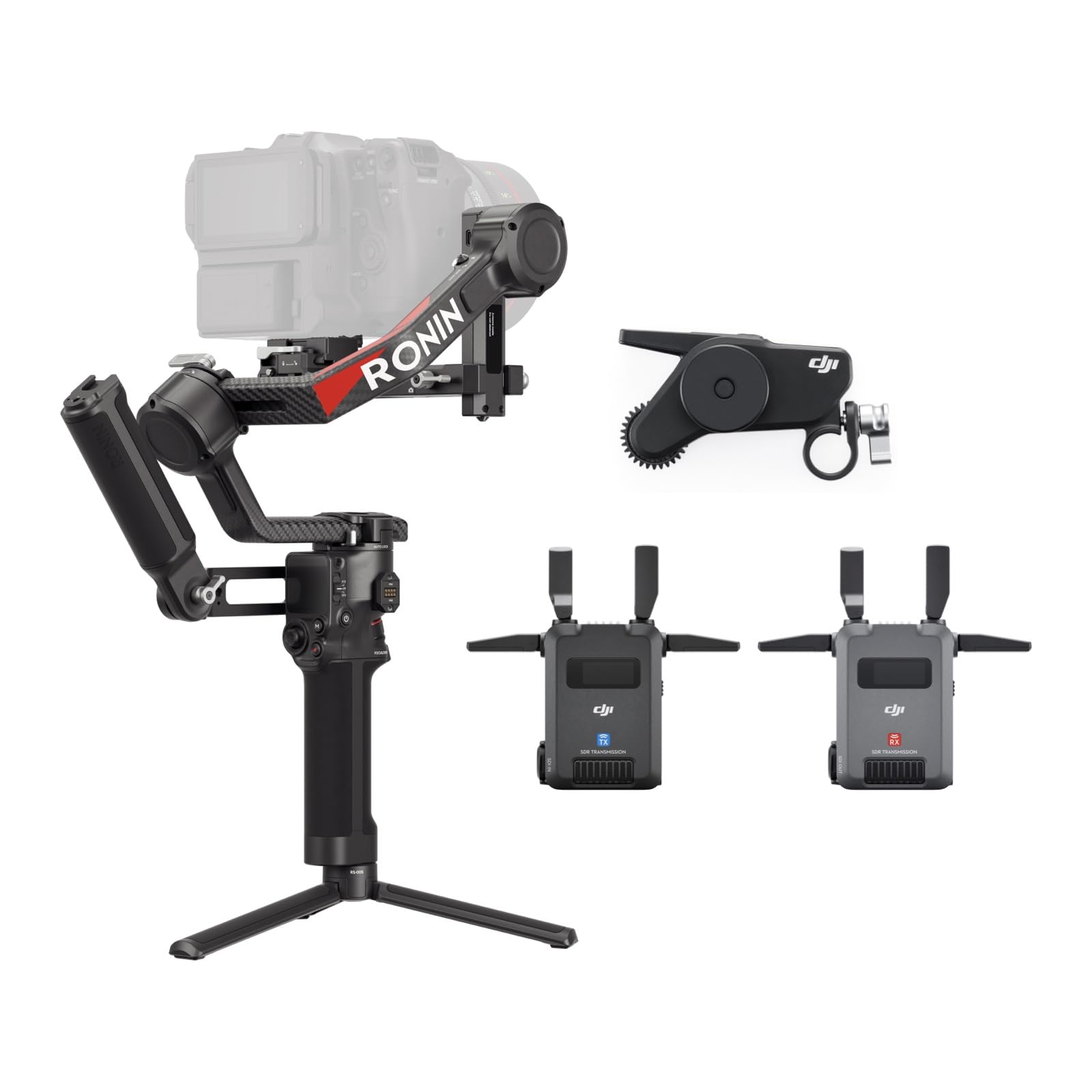
RS 5 Gimbal and Combo: tracking and one-hour charging
The DJI RS 5 Gimbal is $569, and the DJI RS 5 Combo is $719. DJI rates the RS 5 for a 3 kg (6.6 lb) payload and approximately one-hour charging. Start here for a camera setup within that weight limit when shorter charging stops and subject tracking matter.
DJI lists the gimbal at approximately 1,193 g, including the upper and lower quick-release plates and screws. With the battery grip and quick-release plates, the stated weight is 1.46 kg. That is separate from the camera load: a 3 kg payload rating does not mean the complete setup weighs 3 kg in hand.
The RS Enhanced Intelligent Tracking Module lets the operator select and position a subject using the gimbal touchscreen. For people, DJI lists tracking at distances up to 10 meters, with the ability to reacquire someone who temporarily leaves the frame. This is useful for a solo operator who needs help maintaining a subject's position in the composition.
Fine-tuning knobs and Teflon-enhanced balancing address setup adjustments. Second-generation automated axis locks handle locking, and the RS 5 switches to vertical shooting without extra accessories. DJI also lists a briefcase handle with gimbal and camera control. These are operational reasons to consider the RS 5, rather than treating payload capacity as the only meaningful difference between models.
RS 4: a 3 kg payload for $469
The DJI RS 4 Gimbal Stabilizer costs $469 and carries the same rated 3 kg (6.6 lb) payload as the RS 5. For a camera rig within that limit, it is the lower-priced choice if approximately one-hour charging is not a priority. DJI lists its weight at 1,066 g.
Second-generation native vertical shooting uses a horizontal plate that can be released and secured in the vertical position. No additional accessories are needed for that change. It suits work that alternates between horizontal footage and vertical delivery without making an extra mounting accessory part of the process.
The joystick mode switch changes between zoom and gimbal control. Teflon-coated axis arms assist balancing adjustments, while second-generation automated axis locks help with starting work or entering sleep mode. An RSA communication port provides a connection to DJI's control accessory ecosystem.
The RS 4 has a 3,000 mAh battery and USB-C charging, with an approximately 2.5-hour charging time. Compared with the RS 5's approximately one-hour figure, it needs more time at the charger. That is a concrete trade-off to weigh against the RS 4's lower purchase price.
RS 4 Mini Combo: smaller camera rigs and phone use
The DJI RS 4 Mini Combo is $369. DJI specifies a payload range of 0.4–2 kg (0.88–4.4 lb), so it belongs on the shortlist for smaller camera setups. Pay attention to both ends of that range, not just the maximum. DJI also lists support for smartphones, making this an option for someone working with both recording devices.
The gimbal weighs approximately 890 g with its quick-release plate, excluding the tripod. DJI separately lists the extended grip/tripod at approximately 140 g. Those inclusions matter when comparing carrying weight: the 890 g figure is not the weight of the gimbal with its tripod attached, and neither figure includes a camera.
Second-generation automated axis locks release when the gimbal powers on and lock when it powers off or enters sleep. The axis arms fold flatter for storage. For work with repeated setup and packing, those features address the small mechanical steps that otherwise get repeated at every location.
The Mini also has third-generation native vertical shooting and Responsive Follow Mode, plus Teflon-enhanced balancing. Its pogo-pin connection is compatible with the DJI RS Intelligent Tracking Module. DJI lists a 3,100 mAh battery and a charging time of one hour and 50 minutes. Choose it for a suitable lighter rig, not as a substitute for a 3 kg-rated model.
Osmo Mobile 8: the $149 phone-video option
The DJI Osmo Mobile 8 is $149. This is the direct choice for phone-video work rather than a camera rig. DJI lists an approximately 370 g weight including the gimbal, built-in tripod, magnetic phone clamp and Multifunctional Module.
It provides three-axis stabilization with unlimited 360-degree pan rotation. Unlimited pan means the gimbal can keep turning horizontally rather than reaching the end of a fixed pan range. That does not describe every axis: DJI specifies a controllable tilt range of -20 degrees to 40 degrees.
The Multifunctional Module combines human and pet tracking with lighting and audio capture. Direct phone connection supports native tracking. For someone recording themselves or following a pet, tracking is a more relevant buying consideration than the kilogram payload ratings used to compare the camera gimbals.
A built-in extension rod gives more framing reach, and the built-in tripod provides a way to set the gimbal down for stationary recording. DJI also identifies the grip as designed for low-angle shots. Folded dimensions are 190 × 95 × 46 mm, a useful measurement when deciding where it will fit in a bag.
DJI lists 10-hour battery life and phone charging, with a 3,350 mAh battery. Charging takes approximately 2.5 hours when measured with a 10W USB-C charger. Keep that charger condition attached to the charging-time figure when planning a charging break.
RS 4 Pro Combo (2026): the $1,399 option
The DJI RS 4 Pro Combo (2026) is $1,399, the highest price in this lineup. If an equipment list calls for this exact Combo, this is the model to select. For someone still deciding, the Pro name alone should not settle the purchase; the camera rig and required controls are better starting points.
How to choose by recording device and payload
For a camera setup, count the lens and anything else the gimbal must carry, not just the camera body. Payload is a weight limit, not a guarantee that every camera-and-lens combination will balance.
- Phone video: Start with Osmo Mobile 8 at $149 for native tracking, a built-in extension rod and tripod.
- A camera rig between 0.4 and 2 kg: Consider RS 4 Mini Combo at $369, especially if smartphone support also matters.
- Up to 3 kg at a lower price: RS 4 is $469, with vertical switching that requires no additional accessories.
- Up to 3 kg with shorter charging stops: Consider RS 5 Gimbal at $569 or RS 5 Combo at $719. DJI lists approximately one-hour charging and enhanced intelligent tracking for the RS 5.
All seven options are in stock at Unique Photo.
Prices at Unique Photo
- DJI RS 4 Pro Combo (2026): $1,399.00
- DJI RS 5 Combo: $719.00
- DJI RS 5 Gimbal: $569.00
- DJI RS 4 Gimbal Stabilizer: $469.00
- DJI RS 4 Mini Combo: $369.00
- DJI Osmo Mobile 8: $149.00
Prices as of October 31, 2026. Browse more: DJI Ronin/Osmo, DJI at Unique Photo.
Frequently asked questions
Which DJI gimbals have a 3 kg payload capacity?
DJI rates the RS 5 Gimbal, RS 5 Combo and RS 4 Gimbal Stabilizer for loads up to 3 kg (6.6 lb). The RS 4 Mini Combo has a specified payload range of 0.4–2 kg.
Can the DJI RS 4 Mini Combo support a smartphone?
Yes. DJI lists the RS 4 Mini Combo as supporting cameras and smartphones.
Does the DJI Osmo Mobile 8 charge a phone?
Yes, DJI lists phone charging among its features. It also lists a 3,350 mAh battery and 10-hour battery life.
Which DJI gimbals switch to vertical shooting without extra accessories?
The RS 5 and RS 4 support vertical shooting without additional accessories. On the RS 4, the horizontal plate is released and secured in the vertical position.