Nikon NIKKOR Z 120-300mm f/2.8 TC VR S Lens is available to preorder for $13,996.95, with a built-in 1.4x teleconverter extending reach to 420mm.
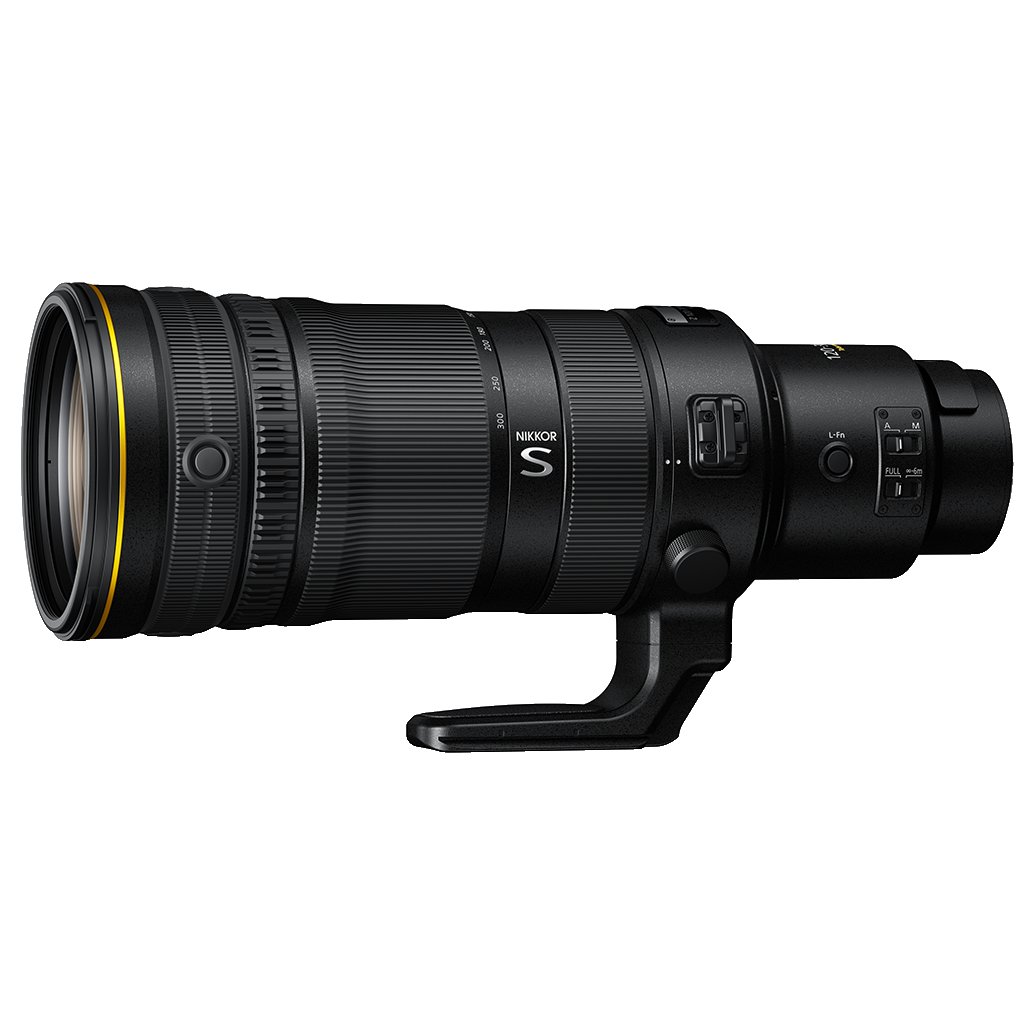
An f/2.8 zoom for sports and wildlife
The Nikon NIKKOR Z 120-300mm f/2.8 TC VR S Lens (Z Mount) is a new full-frame telephoto zoom aimed at sports and wildlife photographers. It combines a constant f/2.8 maximum aperture with an integrated 1.4x teleconverter, giving it two working ranges without attaching an external converter.
The practical appeal is framing flexibility when moving closer is not an option. A player approaching the sideline may need a wider view; a distant animal may need more reach. The zoom handles changes within its focal-length range, while the converter shifts that entire range longer. This is a lens built around changing subject distance rather than one fixed composition.
Constant f/2.8 from 120mm to 300mm
With the teleconverter disengaged, the lens covers 120–300mm with a constant f/2.8 maximum aperture. Zooming to 300mm does not reduce that maximum aperture. An exposure set at f/2.8 can stay there as framing gets tighter, so zooming alone does not force a change in shutter speed or ISO.
For action in limited light, f/2.8 gives more room to maintain a short shutter speed before raising ISO. It also allows shallow depth of field, which can help separate a subject from a distracting background. The actual amount of background blur still depends on focal length and the distances between camera, subject and background. The aperture is useful, but it does not make those distances irrelevant.
Built-in 1.4x teleconverter: 168–420mm at f/4
A built-in lever engages the 1.4x teleconverter, changing the lens to a 168–420mm f/4 configuration. That adds reach at both ends of the zoom range. It also means the widest available view becomes 168mm rather than 120mm, a meaningful tradeoff if the subject suddenly comes closer.
| Teleconverter setting | Focal-length range | Maximum aperture |
|---|---|---|
| Disengaged | 120–300mm | f/2.8 |
| Engaged | 168–420mm | f/4 |
The move from f/2.8 to f/4 costs one stop of light. At maximum aperture, maintaining the same shutter speed and exposure requires doubling ISO, assuming the light stays unchanged. Nikon describes the converter as matched to the lens’s internal optics. Because it is integrated, changing ranges does not require removing the lens from the camera or adding an external component between them.
VCM autofocus and up to 6.5 stops of VR
Nikon specifies a Silky Swift Voice Coil Motor (VCM) for high-speed autofocus. Its job is to move focus quickly, which matters when subject distance changes during a sequence. A subject running toward the camera presents a different focusing demand from one staying at roughly the same distance across the frame.
Nikon also rates optical stabilization at up to 6.5 stops via Synchro VR. Stabilization addresses camera shake, helping reduce blur caused by movement of the camera and lens during an exposure. It does not freeze a running athlete or a bird’s wings.
That distinction matters here. A stationary subject may allow a slower shutter speed with stabilization; moving subjects still need a shutter speed suited to their motion. The VR rating is not a reason to lower shutter speed indiscriminately during action.
S-Line optics and anti-reflection coatings
The optical design includes aspherical, SR, ED and Super ED elements. These specialized elements address aberrations that can reduce detail or introduce color fringing. Their purpose is image correction, separate from the autofocus motor’s job of placing the plane of focus.
Nikon lists Meso Amorphous and ARNEO anti-reflection coatings to suppress flare and ghosting. Those are relevant with strong light sources in or near the frame, such as backlit subjects or stadium lighting. Coatings address unwanted reflections within the optical system; they are not the same thing as stabilization or focus accuracy. Each part of the design tackles a different potential source of image degradation.
Two control rings, two filter options
The lens has a dual-control arrangement: a programmable Fn Ring and a Click Control Ring. The programmable ring provides an assignable control on the lens itself. For a photographer working with a long lens, the practical point is access to a control where the supporting hand is already positioned, rather than moving every adjustment back to the camera body.
Filter support takes two forms: a 46mm drop-in slot and 112mm front filter threads. These are different fitting options, so filter size and mounting style both need attention. A 46mm drop-in setup uses the dedicated slot; a front-mounted filter needs to match the 112mm threads. The two sizes are not interchangeable.
An integrated Arca-type compatible tripod foot handles the support interface. The foot provides a mounting point on the lens rather than relying on the camera’s tripod socket. Arca-type compatibility is the specification to check against an existing tripod-head setup.
Z-mount price and preorder availability
The Nikon NIKKOR Z 120-300mm f/2.8 TC VR S Lens in Z mount is available to preorder from Unique Photo for $13,996.95.
Prices at Unique Photo
- Nikon NIKKOR Z 120-300mm f/2.8 TC VR S Lens (Z Mount): $13,996.95 (preorder)
Prices as of October 29, 2026. Browse more: Mirrorless Lenses, Nikon at Unique Photo.
Frequently asked questions
How much does the Nikon NIKKOR Z 120-300mm f/2.8 TC VR S Lens cost?
The Z-mount lens costs $13,996.95 and is available to preorder.
What range does the built-in teleconverter provide?
The integrated 1.4x teleconverter changes the lens from 120–300mm f/2.8 to 168–420mm f/4. It is engaged using a built-in lever.
How much stabilization does the Nikon Z 120-300mm offer?
Nikon rates optical stabilization at up to 6.5 stops via Synchro VR.
What filter sizes does the Nikon Z 120-300mm use?
The lens supports a 46mm drop-in filter slot and 112mm front filter threads.