Compare the Nikon NIKKOR Z 120-300mm f/2.8 TC VR S Lens with Nikon and Canon alternatives, from f/2.8 zooms to 600mm primes.
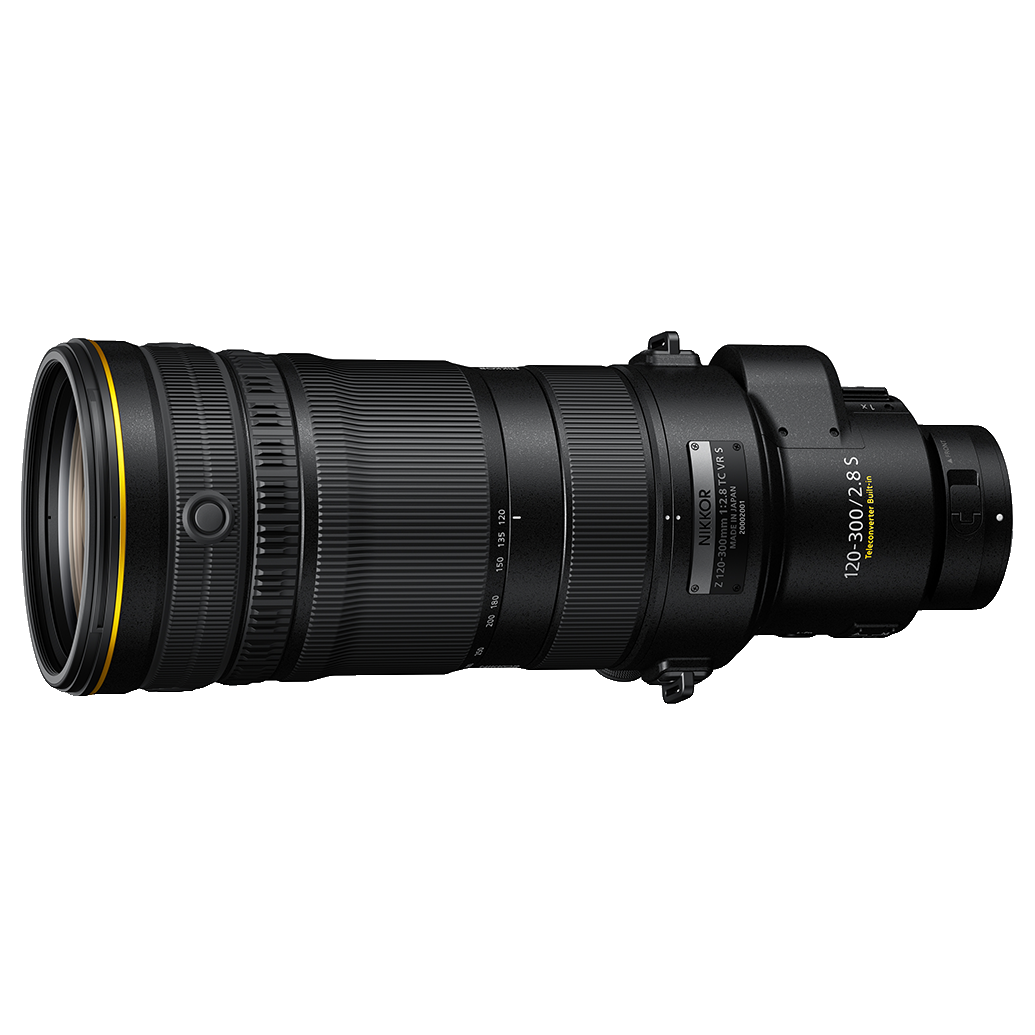
A Nikon Z zoom for changing subject distances
The Nikon NIKKOR Z 120-300mm f/2.8 TC VR S Lens (Z Mount) is available to preorder for $13,996.95. It makes the strongest case for Nikon Z photographers covering action that moves closer and farther away. The 120–300mm zoom lets framing change from a fixed shooting position, while the constant f/2.8 maximum aperture remains available throughout that range.
Its built-in 1.4x teleconverter changes the lens to 168–420mm f/4 with a lever. That is useful when the action moves farther downfield, but the aperture change matters: f/4 admits one stop less light than f/2.8. The converter adds reach without requiring an external converter to be attached.
Nikon specifies a Silky Swift Voice Coil Motor for high-speed autofocus and up to 6.5 stops of stabilization through Synchro VR. Stabilization addresses camera shake, not a runner’s movement. A shutter speed appropriate to the subject is still necessary.
At 6 lb (2735 g), this lens deserves a support plan. It has an integrated Arca-type compatible tripod foot and a removable, rotating collar. Filters can use either the 46mm drop-in slot or 112mm front threads. A programmable Fn Ring and Click Control Ring provide two lens-based controls.
Choose this over a prime when changing framing is the recurring problem. If most pictures need 400mm at f/2.8, rather than occasional access to 420mm at f/4, the Nikon 400mm below is the more direct fit.
A Canon RF zoom that starts at 100mm
The Canon RF 100-300mm f/2.8 L IS USM Lens costs $10,599 and is in stock. It is the zoom choice here for Canon RF photographers covering indoor sports or theater from a distance. Its constant f/2.8 maximum aperture supports the same basic priority as the Nikon zoom: keeping a wide aperture while adjusting framing.
The 100mm starting point gives a wider view than 120mm from the same position on the same sensor format. That matters when an athlete approaches the sideline or several performers need to fit in the frame. Both zooms reach 300mm at f/2.8.
Canon rates optical stabilization at up to 5.5 stops, rising to up to 6 stops of coordinated IS with an EOS R-series camera featuring IBIS. Minimum focus distance is 5.9 feet, and filter size is 112mm. A function/focus preset selector and programmable click-stop control ring add lens-based control. The RF mount makes this an alternative for Canon users, not a native-mount substitute on Nikon Z.
400mm at f/2.8, with Nikon’s built-in converter
The Nikon NIKKOR Z 400mm f/2.8 TC VR S Lens is $12,696.95 and in stock. Choose it when distant action regularly demands 400mm and light is limited. Its native 400mm f/2.8 setting keeps the wider aperture that the 120–300mm zoom gives up when its converter is engaged.
The built-in 1.4x teleconverter changes this prime to 560mm f/4. Those are two focal-length settings, not a zoom range. There is no way to turn a zoom ring back to 120mm when a subject suddenly fills the frame. That trade favors photographers whose working distance is fairly predictable.
Nikon rates VR at 5.5 stops. The lens weighs 2950 g, accepts 46mm filters and focuses as close as 2.5 m with or without the built-in converter. It costs less than the Nikon zoom at the listed prices, so this decision is not simply about paying more for reach. It is about choosing 400mm f/2.8 over continuous framing adjustment.
400mm at f/2.8 for Canon RF
The Canon RF 400mm F2.8 L IS USM Lens costs $13,399 and is in stock. For an EOS R-series photographer, it suits work where 300mm is regularly too short but an f/2.8 maximum aperture remains important. The price of that extra reach is losing the 100–300mm zoom’s framing adjustment.
Canon specifies up to 5.5 stops of optical shake correction with three IS operation modes. Weight is 6.37 lb, and minimum focus distance is 2.5 m. The dust- and water-resistant design includes a fluorine-coated front element for easier cleaning.
Two focus presets can recall memorized distances, which is useful when attention repeatedly switches between two known positions. The customizable electronic focus ring also permits manual focus during SERVO AF. Canon lists compatibility with 1.4x and 2x extenders for additional reach. Buy this for a recurring need for 400mm at f/2.8, rather than assuming a longer prime replaces every job done by a zoom.
600mm or 840mm on Nikon Z
The Nikon NIKKOR Z 600mm f/4 TC VR S Lens is $14,696.95 and in stock. It is the Nikon choice here when distance is the main obstacle, such as wildlife that cannot be approached or action viewed from a restricted position. Its native 600mm focal length already exceeds the zoom’s 420mm converted setting.
Engaging the built-in 1.4x teleconverter produces 840mm f/5.6, the longest listed focal-length setting among these lenses. The trade is a narrower view and one stop less light than at 600mm f/4. For subjects that move toward the camera, that narrower view can become a framing limitation rather than an advantage.
The lens weighs 7.2 lb and includes VR and a detachable, rotating tripod collar. Minimum focus distance is 4.3 m, with a 46mm filter size. That focusing distance deserves attention for nearby wildlife. Choose this prime because the subject needs 600mm or 840mm, not simply because it offers the largest focal-length number.
600mm at f/4 for Canon RF
The Canon RF 600mm F4 L IS USM Lens costs $14,499 and is in stock. It is the long-distance choice in this group for EOS R-series photographers. The 600mm focal length gives tighter framing than the Canon 400mm from the same position, while the f/4 maximum aperture admits one stop less light than f/2.8.
Canon rates optical stabilization at up to 5.5 stops and provides three IS operation modes. The lens weighs 6.8 lb and focuses as close as 4.2 m. Its dust- and water-resistant design includes a fluorine-coated front element.
A customizable electronic focus ring supports manual focus during SERVO AF, and two focus presets recall stored distances. Canon also lists compatibility with 1.4x and 2x extenders. This is a better fit than the 100–300mm zoom when distant subjects consistently occupy too little of the frame. For action that finishes close to the shooting position, the zoom leaves more room to adjust.
Choose by mount, then check the working distance
Start with the camera mount: the Nikon lenses listed use Nikon Z, and the Canon lenses use Canon RF. Within that system, check the focal lengths needed from the actual shooting position. Frequent framing changes argue for a zoom; consistently distant subjects argue for a longer prime.
Then consider the aperture at the focal length that matters. The Nikon zoom reaches 420mm at f/4, while both 400mm primes provide f/2.8 at 400mm. Stabilization does not replace that aperture advantage for moving subjects. Finally, check minimum focus distance and carrying weight against the assignment. Those limits remain relevant even when the budget covers every lens here.
Prices at Unique Photo
- Nikon NIKKOR Z 120-300mm f/2.8 TC VR S Lens (Z Mount): $13,996.95 (preorder)
- Canon RF 100-300mm f/2.8 L IS USM Lens: $10,599.00
- Nikon NIKKOR Z 600mm f/4 TC VR S Lens: $14,696.95
- Nikon NIKKOR Z 400mm f/2.8 TC VR S Lens: $12,696.95
- Canon RF 400mm F2.8 L IS USM Lens: $13,399.00
- Canon RF 600mm F4 L IS USM Lens: $14,499.00
Prices as of November 11, 2026. Browse more: Mirrorless Lenses, Nikon at Unique Photo.
Related reading: Nikon NIKKOR Z 120-300mm f/2.8 TC VR S Lens Announced.
Frequently asked questions
How much is the Nikon NIKKOR Z 120-300mm f/2.8 TC VR S Lens?
It costs $13,996.95 and is available to preorder.
Does the Nikon Z 120-300mm f/2.8 have a built-in teleconverter?
Yes. Its integrated 1.4x teleconverter changes the lens from 120–300mm f/2.8 to 168–420mm f/4.
What is the difference between the Nikon Z 120-300mm and 400mm f/2.8?
The 120–300mm is a constant-f/2.8 zoom with a built-in converter providing 168–420mm f/4. The 400mm is an f/2.8 prime whose built-in converter provides 560mm f/4.
Which Nikon lens in this guide has the longest reach?
The Nikon NIKKOR Z 600mm f/4 TC VR S reaches 840mm f/5.6 with its built-in 1.4x teleconverter engaged. Without the converter, it is a 600mm f/4 lens.