
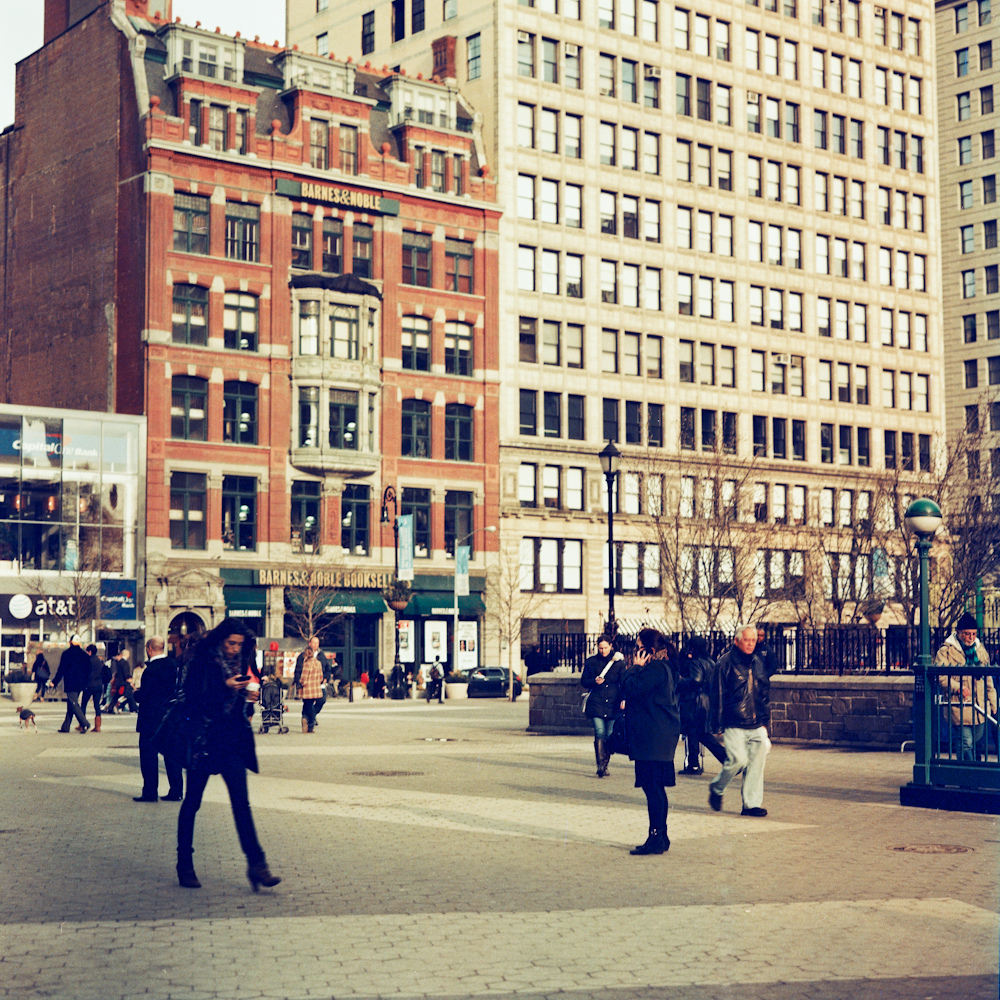
- Redscale film doesn't always have to leave you "seeing red"
In the past I have crowed about the benefits of shooting film and how digital has degraded the quality (certainly not the quantity) of photography over the years. However I haven't posted anything specific about different films beyond the Instax 200 film camera, which really doesn't count. So it's time to back up my fiery tirades with some posts on analog (film) photography. We recently started carrying Lomography products here at Unique Photo and one particular product caught my eye. No it wasn't a Dianna camera or strange fisheye lens, but rather a film called "Red Scale XR" Based on research I've done and a whole lot of common sense, I came to realize that the Lomography group isn't producing/coating their own film, but rather reusing old film. I'm ok with that because the whole Lomography concept or "lo-fi movement" is based on whacky, harsh, and slightly unpredictable results. So let's take a look at what exactly "Redscale" film is and how my experiment with it went.
Background Info
"Redscale" film is actually just film that is taken and rewound onto a reel (120) or cartridge (35mm) with the emulsion facing the opposite way. If you're a true psychopath (like me) still using large-format sheet film, all you need to do is load your film backwards! It is totally possible to do this yourself if you have the patience and a dark space to work in. While I have looked at the exact scientific explanation of how Redscale film works, here is a simple explanation in layman's terms: Light hitting the film passes through the non-emulsion side of the film first. The resulting images will have a strong red/orange tone since the light is passing through the orange/tinted film base prior to exposing the light sensitive emulsion. As expected, some overexposure is required to get optimal results.
Lomography markets two types of Redscale films, one is simply "Redscale" and I'm assuming depending on how you expose that film, you get a variety of red/orange tones. The second and the one I chose to test is called "Redscale XR" The XR stands for "Extended Range" The packaging explains that the film can be shot at a variety of ISOs ranging from 50-200. The higher the ISO setting, the more red/orange the resulting image will be. I grabbed Nick (my new blogging partner in crime) and we went on a small excursion in NYC. I figured Manhattan would be nice because of the variety of settings and colors there. Here are some sample images at ISO 50 and ISO 200. I know most people will be using this film in a Holga or Dianna camera, but to be a little bit more precise with metering, I shot with a Hasselblad 500 C/M and Nick used a Pentax 645 AF. (Redscale XR comes in both 120 and 35mm formats.) For the full gallery of our day's excursion, check out this gallery.
ISO 50
As you can see, shooting at ISO 50 produces results with a warm glow, but retains a lot of the normal colors. There is an overall vintage look that I actually really enjoy. I am sure you could replicate this with some kind of photoshop wizardry, but it takes the fun out of it.
- Photo by Mike Zawadzki
- Nick took this one of me staring into your soul through Redscale film.
ISO 200
The results at ISO 200 were more along the lines of what I thought Redscale film would produce. Strange highly orange/red photos. I enhanced the blacks in Adobe Lightroom (Shh don't tell any of the Lo-Fi purists!) because the scans were filled with entirely too much cyan noise in the shadows.
[caption id="" align="aligncenter" width="600" caption="In reality the text was bright blue and now it is white, so you can see how strongly oragne/red this film renders colors."]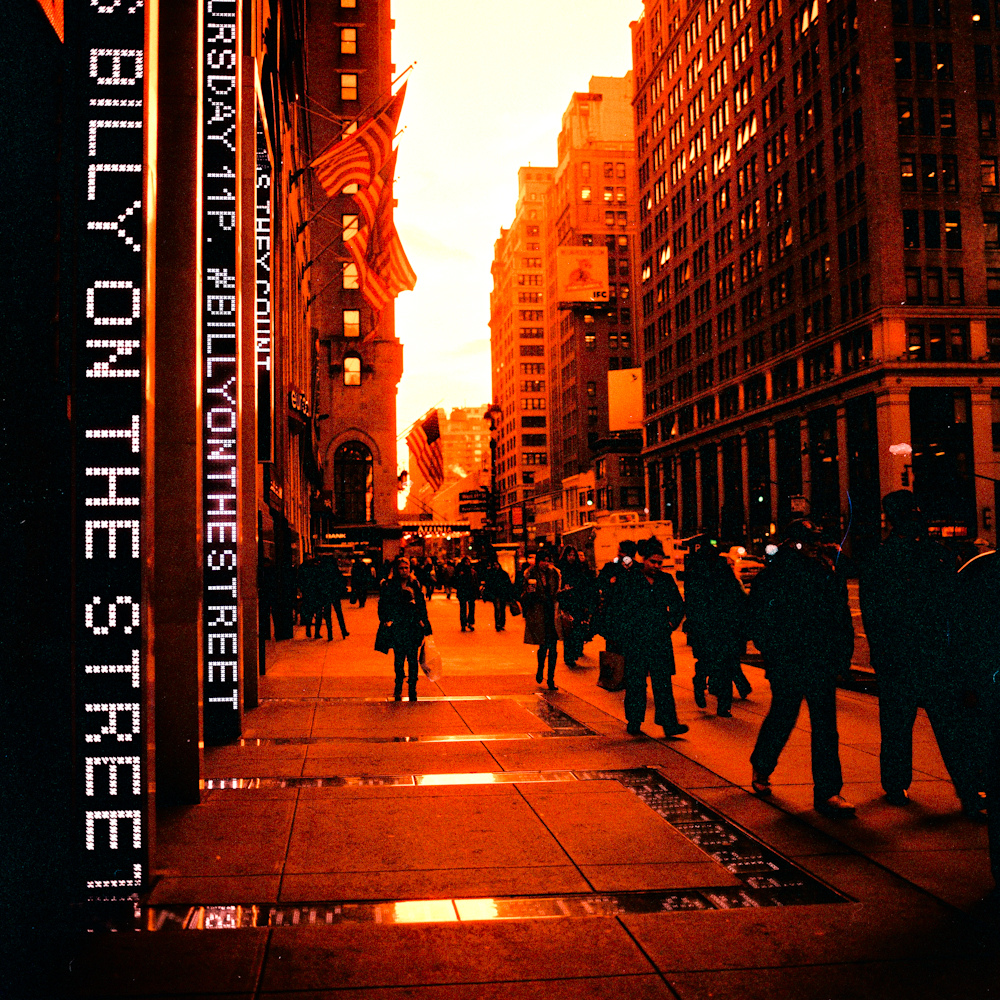 [/caption] [caption id="" align="aligncenter" width="600" caption="Nick took my favorite image of the day here. I think the redscale actually works quite nicely and creates a sinister look. "][/caption]
Tips
-I would actually recommend exposing at ISO 100. I found ISO 200 to produce results that were often too low in contrast and seriously way too warm. I know that is the point of the film, but I am not crazy about the look. -Try ISO 25 and see what happens. I am going to do this next and will post the results. I imagine the images will still have that vintage/warm look, but perhaps more accurate color. Or they may come out entirely too overexposed. -Try ISO 400 and PUSH processing. Ask your local lab (If you are in the NJ/NYC area come to Unique Photo! We process both 35mm and 120 film!) I'm sure the more you push this film, the more graphic looking (high saturation/high contrast) your results will be -When scanning your ISO 200 images, be sure to adjust levels to increase contrast, otherwise you will end up with a plethora of cyan/blue shadow noise/grain. -If using a Dianna or Holga camera, use the setting that will allow the most light in (Cloudy on a Dianna) to get results similar to those I achieved at ISO 50. The more exposure you give Redscale film, the more "normal" it is going to look. Of course if you prefer the moody red/orange feel, shoot your camera how you normally would. -Have fun. Seriously. -MZ