Lens Review: Bower 35mm f/1.4 AS UMC
[caption id="attachment_4757" align="alignright" width="300" caption="The $499 Challenger"] [/caption]
I have to be honest, I used to be kind of a purist when it came to photography. I never used filters on my lenses, I always used manual exposure/focusing, and I have shot a variety of analog cameras using film from 35mm to 8x10. For one reason or another, I have become more and more of a tech-nut. When Unique became a Leica dealer I was the first to learn everything about the line. Whenever a new lens comes in, I'm the first one that wants to get my hands on it and go play. So when we decided to bring Bower lenses into stock, I had the same reaction.
In this economic slump, we've all had to cut expenses and look for good deals on everything, from camera lenses to groceries. With groceries, many have gone from buying Coke or Pepsi to buying Sam's Club Cola, or from Rolled Gold Pretzels to America's Choice pretzels. In this time of cutting costs, many professional photographer don't believe that they can cut costs on lenses and cameras. Lenses are the photographer's most important tools of the trade, and pros have always considered price and quality to go hand in hand. Just like the old saying goes, "You get what you pay for." That being said, I was intrigued by the $499 price tag for a 35mm (full frame) f/1.4 lens. You just don't see that kind of price associated with that kind of lens! I do beileve most things like this are too good to be true, but let's take a look at how the Bower 35mm f/1.4 stands up against Canon, Nikon, and Zeiss counterparts.
The Line-up
So what about this Bower lens? Does it really deserve to be in the same post as the Canon, Nikon, and Zeiss? I say why not? Lens brand in my opinion doesn't matter as much as whether or not the lens gives me the results I want. This is why I have chosen to bypass the MTF charts, and the lens sharpness charts, and just use the lens in every day shooting.
Build/Construction
To start with, the build is not the best on the market, but it is definitively very high in quality. When you first look at the Bower 35mm f/1.4 , you realize that the form factor is unlike every other 35mm lens on the market.
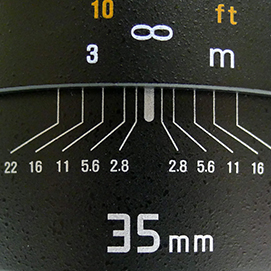
Unlike other modern 35mm lenses, the Bower has a clear and simple to understand depth of field scale as seen below:

- Not the best DOF scales, but a nice addition for those not used to manual focusing
The aperture ring is made of plastic but has a positive click for 1/2 stop increments (except between f/1.4 - f/2 & f/16 - f/22). This makes it incredibly easy for someone to make quick aperture adjustments without taking their eyes our of the viewfinder. While the Bower 35mm f/1.4 AS UMC is the largest of the four lenses tested, it has a better feel than the Canon and Nikon lenses for manual focusing, with exception to the Zeiss 35mm which has been widely picked up by the HDSLR video crowd because of the resistance of focusing ring. The Bower is a great cinema option for anyone working with any of the HDSLR cameras. You will be using MF for cinema anyway.
The focusing ring has a nice solid resistance that the Nikon and Canon seem to be lacking, but is slightly tighter than the Zeiss. The focus feels more like it is hydraulically dampened as opposed to the worm gear feel from the Nikon and the total lack of resistance of the Canon.
Image Test

- Lens Test Chart
As you can see from the image above, and this link: HI-Res image (**Be aware that this is a huge image file and may take time to render online), I tested the lenses at their full stop apertures. You may also notice that I skipped F/2 for the Canon, Nikon, and Bower. While I had mentioned above that the Bower 35mm f/1.4 AS UMC has half-stop clicks, they do not work between f/1.4-f/2.8, thus, no f/2 for the Bower. In keeping things even, I decided that the shots at F/2 from the Canon and Nikon were irrelevant because they couldn't be compared to the Bower, but both are sharp at f/2, which is one full stop from wide open at f/1.4. Remember, my test is more for the practical aspects of the Bower 35mm f/1.4 as UMC, and not the full-blown technical resolution lens tests that you would see on other sites.
All of the shots above were taken on a tripod, with a Stellar 18 inch ring light for constant even lighting and at ISO 100. The Zeiss, Canon, and Bower lenses were tested on the Canon 5D Mark II, while the Nikon was tested on the Nikon D3X. They were then processed in Adobe Photoshop CS5 and had all settings turned to neutral. White Balance was set using a Color Checker Passport.
Sharpness / Contrast / Vignetting / Color
Much to my surprise, the Bower lens, wide open (f/1.4), has a slight edge over the competition as far as sharpness is concerned, though I would say that it lacks in contrast wide open in comparison. When shot at F/5.6, all of the Canon mount lenses are almost indistinguishable from each other. The sharpness and contrast are close enough that for day-to-day shooting you would never tell the difference. This will be true with most lenses. Any modern lens stopped down to f/5.6 or f/8 is going to be sharp.
Vignetting wide open is just about the same in comparison to the Canon and Nikon lenses, though it clearly is better than the Canon. Both the Bower 35mm f/1.4 AS UMC and the Nikon 35mm f/1.4G are bright in the center with a decent amount of fall-off while the Canon 35mm f/1.4L USM is dark across the whole frame, while still falling off in the corners. Vignetting is barely visible around f/5.6.
As far as color goes, I would have to say that the Bower 35mm F/1.4 AS UMC has the most even color rendition from f/2.8 on, as can been seen in the color of the Coke bottle from shot to shot. Wide open, the Reds seem to go a little orange in both the Bower and the Nikon lens, while the Canon and Zeiss are more of a deeper/true red. Though, in my opinion, color rendering is just numbers in our digital camera that produce an image on a screen or LCD, so thy can be altered to what ever we want them to be. Having the lens produce the most accurate color right out of the camera does decrease post-production time, but with Lightroom 3 and DXO labs creating lens profiles for our lens and camera combination, it almost doesn't matter anymore what you buy, as long as someone out there has done the legwork to make the correction just a few clicks away.
It should be noted that in the chart, the Nikon images are a little "warmer" than the Canon images. This is something that has been noted by almost everyone I've every spoken to about the differences in Canon and Nikon. The fact of the matter is that Nikon DSLR's do produce a "warmer" toned image. The reds are more natural while the whole images has a slight yellowish feel to it. One the other hand, Canon has a "Cool" feeling to it. Canon DSLRs will tend to have more pronounced reds and a slight blueish feel. One more thing should be noted that this is only really noticeable when the shots are side by side. There is nothing wrong with this however, it would just come down to the photographer as to whether they like the colors. When looking at the Zeiss and the Bower lens, you can notice the colors seem to be more neutral when side by side with the Canon and Nikon lenses, though the red seems to be a little more vibrant from the Zeiss.
Usage

- Fast aperture lenses give you the awesome ability to shoot at f/4 and have wildly sharp images while still maintaining a relatively shallow depth of field (ISO 100 @ 1/500th at f/4)
By this point, you must be asking yourself, "If this lens is so sharp, and is holding its own very well with the big name brands, there has to be a catch." Well there is a small catch. Most lenses in this class are auto focus and internal aperture controlled. The Bower 35mm f/1.4 is a manual focus only lens. This lens, released in April of this year under the Samyang / Rokinon name as well, is designed more like the Nikon and Canon lenses from the 70s and 80s. All of the Bower lenses produced are manual focusing, external manual aperture control, and completed with stop-down metering for our modern DSLRs. This poses a challenge for some photographers. So why would you buy a lens that has no electronics, no in camera aperture control, and has to be stopped down to provide a correct metering? Easy answer!
It is as sharp as the lenses that are 2-3 times the price. With a price tag of $499 US, the Bower 35mm F/1.4 AS UMC falls miles below the Zeiss ($1,000ish), Canon ($1430ish) and Nikon ($1600ish) equivalents!

- Focusing in low light can be a pain in low light without a fast 1.4 aperture(ISO 1600 @ 1/30th at f/1.4)(Image Credit: Antonio Di Benedetto)
I will admit, the AF is a big thing to lose on any lens if you've been using AF for years now. Still in my opinion, there are great advantages to a manual focus lens. The biggest thing is that it forces you to slow down and really compose your shot. I notice that I am more aware of what is in the frame when I have to pick my focus point consciously instead of just pressing a button and waiting for the little red light to blink in the viewfinder. The only caveat about this lens is that there are no electronics in the lens to allow for focus conformation on the Canon cameras. This is easily fixed if you are shooting any of the higher-end DSLRs from Canon since they have interchangeable focusing screens design to aid in manual focusing. My 5D Mark II has the Canon EG-S screen installed so when you are looking in the viewfinder, the focus will pop when you nail it. Even if you bought the lens, and had to buy the focusing screen, you are still making a much smaller investment than purchasing an OEM Canon or Nikon lens.
I have to be honest and say that there is another problem with the Bower 35mm F/1.4 ASUMC. If you are not used to shooting with an old Canon or Nikon lens that had stop-down metering, the external aperture will be somewhat of a pain for you at first. For those of you that do not know what i am talking about, "Stop-Down metering" is where the lens attached to the camera has an independent aperture control from the camera. This causes the camera, in Canon's case, to register a "00" where the aperture is normally displayed. In order to shoot a correct exposure at a given F-stop, you have to physically stop the lens down and cut the light passing into the camera's meter. Alright so no big deal, just another step in shooting right? Well this presents a problem. stopping the lens down causes the light passing into the camera to be cut in half every stop down, which causes the viewfinder to become incredibly dark as you get to smaller apertures like f/8. The problem is that when you are looking though the viewfinder that has been darkened, it becomes increasingly difficult to see what is in your frame. The best way to counter-act this is to focus closer to wide open, then stop down to meter, and take your shot.
Final Thoughts
This is the part where everyone usually gives you the line about how all of the items reviewed were great and how its a hard choice to make, but I've never liked reading that at the end of these typical reviews because they seem to often lack conviction. If you don't "need" auto-focus but want a super fast and sharp wide angle lens, give the Bower 35mm f/1.4 a chance. Yes there is no AF and yes you have to shoot in a manual mode, but that's what photographers did for years and years. Unless you photograph a lot of serious action, this is a fantastic lens. It goes back to what I wrote before about people cutting costs when i comes to brand names... Why pay more for something just because it has a brand name attached to it? I believe Bower has produced a remarkable lens. True it doesn't have the fancy red stripe that the "L" series has, and it doesnt have the sleek lines, or gold lettering that the pro Nikon lenses have, but who really cares? I don't! I'll take performance and quality over glitz and glamour any day.
Henri-Cartier-Bresson said that his Leica was an "extension of his eye". This not only true for Leica, but of all cameras and lenses. They are nothing more than tools. When we take brand loyalty out of the equation, we are left with just a mechanical object that projects an image on a camera sensor, and at that point, I would rather have the lens that does the job I need it to.
More Samples
[caption id="attachment_5613" align="aligncenter" width="300" caption="Its hard to differentiate the depth of field when you are working at f/1.4, but a nice feature of Stop-Down-Metering is that you have an instant DOF preview enabling you to make sure your shot is exactly how you want it(ISO 400 @ 1/30th at f/4)"] [/caption] [caption id="attachment_5612" align="aligncenter" width="300" caption="ISO 6400 @ 1/400th at f/1.4"]
 [/caption] [caption id="attachment_5637" align="aligncenter" width="300" caption="(ISO 400 @ 1/640th at f/2.8)"]
 [/caption] Want to see more samples? Head over to my Flickr page where I will be periodically posing new images with this lens and some others.