Fujifilm’s Instax line has long occupied a special place in modern photography: part social object, part image-making tool, and part antidote to the frictionless flood of phone pictures. Within that family, the wide-format models have always stood apart. They trade pocketability for a larger print, one that feels more like a shared photograph than a novelty. With the arrival of the Fujifilm Instax Wide 400 in late 2023, Fujifilm revisited that idea for a new generation of instant shooters, offering a camera designed around the simple appeal of bigger prints for group portraits, travel snapshots, and broad scenes.
Seen from the perspective of its release period, the Instax Wide 400 is less about technical reinvention than refinement. It keeps the core virtues that make the wide Instax format attractive in the first place, while adding practical touches for the kinds of situations where a larger instant print really shines. For photographers, families, event-goers, and casual image-makers who wanted an easy instant camera with more visual presence than a mini-format print, the Wide 400 arrived as an especially timely update.
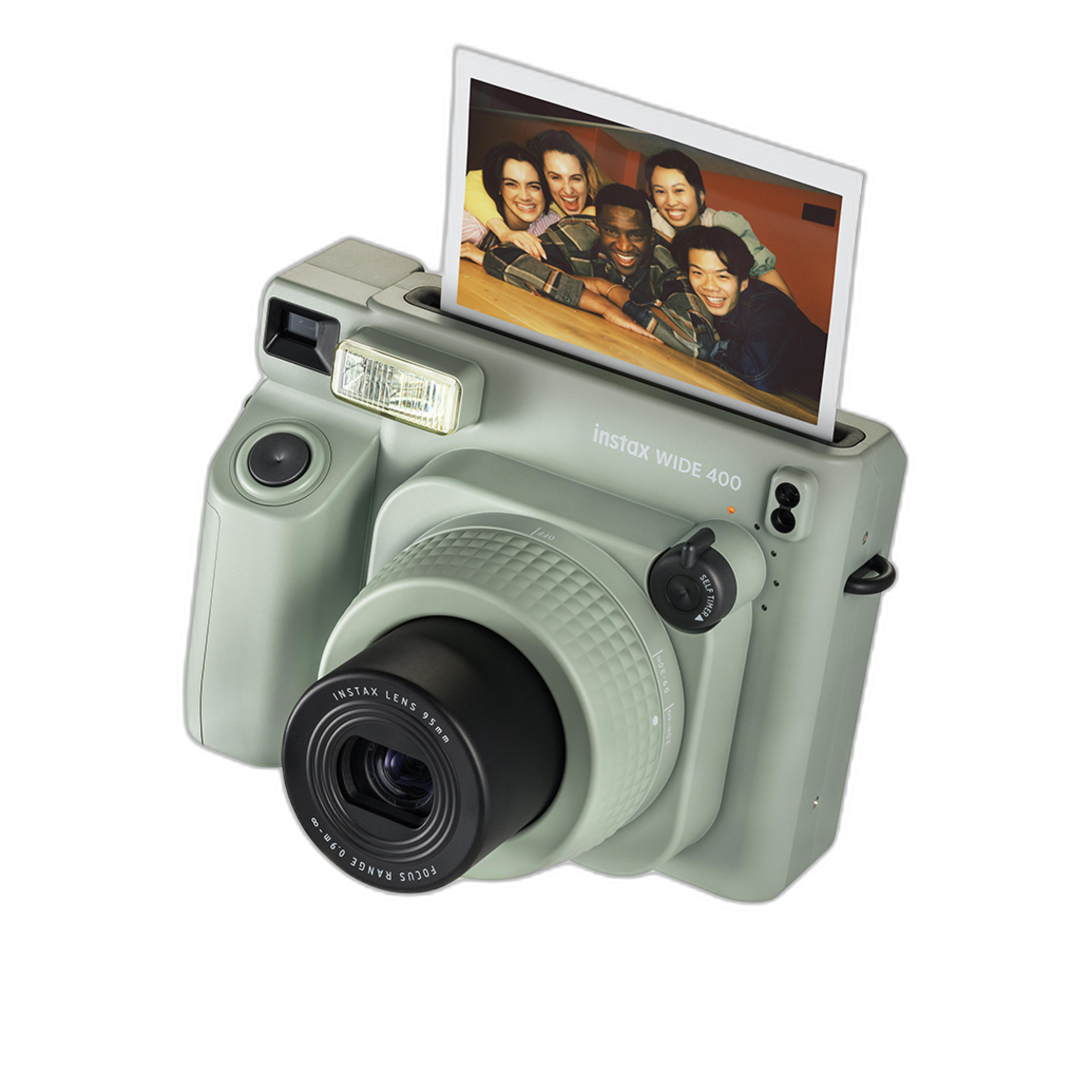
A Larger Instant Print in a Phone-Camera World
By 2023, instant photography had already proved it was no passing trend. What had changed was the role it played. Earlier revivals often leaned on nostalgia alone, but the strongest instant cameras increasingly succeeded because they offered something digital photography does not: a physical print that appears quickly, can be passed around immediately, and has enough size to matter in the hand.
That is exactly where the Instax Wide 400 positions itself. It uses Instax Wide film, the broadest mainstream format in Fujifilm’s instant lineup. The value of that larger print is easy to understand in practice. A wide-format image gives faces more breathing room in group shots, makes environmental portraits feel less cramped, and allows landscapes and travel scenes to read more naturally. In other words, the camera’s format is not just a novelty specification; it directly shapes the kinds of photographs the camera encourages people to make.
This is also why the Wide series has always held a distinctive niche. Mini-format prints can feel intimate and playful, while square prints bring compositional symmetry. Wide prints, by contrast, feel social. They invite multiple viewers at once, and they better suit the occasions where people are most likely to want an instant camera out in the first place: parties, vacations, family gatherings, reunions, and casual outdoor shooting.
What the Instax Wide 400 Offers
The Instax Wide 400 keeps the shooting experience straightforward, which is central to the Instax concept. Fujifilm built the camera around automatic exposure, reducing the need for users to think about settings before pressing the shutter. That matters in an instant camera because hesitation often means a missed moment. The format is at its best when used quickly and confidently, whether photographing a group at a picnic table or a scenic overlook just before the light changes.
Just as important are the camera’s practical extras. The Wide 400 includes a tripod socket, a feature that may sound small on paper but significantly broadens the camera’s usefulness. Instant cameras are often treated as purely handheld party tools, yet a tripod mount makes the Wide 400 more flexible for self-timer-style group portraits, vacation photos that include the photographer, and steadier shooting in situations where compositional control matters. Given the wide format’s suitability for group scenes, the presence of a tripod socket feels especially appropriate.
The other notable extra is a close-up lens attachment. This addresses a longstanding challenge in larger instant cameras: while they are often excellent for casual portraits and general snapshots, getting closer to a subject can be trickier without dedicated help. An included close-up attachment gives users more freedom for tighter portraits, small still lifes, and detail shots, expanding the camera’s creative range beyond broad scenes and group photos.
Designing for Groups and Landscapes
The title promise of “big prints for groups and landscapes” is not marketing fluff. It gets at the real photographic logic behind this model. Wide instant film works especially well when the frame needs to accommodate multiple points of interest. In a group portrait, that means faces do not need to be crowded awkwardly. In a landscape, it means the image can hold a horizon line, foreground detail, and sky with a little more breathing room than smaller formats typically provide.
At release, this gave the Wide 400 a clear identity in the Instax ecosystem. It was not the line’s most compact camera, nor was it trying to be. Instead, it embraced a larger body and larger film as part of a specific use case. Bring it to a gathering, and the resulting prints are big enough to share. Bring it on a trip, and scenic images have a more convincing sense of space. Even for casual users, that distinction is immediately legible the moment a print develops.
There is also an archival logic to the format. A larger instant print often ages better as an object. It is easier to display, easier to write on, and easier to appreciate years later without feeling like a tiny token. In that respect, the Wide 400 belongs to a long tradition of cameras whose greatest strength is not merely image capture, but memory-making in physical form.
Ease of Use as a Feature, Not a Compromise
Some photographers are tempted to judge simple cameras by what they omit. But with instant photography, simplicity is often the feature that matters most. The Wide 400’s automatic exposure should be understood in that context. Fujifilm was not building a technically intimidating specialist machine; it was refining a camera meant to work for newcomers, families, and experienced photographers who wanted a low-friction companion to their more advanced gear.
That approach aligns with the history of successful instant cameras across generations. The strongest models tend to disappear in use. They let the photographer focus on people, timing, and place rather than camera operation. In a release-era assessment, that would likely be one of the Wide 400’s biggest strengths: it understands that the emotional payoff of instant photography comes from participation. The camera should help make the moment happen, not delay it.
For photographers who already own digital systems, that simplicity can be refreshing rather than limiting. The Wide 400 occupies a different lane from mirrorless or DSLR gear. It is not trying to replace precision tools. It is offering a parallel experience—slower in one sense because each frame matters, but faster in another because the result is immediate and tangible.
Where the Wide 400 Fits in Instax History
Historically, the Instax Wide 400 represents Fujifilm’s continued confidence in the wide instant format at a time when compact and smartphone-linked products often dominate attention. That alone is notable. In an era where many consumer imaging products chase miniaturization or app integration first, the Wide 400 stands for the idea that format still matters. Bigger prints create a different experience, and that difference is worth preserving.
It also reflects how mature the Instax brand had become by 2023. Fujifilm no longer needed to justify instant photography as a comeback story. Instead, it could segment its lineup more clearly, with each camera serving a recognizable style of use. The Wide 400’s role was to be the camera for people who wanted a generous print size, straightforward operation, and a few thoughtful additions—like the tripod socket and close-up lens attachment—that make the camera more versatile in real-world situations.
As an archival release-period piece, it is fair to say the Wide 400 looked like a smart evolution rather than a radical break. That is often the sign of a healthy product category. Fujifilm understood the established appeal of wide-format instant photography and focused on making the camera more accommodating to how people actually use it.
Final Thoughts
The Fujifilm Instax Wide 400 arrives as a clear statement of what wide instant photography does best. Its use of Instax Wide film gives prints a stronger social and visual presence than smaller formats. Automatic exposure keeps operation approachable and quick. And the inclusion of a tripod socket and close-up lens attachment adds welcome flexibility for group portraits, travel use, and more varied subject matter.
For anyone looking back at the camera from its 2023 release period, the appeal is easy to understand: this is an instant camera built for occasions that deserve more room in the frame and more substance in the print. It is a reminder that instant photography is not just about novelty—it is about giving memories a physical form, right away, in a size that people can actually gather around.
If you are interested in the Fujifilm Instax Wide 400 or want to explore more about the history and appeal of instant photography, Unique Photo is a great place to buy, compare options, or learn more.