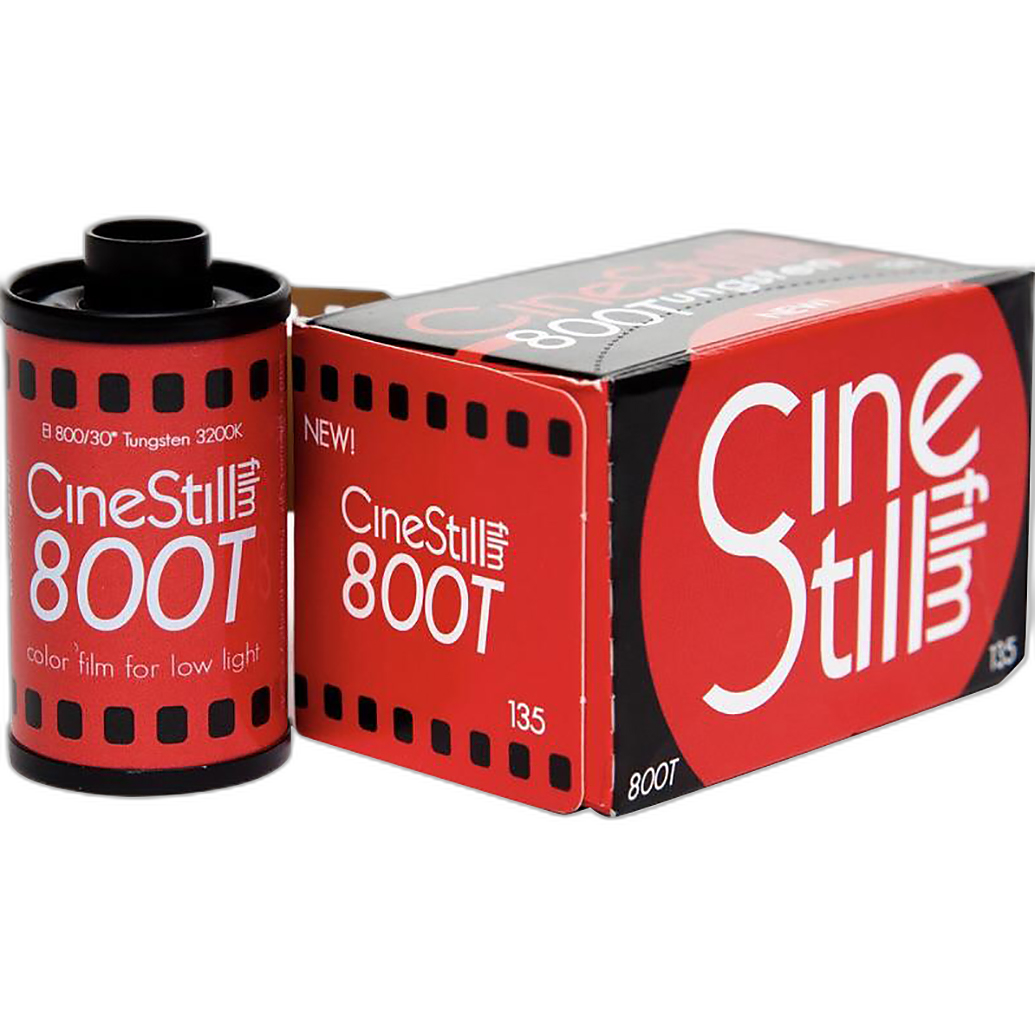
Few modern films have developed a visual identity as quickly as CineStill 800T. In an era when many photographers were rediscovering film for its texture, color response, and unpredictability, 800T stood out by doing something very specific: it brought a cinema-derived tungsten-balanced look into everyday still photography. The result was a stock that felt immediately different from mainstream daylight color negative films. Street scenes after dark, neon storefronts, practical lamps, wet pavement, diners, bars, and city intersections all seemed to take on a distinct personality when photographed on CineStill 800T.
Part of that identity came from its technical foundation, and part of it came from its rendering. Rated at ISO 800, processed in standard C-41 chemistry, and balanced for tungsten light at 3200K, CineStill 800T offered photographers an unusually accessible way to work in lower light while embracing the color of artificial illumination rather than correcting it away. Its signature red halation around bright highlights became one of the defining visual markers of the film and helped make it one of the most recognizable emulsions of its generation.
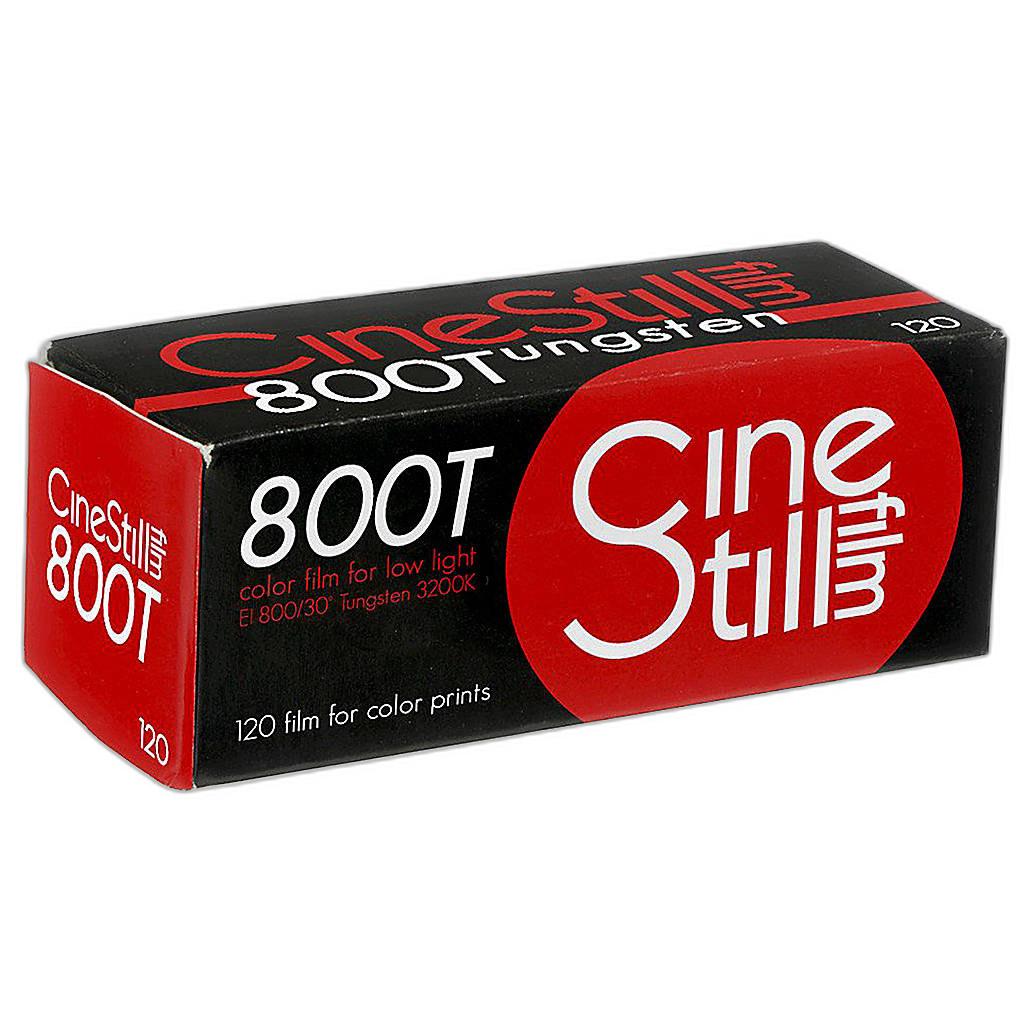
What CineStill 800T Is
CineStill 800T is a color negative film designed for C-41 processing, derived from motion-picture film with the remjet layer removed. That last point is central to understanding both why the film is easy to use in standard still-photography labs and why it looks the way it does. Traditional cinema film stock uses a remjet backing for technical reasons in motion-picture workflows, but that backing is not compatible with normal C-41 minilab processing. By removing it, CineStill made a cinema-derived emulsion practical for still photographers who wanted to shoot and process film through familiar channels.
In practical terms, that meant photographers could load 800T into ordinary still cameras and send it through standard C-41 processing without requiring a specialized motion-picture lab workflow. For many users, that accessibility was as important as the look itself. CineStill 800T did not simply offer an unusual palette; it made that palette available within the everyday habits of still photography.
Tungsten Balance and Why It Matters
The defining technical trait of CineStill 800T is its tungsten balance of 3200K. Most common color negative films are daylight balanced, which means they are designed to render neutral color under daylight conditions. Under tungsten or mixed artificial light, daylight film often records a pronounced warm or orange cast unless corrected with filtration or adjusted during printing or scanning.
CineStill 800T approaches the problem from the opposite direction. Under tungsten lighting, it is designed to produce a more natural color balance. That made it especially appealing for photographers working in theaters, on city streets at night, in interiors lit by practical bulbs, or in environments dominated by sodium vapor, fluorescent, LED, and neon sources. Of course, real night scenes are rarely lit by a single color temperature, and that complexity became part of the appeal. Rather than neutralizing every source into sameness, 800T often emphasized the layered color relationships of nighttime environments.
When used in daylight, the tungsten balance naturally shifts the image cooler unless corrected. That behavior was not a flaw so much as a creative choice. Some photographers embraced the blue cast for atmospheric daytime imagery, while others reserved the film primarily for evening and interior work where its intended balance could shine.
ISO 800 and the Freedom of Low-Light Shooting
Another major part of the film’s popularity was its ISO 800 speed. In film photography, speed is freedom: freedom to work handheld after sunset, freedom to stop down a bit more when needed, and freedom to capture ambient light without always relying on flash. For street photographers, event shooters, and anyone drawn to night scenes, ISO 800 represented a practical sweet spot. It was fast enough to be genuinely useful in dim conditions while still retaining the color negative latitude that many film photographers value.
That balance helped CineStill 800T become more than a novelty stock. It could serve as a working film for photographers who regularly found themselves in marginal light. It also made the film approachable for those experimenting with nighttime photography for the first time, because it reduced some of the technical barriers associated with slower emulsions.
The Signature Look: Red Halation Around Highlights
If one visual characteristic became synonymous with CineStill 800T, it was red halation around highlights. This glow, especially visible around point light sources and bright specular highlights, gave the film an immediately recognizable cinematic aura. Tail lights, neon tubes, street lamps, illuminated signs, and reflections on wet surfaces could all take on a subtle or pronounced reddish halo.
Historically, halation is not unique to CineStill, nor is it always desirable in every photographic context. But in the case of 800T, it became an expressive feature rather than merely a technical artifact. For many photographers, the effect reinforced the film’s mood: urban, nocturnal, slightly dreamlike, and emotionally resonant. It is one of the reasons the film became so heavily associated with night streets and available-light portraiture.
At the same time, the halation effect is worth understanding rather than romanticizing too simplistically. Its intensity can vary depending on the scene, the brightness and size of highlights, lens choice, exposure, and scanning interpretation. Some images show only a trace of it; others lean into it as a central design element. That variability is part of the film’s charm and part of the reason no two rolls feel exactly the same.
A Cinema-Derived Film in Still Photography Culture
CineStill 800T arrived at a moment when many photographers were interested not just in film as a medium, but in crossovers between still and motion-picture aesthetics. The idea of shooting a cinema-derived stock in a 35mm or medium format camera held a strong appeal. It suggested a link to the visual language of movies: practical lighting, dramatic contrast, color-rich night exteriors, and a looser, more atmospheric approach to available light.
But CineStill 800T’s place in photographic culture was not just about borrowing cinema prestige. It was also about expanding what still photographers expected from color negative film. Instead of treating artificial light as a problem to be corrected, 800T encouraged photographers to see it as subject matter. It rewarded paying attention to the color of lamps, signs, windows, brake lights, and reflections. In that sense, the film helped shape a way of seeing as much as it offered a look.
Best-Known Uses and Typical Subjects
Over time, CineStill 800T became particularly associated with several recurring subjects. Night street photography is the most obvious. The combination of ISO 800 speed, tungsten balance, and halation made it a natural fit for city scenes after dark. Portrait photographers also gravitated toward it, especially for environmental portraits under practical lighting where the surrounding ambience was part of the image. Cars, gas stations, diners, motels, concerts, and rainy urban scenes all became familiar territory for the stock.
That said, part of the film’s appeal lay in using it outside the obvious contexts. Some photographers enjoyed taking a tungsten-balanced film into daylight specifically for the cooler cast and altered palette. Others used it indoors in mixed light where no single balance could ever be perfectly neutral. CineStill 800T often worked best when the photographer accepted color complexity instead of trying to eliminate it.
Why CineStill 800T Endured
Many films are appreciated for versatility. CineStill 800T, by contrast, became beloved because it was distinctive. It had a clear identity: color negative, C-41 process, cinema-derived, remjet removed, ISO 800, tungsten-balanced at 3200K, with characteristic red halation around highlights. That list of traits translated into a rendering that photographers could recognize almost instantly.
In historical terms, the film’s significance lies in how successfully it bridged niche appeal and broad adoption. It spoke to enthusiasts who wanted something different, but it was accessible enough to become a regular choice rather than a one-time experiment. It also arrived at a time when online photo culture amplified recognizable visual signatures, and 800T certainly had one.
Conclusion
CineStill 800T remains one of the most distinctive modern film stocks to emerge from the still-photography revival: a tungsten-balanced, ISO 800, cinema-derived color negative film for C-41 processing, known above all for its atmospheric rendering and red halation glow. Whether approached as a practical low-light film or as a creative tool with a strong visual personality, it earned its place through a look that few other emulsions could convincingly replicate.
For photographers interested in exploring CineStill 800T or learning more about film stocks old and new, Unique Photo is a great place to buy film, compare options, and connect with a community that still values the craft and history of analog photography.