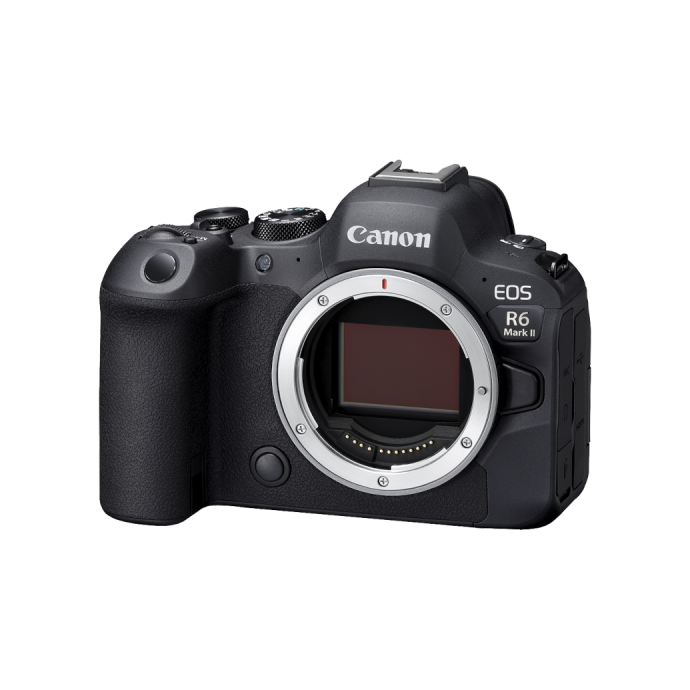
Canon expanded its full-frame mirrorless lineup on November 2, 2022 with the announcement of the EOS R6 Mark II, a camera aimed squarely at hybrid creators who needed speed, dependable autofocus, and stronger video performance in a compact RF-mount body. Positioned as the successor to the original EOS R6, the Mark II arrived with a newly developed 24.2-megapixel full-frame sensor, faster continuous shooting, and a headline-grabbing promise that resonated across the market at the time: no standard recording limit. At launch, Canon set the EOS R6 Mark II at $2,499 in the U.S., placing it in one of the most competitive segments of the mirrorless market.
Seen from the perspective of late 2022, the EOS R6 Mark II was more than a routine refresh. It reflected how quickly expectations had changed for enthusiast and professional cameras alike. Buyers no longer wanted to choose between stills speed and serious video capability. Canon's answer was a camera designed to do both, while staying within the now-mature Canon RF mount ecosystem.

A Faster, More Flexible Successor
The original EOS R6 had already earned a reputation as one of Canon's most balanced all-around full-frame mirrorless cameras, especially for wedding, event, wildlife, and multimedia work. With the EOS R6 Mark II, Canon kept the basic concept intact but addressed several areas photographers and filmmakers were watching closely.
At the center of the announcement was the new 24.2MP full-frame sensor. That modest increase in resolution over the prior generation mattered not just on paper, but in terms of practical flexibility. It gave users a bit more room for cropping while preserving the camera's orientation toward speed and low-light versatility rather than sheer pixel count. In Canon's lineup, that made the R6 Mark II a distinct complement to higher-resolution options, rather than a direct substitute for them.
Just as important was the dramatic increase in burst performance. Canon announced up to 40 frames per second with the electronic shutter, a figure that immediately signaled the company's intent to keep the R6 Mark II highly relevant for action shooters. For sports, birds, and other unpredictable subjects, that kind of speed represented a major talking point in 2022. It showed how much mirrorless bodies had matured, especially in mid-to-upper-tier categories that just a few years earlier were still compared cautiously against professional DSLRs.
40 fps Electronic Shutter: Why It Mattered
By late 2022, high-speed burst rates had become one of the clearest ways manufacturers demonstrated the advantages of mirrorless technology. Canon's announcement of 40 fps e-shutter shooting placed the EOS R6 Mark II among the fastest cameras in its class, at least on headline specifications. For photographers covering peak-action moments, that meant more frames to choose from when timing was critical.
This kind of performance was especially attractive to wildlife and sports users already invested in Canon glass or considering a move into the RF system. The EOS R6 Mark II gave those photographers a body that promised quick response in a package smaller and lighter than many DSLR-era equivalents. It also reinforced a broader industry trend: speed was no longer reserved exclusively for flagship bodies.
Historically, the R6 Mark II stands as part of Canon's broader push in the early RF era to make mirrorless feel not like a compromise, but like a clear upgrade path. Cameras such as this helped accelerate that perception.
Video Advances and the Appeal of No Recording Limit
While the EOS R6 Mark II's stills capabilities drew plenty of attention, Canon also framed the camera as a serious tool for video creators. The spec sheet highlighted 4K60 oversampled video, an important detail because oversampling generally signals a sharper, more refined image than line-skipped or heavily cropped alternatives. For hybrid users in 2022, that wording mattered.
Equally notable was the promise of no recording limit. Around the release period, this was one of the most marketable phrases attached to the camera. It addressed a long-standing frustration among many filmmakers, streamers, event shooters, and interview-based creators who had grown wary of artificial clip-length restrictions. Whether one was documenting long ceremonies, recording educational content, or capturing extended live performances, the idea of a camera without a standard built-in time cap had real practical and psychological appeal.
In historical context, this feature also illustrates how the camera industry was adapting to the expectations of creators who moved fluidly between still photography, social content, client video, and livestreaming. Canon's messaging around the EOS R6 Mark II reflected that transition clearly. This was not simply a still camera with video added on; it was introduced as a genuinely hybrid machine.
The RF Mount Context in 2022
The EOS R6 Mark II launched into a Canon mirrorless environment that was becoming increasingly coherent. The Canon RF mount, introduced just a few years earlier, had moved beyond its startup phase and was rapidly developing into a mature lens ecosystem. For buyers considering the camera at announcement, the mount itself was part of the value proposition.
Canon had already shown that RF would support a wide range of users, from enthusiasts stepping up from APS-C or DSLR bodies to working professionals building complete systems around native mirrorless lenses. In that context, the EOS R6 Mark II made strategic sense. It sat in a sweet spot where many photographers wanted to be: full-frame, high speed, advanced autofocus ambitions, and credible video features, all without the price of a flagship body.
The $2,499 launch price reinforced that positioning. It was not an entry-level camera, but it was also far from unattainable for serious enthusiasts and professionals who viewed the body as a workhorse. In the highly competitive late-2022 market, price mattered as much as specifications, and Canon's announcement made clear that the EOS R6 Mark II was intended to be a central body in the RF lineup rather than a niche offering.
Who the EOS R6 Mark II Was For
At the time of its release, the EOS R6 Mark II looked especially compelling for several kinds of users. Event and wedding photographers would have seen the appeal of a responsive full-frame sensor, high burst rate, and video features useful for short-form clips or full ceremony coverage. Wildlife and sports shooters were likely drawn to the 40 fps electronic shutter figure and the camera's place within Canon's expanding RF telephoto ecosystem. Content creators and filmmakers, meanwhile, had obvious reasons to pay attention to 4K60 oversampled recording and the elimination of a standard recording cap.
That breadth of appeal is an important part of the camera's significance. Historically, some camera releases are easy to classify as specialist products. The EOS R6 Mark II was not one of them. Its announcement represented Canon's attempt to build a broadly useful, modern full-frame mirrorless body for the way people actually worked in the early 2020s.
An Archival Look Back
Viewed as an archival 2022 announcement, the Canon EOS R6 Mark II captures a moment when hybrid performance had become the norm rather than the exception. A 24.2MP full-frame sensor, 40 fps electronic burst shooting, 4K60 oversampled video, and Canon RF mount compatibility together created a camera that felt sharply tuned to the demands of its era. The added emphasis on no recording limit only strengthened its relevance for creators who needed one body to handle multiple roles.
Canon's messaging around the R6 Mark II was clear at launch: this was a camera built for speed, flexibility, and multimedia production, delivered at a price that placed it in the heart of the enthusiast/pro market. For many observers in 2022, it looked like one of the most important all-around Canon mirrorless releases of the year.
For photographers, filmmakers, and collectors looking back at landmark RF-system launches, the EOS R6 Mark II remains an important chapter in Canon's mirrorless history. To explore Canon cameras and lenses, or to learn more about major releases like the EOS R6 Mark II, visit Unique Photo.