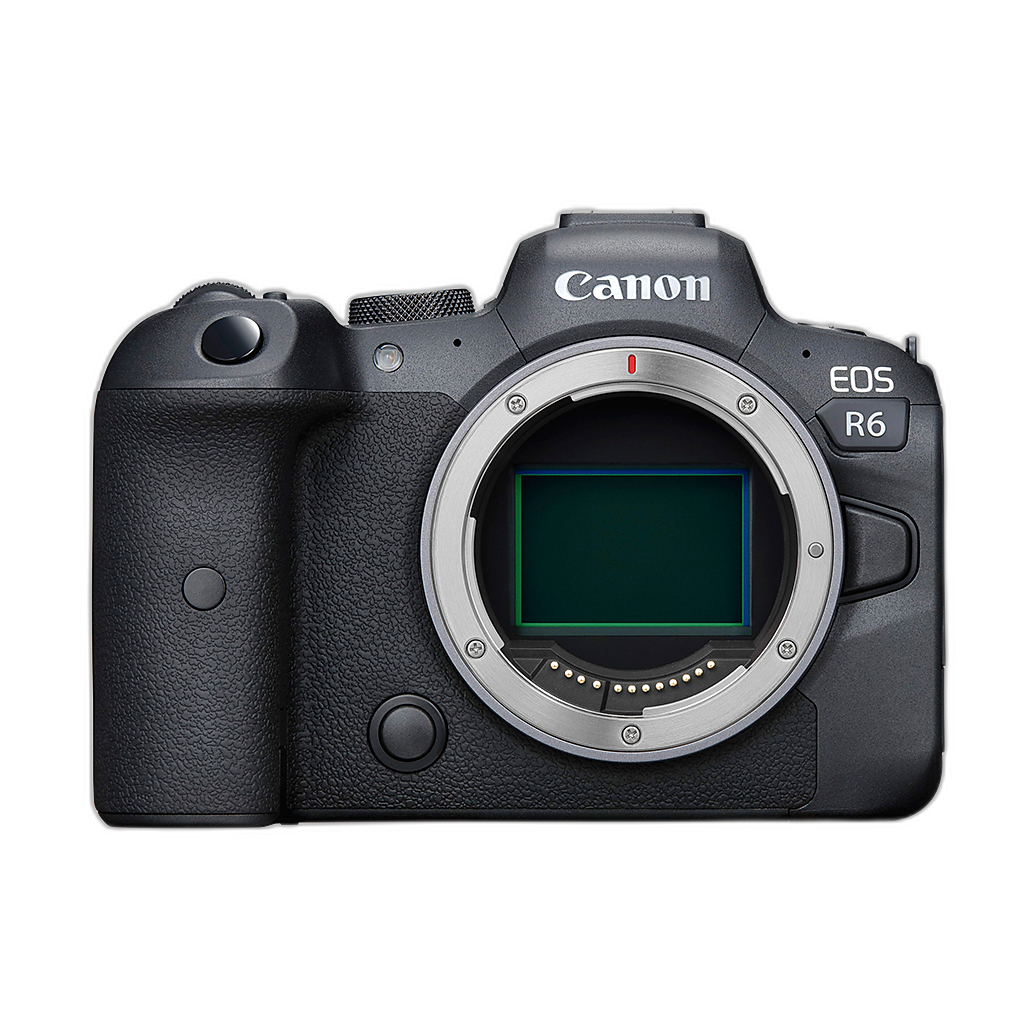
In July 2020, Canon expanded its full-frame mirrorless lineup with the announcement of the EOS R6, a camera positioned as a highly capable all-rounder for photographers and hybrid shooters who needed speed, low-light confidence, and strong video performance without stepping all the way up to the flagship tier. Arriving in the early growth phase of Canon’s RF-mount system, the EOS R6 signaled that the company was serious about bringing advanced autofocus, in-body stabilization, and robust burst shooting to a broader audience within the EOS R family.
At launch, the Canon EOS R6 entered the market at $2,499 USD, giving enthusiasts and working photographers a compelling option in the rapidly evolving full-frame mirrorless segment. With its 20.1-megapixel full-frame sensor, 4K60 video, and in-body image stabilization rated up to 8 stops, the camera was immediately framed as a practical tool built for real-world photography: events, action, portraits, documentary work, and low-light shooting among them.

A Major RF-Mount Milestone
By the time of the EOS R6 announcement, Canon’s RF ecosystem was still relatively young but growing quickly. Early EOS R bodies had established the foundation of the system, while RF lenses had already begun to show Canon’s ambitions for optical performance. The EOS R6 helped fill an important role: it brought many of the technologies photographers were looking for in a modern full-frame mirrorless body, but in a package aimed at broad, day-to-day usability rather than headline-grabbing resolution.
This was an important distinction. In a market that often emphasized megapixel counts, Canon took a different route with the EOS R6. Its 20.1MP full-frame sensor suggested a camera tuned for speed, manageable file sizes, and strong low-light behavior. That combination made the R6 especially appealing to photographers who valued responsiveness and reliability over sheer pixel count.
Built Around Speed and Sensitivity
The EOS R6’s sensor specification was one of the most discussed parts of the announcement. While 20.1 megapixels may have seemed modest compared to some contemporaries, it aligned neatly with the camera’s intended personality. For sports, weddings, events, news, and wildlife work, resolution alone is rarely the whole story. A camera has to lock focus quickly, perform confidently in dim environments, and keep up with unpredictable subjects.
In that context, the EOS R6 looked like a camera designed by priorities that working photographers would recognize immediately. A lower-resolution full-frame sensor can offer practical advantages in throughput and low-light use, and Canon clearly positioned the R6 as a body that emphasized performance under pressure. For photographers shooting long days or high volumes, the balance of image quality, speed, and workflow efficiency was part of the appeal from the start.
Why 20.1MP Made Sense
Canon’s decision to use a 20.1MP sensor was not about making a stripped-down camera. Rather, it reflected a long-standing truth in professional photography: many of the most important images are captured in difficult conditions, not ideal ones. Indoor sports, receptions, concerts, documentary scenes, and dawn-or-dusk wildlife sessions all reward cameras that can produce strong files when light levels drop and moments unfold quickly.
For many users in 2020, that meant the EOS R6 was easy to understand. It was not being pitched as a studio-resolution specialist. It was being introduced as a highly capable generalist with a special aptitude for low-light and fast action.
4K60 and the Hybrid Camera Era
The inclusion of 4K60 video was another major part of the EOS R6 announcement. By 2020, hybrid shooting had become an increasingly central expectation in enthusiast and professional camera design. Photographers were often being asked to deliver both stills and video, sometimes on the same assignment. The ability to record 4K at up to 60 frames per second made the EOS R6 a serious option for creators who wanted smooth motion, flexible footage, and modern video capability in a full-frame body.
Canon’s move here was significant because it showed that the EOS R line was maturing beyond stills-first mirrorless cameras. The EOS R6 was clearly presented as part of a new generation of Canon bodies that could serve multimedia creators, not just traditional photographers. For wedding filmmakers, content producers, commercial shooters, and small production teams, 4K60 was a meaningful specification at the launch price.
In-Body Image Stabilization Comes to the Fore
One of the most important advances associated with the EOS R6 announcement was the arrival of in-body image stabilization in a Canon full-frame mirrorless body, rated at up to 8 stops. This was a landmark feature for the RF system and one of the clearest signs that Canon was pushing the platform forward aggressively.
For photographers, IBIS promised tangible benefits across many shooting situations. Handheld work in lower light became more practical. Travel and documentary photography gained flexibility. Portrait, lifestyle, and event photographers could potentially work with greater confidence at slower shutter speeds, especially when paired with compatible RF lenses. For video users, stabilization also offered obvious appeal in smoothing handheld footage and making lighter setups more usable in the field.
Just as importantly, IBIS was not merely a checklist feature. In the context of the EOS R6, it reinforced the camera’s identity as a dependable, versatile tool. Speed, sensitivity, and stabilization formed a coherent package—one aimed squarely at real photographers working in varied environments.
The RF Mount Advantage
The Canon RF mount was central to the EOS R6 story. Introduced as the foundation of Canon’s mirrorless future, RF had already begun to distinguish itself through lens design freedom and a growing catalog that ranged from practical zooms to high-end optics. The EOS R6 benefited directly from that ecosystem momentum.
For Canon users considering a move from DSLR to mirrorless in 2020, the R6 represented a persuasive entry point into the RF world. It offered modern body technology while tapping into a lens roadmap that made the system feel increasingly complete. Existing Canon photographers also understood that moving into RF was about more than a single camera body—it was about investing in the company’s next-generation platform.
That context helped make the EOS R6 especially important historically. It was not simply another camera release. It was part of the period when Canon was actively defining what the RF system would mean for enthusiasts and professionals alike.
Who the EOS R6 Was For
From the moment it was announced, the EOS R6 seemed tailored to a wide spectrum of users. Wedding and event photographers had obvious reasons to pay attention: full-frame imaging, strong low-light potential, image stabilization, and credible video features all addressed modern assignment needs. Action-oriented shooters could appreciate the camera’s emphasis on responsiveness. Travel and documentary photographers could see value in a stabilized, capable body that was flexible across genres.
Perhaps the camera’s greatest strength on announcement was that it did not appear narrowly specialized. The EOS R6 looked like the sort of model many photographers could use as a main body rather than a niche second camera. In that sense, calling it an all-rounder was not marketing fluff; it accurately described the role Canon seemed to have designed it to play.
A Strong Statement in 2020
Looking back at the EOS R6 announcement from a historical perspective, it stands as one of Canon’s most consequential mirrorless launches of the period. The camera helped establish a clearer identity for the EOS R lineup by showing that Canon could deliver a full-frame mirrorless body with a practical balance of speed, stabilization, video capability, and value.
Its 20.1MP full-frame sensor, 4K60 recording, up to 8 stops of IBIS, and $2,499 launch price combined to create a body that felt unusually well judged for the needs of 2020 photographers and content creators. It was a camera built less around extremes than around usefulness—and that often proves the more enduring formula.
Conclusion
The Canon EOS R6 arrived as a confident and timely addition to the RF system: fast, low-light friendly, video-capable, and broadly appealing. For many photographers watching Canon’s mirrorless evolution in 2020, it looked like one of the clearest signs yet that the EOS R platform was coming into its own. If you want to explore the Canon EOS R system, compare current Canon gear, or learn more about the history of important camera releases like the EOS R6, Unique Photo is a great place to shop, research, and stay connected to the world of photography.