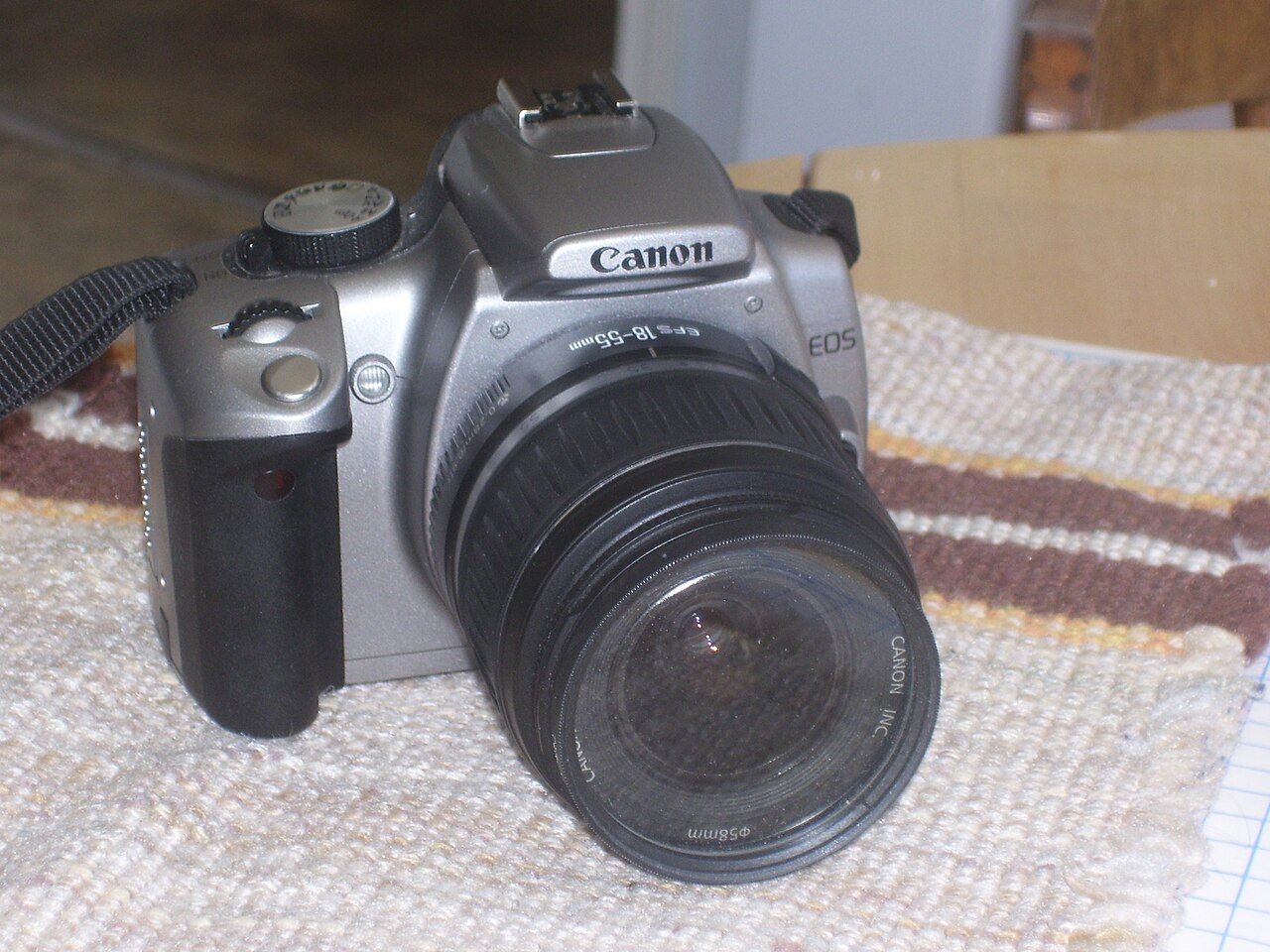
Canon’s original Digital Rebel helped crack open the DSLR market for a much wider audience. With the arrival of the Canon EOS Digital Rebel XT in early 2005, that idea became even more convincing. Smaller, lighter, faster, and more affordable at launch, the XT refined Canon’s entry-level DSLR formula at exactly the right moment. For many photographers moving up from compact digital cameras—or stepping into digital SLR photography for the first time—the Rebel XT looked like the camera that made the transition feel practical.
Announced on February 17, 2005, the Digital Rebel XT (known in some markets as the EOS 350D) brought an 8MP APS-C CMOS sensor, support for the broad Canon EF lens mount, and a launch price of $899. That combination positioned it squarely at the center of one of the most important shifts in modern camera history: the moment when DSLRs stopped being niche aspirational tools and started becoming everyday enthusiast cameras.
A Smaller DSLR for a Bigger Audience
The Rebel XT’s importance is not just in its specifications, but in how clearly Canon understood the market in 2005. Digital photography was no longer experimental. Consumers were buying compact digital cameras in large numbers, and many serious hobbyists were beginning to expect more image quality, more control, and more room to grow. The challenge was making a DSLR feel less intimidating—physically, financially, and operationally.
That is where the XT stood out immediately. Canon trimmed the camera’s body compared with the earlier Rebel design, giving it a more compact, more approachable form without abandoning the core EOS handling philosophy. It remained recognizably an SLR, but one that felt much easier to carry and easier to imagine as an everyday camera. For shoppers in 2005, that mattered. A DSLR no longer had to look oversized or feel like a specialist’s tool to be taken seriously.
Just as important, Canon’s EOS system gave buyers a direct path into a mature interchangeable-lens lineup. Because the camera used the Canon EF mount, photographers were not buying into a dead-end product. They were entering a system with established lenses, accessories, and a clear upgrade path. That system confidence was one of Canon’s strongest advantages in the mid-2000s.
Why 8 Megapixels Mattered in 2005
Today, 8 megapixels may sound modest, but in 2005 it was a highly marketable and genuinely useful figure for an affordable DSLR. The Rebel XT’s 8MP APS-C CMOS sensor represented a meaningful step forward for photographers who wanted more than a compact camera could reliably deliver. Resolution was only part of the story, of course. The larger APS-C sensor format was central to the camera’s appeal, promising the image-quality advantages that helped define the DSLR experience in this period.
For enthusiasts printing their work, cropping more confidently, or simply looking for cleaner images than most small-sensor cameras could produce, the XT arrived at a sweet spot. It offered enough resolution for serious use while preserving the broader advantage of DSLR image quality: a larger sensor paired with interchangeable lenses and optical SLR handling. Canon had already built a reputation around CMOS sensor development, and the Rebel XT helped bring that benefit to a much wider customer base.
In practical terms, the camera’s imaging package made the move up from point-and-shoot models easier to justify. Buyers were not just paying for a more complicated body style; they were paying for an image-making platform with visibly different potential.
The Rebel Line Grows Up
The original Digital Rebel was already a landmark camera, but the XT felt more polished and more assured. Canon appeared to understand that the first wave of entry-level DSLR buyers had taught the industry something important: beginners and enthusiasts did not want “cheap” cameras so much as they wanted accessible cameras. Those are not the same thing.
The Rebel XT therefore landed as a camera that balanced affordability with legitimacy. At $899 at launch, it was still a serious purchase, but it moved DSLR ownership into far more realistic territory for students, families, hobbyists, and film SLR users considering the jump to digital. In the context of 2005, that price point was a major part of the headline. Canon was not merely releasing another body; it was continuing to normalize the idea that a DSLR could be the default camera for a dedicated amateur.
This is one reason the XT occupies such an important place in camera history. It was not the first DSLR, nor the first digital Canon EOS model, nor even the first Rebel-branded DSLR. Its significance lies in refinement and timing. It arrived when consumer demand, digital maturity, and system confidence all aligned.
Canon EF Mount: A Real System Advantage
One of the strongest selling points of the Digital Rebel XT was its place in the broader EOS ecosystem. The Canon EF mount was already well established, and that mattered tremendously for photographers trying to think beyond a single body purchase. A new buyer could begin with a basic lens and later expand into wide-angle, telephoto, macro, or fast prime options without changing systems.
In historical hindsight, this system strength was crucial to the mainstreaming of DSLRs. Cameras like the XT succeeded not only because they were attractively priced, but because they gave first-time buyers confidence that their investment would grow with them. Someone purchasing a Rebel XT in 2005 could reasonably see it as the start of a photographic journey rather than a temporary stopgap.
For retailers and educators, this was equally important. A camera that sits inside a coherent lens system is easier to recommend because it supports progression. The Rebel XT was an easy camera to understand in that context: approachable enough for a newcomer, yet serious enough to reward learning.
A Transitional Camera for a Transitional Era
Looking back, the Canon Digital Rebel XT belongs to a fascinating transitional period in photo history. Compact digital cameras were still dominant in unit sales, but the DSLR had begun to capture the imagination of enthusiasts in a new way. Manufacturers were racing to make SLR photography more attainable, and Canon was among the clearest leaders in shaping that movement.
The XT’s compact body, 8MP APS-C CMOS sensor, and aggressive launch pricing gave it broad appeal, but its real achievement was cultural. It helped normalize the DSLR as a family camera, a travel camera, a student camera, and a first “serious” digital camera. It was a model that many buyers could aspire to without feeling excluded by price or complexity.
That role should not be underestimated. Some cameras break barriers through radical technology. Others do it by making existing strengths available to far more people. The Digital Rebel XT belongs firmly in the second category, and its impact was substantial. It gave a generation of photographers a practical on-ramp into interchangeable-lens digital photography.
Historical Legacy
In the long view of Canon history, the Digital Rebel XT stands as one of the key cameras in the democratization of the DSLR. It helped confirm that entry-level did not have to mean stripped-down in spirit. Instead, it could mean thoughtfully designed, well positioned, and tied to a serious photographic system.
For many photographers who encountered it in 2005, the XT was likely their first convincing glimpse of a digital SLR that felt both desirable and attainable. That is a powerful combination, and it explains why this model still occupies an important place in discussions of digital camera history. It was not only a product announcement; it was evidence that the mainstream DSLR era had truly arrived.
Final Thoughts
The Canon EOS Digital Rebel XT (350D) remains a milestone camera: an 8MP APS-C CMOS DSLR with the backing of the Canon EF system and a notable $899 launch price that helped bring serious digital photography to a much larger audience. As an archival snapshot of 2005, it captures a moment when Canon refined the affordable DSLR into something truly mass-market.
If you’d like to explore historic camera milestones, learn more about Canon gear, or shop current cameras and lenses, Unique Photo is a great place to buy, compare, and keep the history of photography alive.