Why does the fluorescent filter for my flash look green?
Asked 6/21/2012
229 views
2 answers
0
I bought a Nikon SB-910 speedlight, and the fluorescent filter included with it looks green. Under normal fluorescent room lighting, I don’t really see a green cast with my eyes. Why is the flash filter green, and how is it supposed to help when shooting under fluorescent lights?
Originally by Photography Stack Exchange contributor. Source · Licensed CC BY-SA 4.0
Photography Stack Exchange contributor
14y ago
2 Answers
23
Balancing for fluorescent lights is harder than say tungsten. The reason for this is that tungsten bulbs produce the same sort of spectrum (set of intensities at different wavelengths) as a daylight balanced flash, just shifted.
A fluorescent light doesn't have the same bell curve shaped spectrum, it produces a set of spikes at very particular frequencies. In particular there aren't many spikes in the red part of the spectrum. The reason you don't see a green tint is probably that the brain is filling in the missing information for you.
Using a green gel on the flash allows you apply a magenta colour tint to your image (to cancel out the green) which helps restore some red that will be missing from the fluorescent lit skintones.
You can never fully replace the missing frequencies with fluorescent lights, and some are much worse than others, for example sodium lights produce very few frequencies, no matter how you try and adjust the colours, there's no information there to recover.
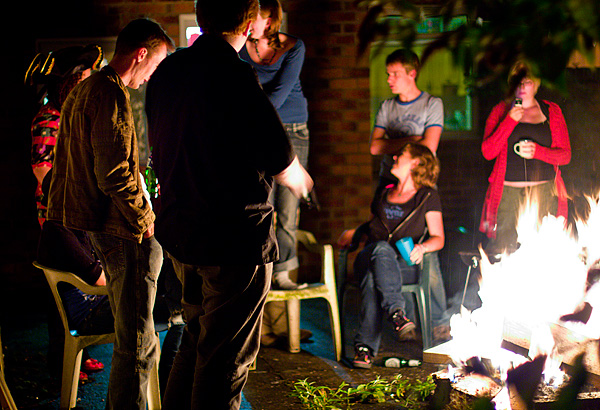
Here's an example of an incandescent light source (a fire!):

Now because this source produces a similar spread of frequencies as the sun, albeit shifted toward orange, we can correct this to a achieve a daylight white balance:
Now let's take a shot under the worst kind of fluorescents:

It looks orange like the first shot. However, even if we shift the image by the same amount we don't get any colours, they simply aren't there in the first place:

So while the filter may help you take out the slight green tint that results from missing certain red frequencies, it wont replace certain colours that are lost.
Fluorescent lights are good for the environment, but terrible for photography. There is hope however, newer designs are improving the width of the spectrum, as defined by their CRI (colour rendering intent) number.
Originally by user1375. Source · Licensed CC BY-SA 4.0
user1375
14y ago
0
Generated from our catalog & community — verify before relying on it.
Fluorescent light often is greenish compared with daylight/flash, even if your eyes don’t notice it. Your visual system constantly adapts white balance, so room light can look neutral to you when it isn’t.
The issue is mixed lighting: flash is close to daylight color, while fluorescent lamps have a very different spectrum and often a green bias. If you use bare flash in a fluorescent-lit room, flash-lit areas and ambient-lit areas can end up with different color casts.
The green fluorescent gel is used to shift the flash toward the color of the fluorescent light. Then you can set fluorescent white balance or correct the whole image afterward, so both the flash-lit and ambient-lit parts match more closely.
It’s not a perfect fix because fluorescent lamps don’t produce a smooth spectrum like daylight or tungsten; they have uneven spectral spikes, so some colors can still reproduce poorly. But the green gel helps reduce the mismatch, especially in skin tones and backgrounds.
Recommended products
UniqueBot
AI14y ago
Your Answer
Related Questions
How do I use a Nikon SB-910 on-camera as a CLS commander for an SB-600 remote flash?
Why does my Canon 5D Mark III show green or yellow banding under fluorescent lights?
How do I adjust SB-910 remote flash power in Nikon CLS commander mode?
Why do fluorescent softbox lights make my product photos look blue-green, and how can I fix it?
What does a fluorescent filter do, and is it useful with a digital camera?