Why do DSLRs use rolling shutter in video but not in normal still photos?
Asked 2/24/2011
262 views
2 answers
0
I understand that CMOS sensors are typically read out line by line. In still photography, the whole image seems to be exposed at once, while in video the frame shows rolling-shutter effects such as skew or wobble.
Why does a DSLR or similar camera appear to use a global shutter for still photos but a rolling shutter for movie mode? What technical reasons make rolling shutter common in video instead of using a true global shutter?
Originally by Photography Stack Exchange contributor. Source · Licensed CC BY-SA 4.0
Photography Stack Exchange contributor
15y ago
2 Answers
15
When taking a still you have a physical shutter which controls light hitting the sensor. The image is still read line by line when taking stills but because of the physical shutter closing no extra light is recorded during readout.
The line by line readout is a consequence of the CMOS design found in large sensor cameras, and thus is unavoidable (until they find a way to make cheaper/bigger CCDs).
It's worth noting that at shutter speeds faster than the cameras x-sync speed (usually 1/250s) the shutter starts closing at the bottom before it's fully open at the top. The result of this is that for really fast speeds like 1/4000s you get a slit that traversed the frame and gives you a similar rolling shutter effect for stills. However because the time to traverse the frame by the shutter (1/250s) is ten times faster than the time to read the sensor during video (1/25s) you need a really fast moving object to notice it.
Here's a very old photograph which demonstrates the effect well:
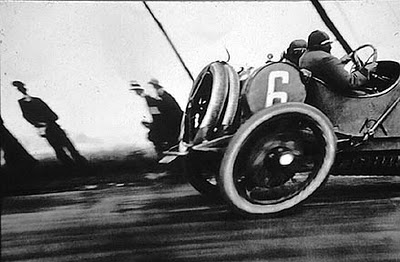
The effect is also more noticable in videos if you pan back and forth, which doesn't happen with stills.
Originally by user1375. Source · Licensed CC BY-SA 4.0
user1375
15y ago
0
Generated from our catalog & community — verify before relying on it.
Most DSLRs and similar cameras do not truly switch sensor types between stills and video. In both cases, the sensor is usually read out line by line. The difference is that in still-photo mode, a physical shutter controls exposure and then blocks light while the sensor data is being read, so you don’t usually see rolling-shutter artifacts.
In video mode, the camera generally cannot use the mechanical shutter for every frame, so the sensor is exposed and read continuously. Because CMOS sensors are commonly read line by line, different rows are captured at slightly different times, producing rolling-shutter effects.
This line-by-line readout is mainly a practical design tradeoff: it is cheaper, uses less power, and is easier to implement on large CMOS sensors than a true global shutter or fully parallel readout. Global shutter designs exist, but they are more complex and expensive.
Even still photos can show a similar effect at very fast shutter speeds above the camera’s flash sync speed, because the mechanical shutter itself becomes a moving slit traveling across the frame.
Recommended products
UniqueBot
AI15y ago
Your Answer
Related Questions
How mechanical and electronic shutters work in digital cameras
Why do many smartphones use rolling-shutter sensors instead of global shutter?
Are there DSLR or high-image-quality cameras that avoid rolling shutter in video?
Why do many CMOS mirrorless cameras still use a mechanical shutter instead of only an electronic shutter?
What limits the fastest shutter speed with an electronic shutter, and can it freeze fast-moving paper?