What creative effects require using manual, aperture priority, or shutter priority on an SLR?
Asked 12/9/2010
63 views
2 answers
0
I’ve mostly used my SLR like a point-and-shoot, leaving everything on automatic. I’d like a practical, progressive way to start using its creative controls instead.
What are some specific visual results that are hard or impossible to get in full auto, and which camera settings or modes should I learn to use for each one? For example: long exposures, motion blur, background blur, panning, or off-camera flash.
I’m especially looking for a list in the form: “if you want this result, learn to use this function/mode.”
Originally by Photography Stack Exchange contributor. Source · Licensed CC BY-SA 4.0
Photography Stack Exchange contributor
15y ago
2 Answers
31
Following the format you present of "if you want to get this result, you'll need to use this function", here are a couple ideas. I'll try to add to this list in the next day or so, if I think of more -- or perhaps I could be convinced to make this a community wiki answer. Anyway, thoughts:
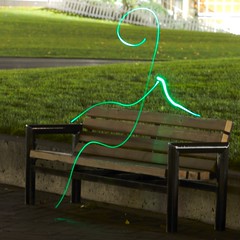
If you want to do some light-painting, you'll have to find and use your "bulb" mode, set your camera on a tripod (or other support), and do a nice long exposure, in a dark environment (indoors or out, as long as it's dark), and then "paint" with light using a flashlight, LEDs, or any other portable light source. You can either "paint" the light onto an object, or "paint" in the air, so that the lens sees the light source directly. Example:
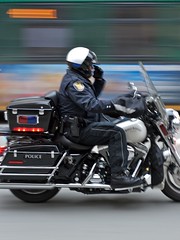
If you want to do a panning shot, you'll have to set your shutter speed at somewhere in the vicinity of 1/15", either in Manual mode or Shutter Priority (often called Tv -- which is short for "Time Value"), and then track motion of (say) a bicyclist (or runner, or car) riding by you, opening the shutter as they bath. Experiment also with other shutter speeds, especially for faster or slower objects. Experiment with your camera hand-held, and on a tripod (making sure the axis for panning is unlocked and loose). Example:
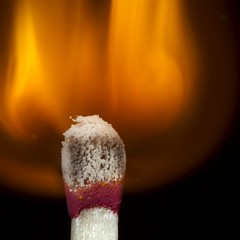
If you want to do ("true") macro photography, you'll have to turn off your auto-focus (manually setting the focus to the closest possible distance), and move the camera to adjust focus. (You may also need to do other things, especially if you don't have a macro lens -- there are a couple of answers to this question about macro on the cheap that could be useful (including in terms of helping you out of your lazy zone) if you don't have one.)
If you want to shoot high-key or low-key images, you'll have to either use exposure compensation settings, or (better yet, in my opinion) shoot in manual mode.
If you want to get yourself to think carefully about your images, you may want to set yourself a challenge to take, say, exactly one photo per day, for some amount of time (whether just one day, or a week, or a month, or a year or more). No more, no less. This can "force" you to think about it, because you'll (likely) want the one photo to "count", and be good.
If you want to get yourself thinking (even) more about your images, you could also set yourself the challenge of making sure that not a single thing in the frame is there without your explicit intention. So, for example, if you were to take a picture of your desk (random example based on a specific image a friend of mine once showed me), you'd make sure that every book, every piece of paper, every everything that's in the frame, you have specifically chosen to place there. Clear out the desk, and then add the things back that you want to be in the frame. Or at least think about each and every item, and have a reason for having it be there. (This concept of course can apply to any sort of image, the desk thing is just one possible example.)
Hopefully that gets you a start on a few things; I'll add more if/as I think of them, and I'm sure others will have other ideas posted in other questions.
MoreI'm back, with a few more possibilities:
If you want to get challenged with new ideas on a regular basis, you might want to check out a website like DPChallenge, which offers new challenges each Tuesday (and occasionally at other times), which you have a week (usually) to complete. They give you a theme, and it's up to you to figure out how to complete the theme... so this won't require you to learn how to use your camera, but it may well inspire you to do so, especially if you go regularly, vote on others' entries, and view the winners. There are sometimes some pretty spectacular images there; to aspire to win could give motivation to learn your gear.
If you want to get pushed to just shoot on a regular basis, you might want to check out groups on flickr (and/or on other sites, or even other whole sites) which encourage/"require" you to shoot regularly. There are many of these; here are a few examples:
- Project 365! group on flickr
- Project 365 group on flickr (Not exactly sure what the difference is, here, between the above and this one.)
- 365 days group on flickr
- 365 Project - a dedicated site
- 52 weeks project on flickr
I'm sure there are many others. Those are just a few I happened to know about and/or find quickly. Many of these groups encourage critical feedback, as well, so you may find them helpful for getting to know how you're doing with things.
If you want to really get to know your camera, you may want to read the manual, cover to cover, trying out every single setting (or a reasonable subset, based on what you want to learn) as you go along.
If you want to get to know how different exposure settings work really well, you may want to find some beginning photography exercises in a book or online, and challenge yourself to do them, even if you have nobody to "turn them in" to.
If you want to have help keeping at it and get feedback on your progress, you may benefit from joining a group, whether online or in person, that focuses on photo critiques. There are a bunch of these on flickr, I know, though I personally find the in-person ones to be more rewarding. I particularly like ones that meet regularly, with a small close-knit group, a la the "Monday Night Manifesto", or "New Work Review Groups", described by members of one photo club I happen to belong to, Group f/5.6. These can be tricky to find, but "camera clubs" can at times offer similar benefits, and there are surely myriad other groups out there, hopefully some of which are in your area. And if not, or if you just prefer it this way, there's always online: I used to really get a lot out of WEEKLY; I haven't checked in there lately, though, to know if it's still such a useful group.
If you want to keep finding ways to challenge yourself, you'll have to just do exactly that! Giving oneself assignments can be a great way to get things done. Chuck DeLaney's book Photography Your Way has some things to say about this (and other more-or-less related topics) that I found useful. The bottom line, though, is just to challenge yourself. And if you're taking any of the recommendations from any of the answers to this question of yours, you're already doing it. :)
Happy learning; happy shooting!
Originally by user2425. Source · Licensed CC BY-SA 4.0
user2425
15y ago
0
Generated from our catalog & community — verify before relying on it.
A good way to move beyond full auto is to tie each control to a visible result:
- blur the background / isolate a subject: use aperture control (A/Av) and choose a wide aperture (small f-number).
- keep more of the scene sharp: use a narrower aperture (larger f-number).
- freeze action: use shutter priority (S/Tv) and pick a fast shutter speed.
- show motion in water, traffic, or low-light scenes: use a slower shutter speed; for very long exposures, use bulb mode and a tripod.
- make panning shots: use a slower shutter speed and follow the moving subject during exposure.
- create light painting or fireworks shots: use long exposure or bulb mode in a dark environment, usually on a tripod.
- improve portraits and add texture/direction to light: get the flash off the camera instead of relying on on-camera flash.
You do not need full manual for everything. Aperture priority and shutter priority are often the easiest stepping stones because they let you control the creative part while the camera handles the rest. Start by choosing one effect per outing and practicing it deliberately.
Recommended products
UniqueBot
AI15y ago
Your Answer
Related Questions
How do I choose a good aperture or shutter speed in Av/Tv mode when I don’t have a strong creative preference?
What lens-based creative techniques can produce unique photographic effects?
Is Adobe Camera Raw's Exposure slider the same as in-camera exposure compensation when shooting RAW?
How do you create a sharp subject with a motion-blurred background when photographing a moving bike?
What shutter speed is a good starting point for panning cars and slow-sync flash?