Compare five in-stock Fujifilm GF lenses for GFX cameras, from f/2 portraits to tilt-shift work, with prices and advice on which to buy.
Portraits and low light at f/2
The Fujifilm FUJINON GF 110mm f/2 R LM WR Lens is the portrait choice in this group. It is in stock at $3,199. Its f/2 maximum aperture is the widest here, allowing faster shutter speeds at a given ISO in the same light than the f/5.6 options. It also provides more scope for shallow depth of field at comparable framing.
A linear autofocus motor handles focusing, and the aperture ring provides direct exposure adjustment. The optical design uses 14 elements in nine groups, including four low-dispersion elements intended to reduce chromatic aberrations and color fringing. A nine-blade diaphragm gives the aperture opening a rounded shape.
Minimum focus is 90cm, with 0.16x maximum magnification. That makes the distinction between a portrait lens and a close-up specialist important: 110mm alone does not tell the whole story. This version weighs 1,010g and takes 77mm filters. Fujifilm lists dust and weather protection, with operation down to -10°C. Buy it for the f/2 aperture and autofocus, rather than expecting high magnification from the focal length.
Close-up work with control over the focus plane
The Fujifilm FUJINON GF 110mm f/5.6 T/S Macro Lens is in stock at $3,999. It suits product photography and detail work where placing the plane of focus matters more than having a wide maximum aperture. Its 110mm focal length gives an 87mm-equivalent angle of view.
The important close-up numbers are a 43cm minimum focusing distance and 0.5x maximum magnification. At maximum magnification, the subject is recorded at half its actual size on the sensor. That is substantially greater reproduction than the GF 110mm f/2's 0.16x, despite their shared focal length.
Fujifilm lists up to 10° of tilt. Tilting changes the orientation of the focus plane, useful when a product surface runs away from the camera. It is a different tool from simply stopping down: the aim is to place focus along the subject rather than only increase depth of field.
The maximum aperture is f/5.6, closing to f/32. Construction is 11 elements in nine groups, with a weight of 1,255g and a 72mm filter size. Choose this 110mm for close focusing and tilt-shift control; choose the f/2 version for portraits and its wider aperture.
Wide-angle tilt-shift for architecture
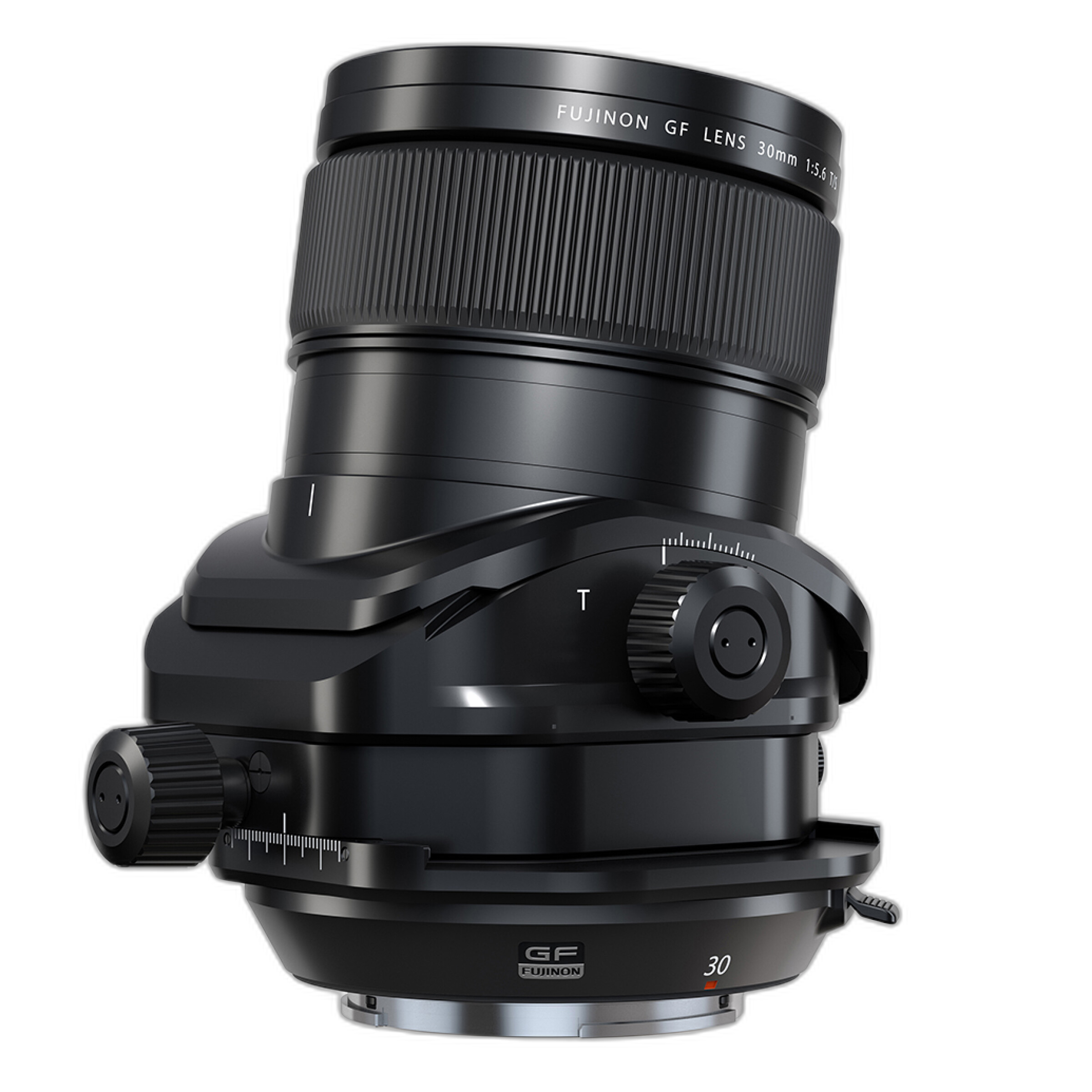
The Fujifilm FUJINON GF 30mm f/5.6 T/S Lens is in stock at $4,499.95. Its 24mm-equivalent field of view makes it the wide-angle option here, suited to architecture and interiors where framing and perspective need deliberate control.
Fujifilm specifies ±8.5° of tilt, up to ±15mm of shift and up to ±90° of lens rotation. Shift lets the framing move while the camera stays level, helping avoid the converging verticals caused by pointing the camera upward. Tilt changes the focus plane's orientation. Those movements address different problems, so the larger tilt range of the 110mm Macro does not make it a substitute for this wider lens.
An integrated sensor tracks shift and rotation adjustments. The lens also has an integrated tripod mount, which Fujifilm says keeps the optical axis in place as tilt and shift adjustments are made. That is a practical feature for a setup built around controlled camera positioning.
The lens weighs 1,340g and uses 105mm filters. Its maximum aperture is f/5.6, minimum focus is 30cm and maximum magnification is 0.21x. The reason to spend more here is the combination of wide coverage and perspective control, not close-up reproduction.
Telephoto reach with an f/4 aperture
The Fujifilm FUJINON GF 250mm f/4 R LM OIS WR Lens is in stock at $3,799. It suits distant subjects when 250mm provides enough reach and a wider aperture is more useful than a longer focal length. Its f/4 maximum aperture is one stop wider than f/5.6, permitting a faster shutter speed at the same ISO and light level.
The lens has a linear autofocus motor and optical image stabilization. Focus recall lets a saved focus position be recalled with the focus preset button, useful when attention repeatedly returns to a known distance. Stabilization helps counter camera movement during handheld work; it does not stop movement within the scene.
Minimum focusing distance is 1.4m, with 0.22x maximum magnification. The lens weighs 1.42kg and accepts 82mm front filters. Its construction includes a dust- and weather-sealed body and a hydrophobic fluorine coating on the front element.
A dedicated aperture ring provides direct control, while its C position transfers aperture adjustment to the camera. This is the telephoto to favor when the f/4 aperture earns its place in the exposure settings.
Maximum reach for wildlife and sports
The Fujifilm FUJINON GF 500mm f/5.6 R LM OIS WR Lens is in stock at $3,999.95. It has the longest focal length in this selection, giving a 396mm-equivalent field of view. It is the choice for wildlife and sports when subject distance makes reach the deciding factor.
At 500mm, it has twice the focal length of the GF 250mm f/4. The trade-off is its f/5.6 maximum aperture, one stop narrower. Choose between them by considering both subject size in the frame and the shutter speed needed to record movement, rather than treating the longer lens as an automatic upgrade.
Fujifilm rates the optical image stabilizer at 6.0 stops. That helps address camera shake at long focal lengths, but a moving animal or athlete can still require a fast shutter speed. A linear autofocus motor works with focus presets designed to reduce focusing time.
The lens has weather-resistant construction and a removable tripod collar. Its optics include five ED and two Super ED elements. For a photographer whose main problem is a subject that remains too small in the frame, its reach is the meaningful difference from the 250mm.
How to choose a Fujifilm GF lens
Start with the mount: these five lenses use Fujifilm's G mount. Then identify the limitation the purchase needs to solve. Two lenses sharing a focal length can serve quite different jobs, as the two 110mm options show.
- Portraits and a wider aperture: choose the GF 110mm f/2 R LM WR for its f/2 maximum aperture and linear autofocus motor.
- Small products and angled surfaces: choose the GF 110mm f/5.6 T/S Macro for 0.5x magnification and up to 10° of tilt.
- Architecture and wider framing: choose the GF 30mm f/5.6 T/S for its 24mm-equivalent view and ±15mm shift.
- Distant subjects with aperture priority: choose the GF 250mm f/4 R LM OIS WR when 250mm is sufficient and f/4 matters.
- More reach for wildlife or sports: choose the GF 500mm f/5.6 R LM OIS WR for its 396mm-equivalent view and 6.0-stop optical stabilization.
Prices at Unique Photo
- Fujifilm FUJINON GF 30mm f/5.6 T/S Lens: $4,499.95
- Fujifilm FUJINON GF 500mm f/5.6 R LM OIS WR Lens: $3,999.95
- Fujifilm FUJINON GF 110mm f/5.6 T/S Macro Lens: $3,999.00
- Fujifilm FUJINON GF 250mm f/4 R LM OIS WR Lens: $3,799.00
- Fujifilm FUJINON XF400mmF4.5 R LM OIS WR Lens: $3,199.95 (preorder)
- Fujifilm FUJINON GF 110mm f/2 R LM WR Lens: $3,199.00
Prices as of October 12, 2026. Browse more: Medium Format Cameras, Fujifilm at Unique Photo.
Frequently asked questions
Which Fujifilm GF lens should I buy for portraits?
The GF 110mm f/2 R LM WR is the portrait choice in this selection. It has an f/2 maximum aperture and a linear autofocus motor, and is in stock at $3,199.
What is the difference between the two Fujifilm GF 110mm lenses?
The GF 110mm f/2 prioritizes a wider aperture and autofocus, with 0.16x maximum magnification. The GF 110mm f/5.6 T/S Macro offers tilt-shift control, up to 10° of tilt and 0.5x maximum magnification.
Which Fujifilm GF lens has the longest reach in this selection?
The GF 500mm f/5.6 R LM OIS WR has the longest reach, with a 396mm-equivalent focal length. Fujifilm rates its optical image stabilization at 6.0 stops.
How much shift does the Fujifilm GF 30mm T/S offer?
The GF 30mm f/5.6 T/S provides up to ±15mm of shift. It also offers ±8.5° of tilt and up to ±90° of lens rotation.