The Tamron 20-40mm f/2.8 Di III VXD Lens for Nikon Z is available to preorder for $729, with a constant f/2.8 aperture and 385 g weight.
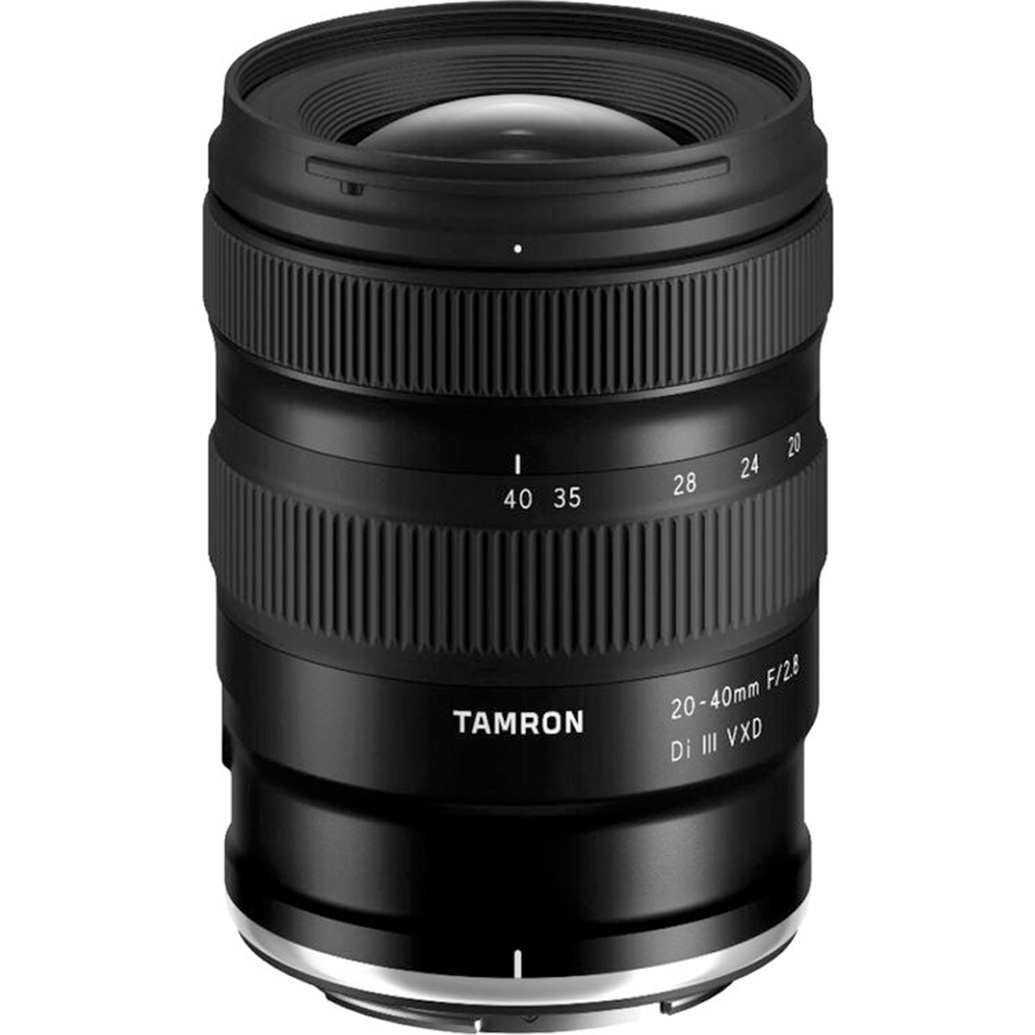
Nikon Z mount, $729, available to preorder
The Tamron 20-40mm f/2.8 Di III VXD Lens (Nikon Z) is a full-frame zoom priced at $729 and available to preorder at Unique Photo. Its main combination is straightforward: a wide-to-natural focal range, a constant f/2.8 maximum aperture and a weight of 13.6 oz / 385 g.
It is aimed at photographers who want wide coverage for travel and street work without giving up a bright maximum aperture. The range also suits video and vlogging, where changing the framing without swapping lenses can be useful. Everyday portraits with some surroundings in the frame are another sensible use for its longer end.
What the 20–40mm range covers
At 20mm, the lens takes in a broad view for landscapes and city scenes. Moving toward 40mm narrows that view to a more natural perspective, useful for concentrating on a person or a smaller part of the scene. Tamron lists a diagonal angle of view from 94° 30' to 56° 49'.
This is a zoom for adjusting wide framing, not for reaching distant subjects. The practical choice is between showing more context at 20mm and reducing that context toward 40mm. For travel, that can mean moving from a whole scene to an everyday portrait with the same lens. It still pays to think about camera position rather than relying on the zoom ring alone.
Constant f/2.8 and the optical design
The f/2.8 maximum aperture stays constant throughout the zoom range. At the widest aperture setting, zooming from 20mm to 40mm does not force a change to a smaller aperture. That matters for manual exposure and for video, where an aperture change during a zoom could change the brightness of the shot.
The aperture also provides depth-of-field control, although background separation still depends on focal length and subject distance. A wide view at f/2.8 will not automatically erase everything behind the subject.
Tamron lists 12 optical elements in 11 groups, including specialized glass elements intended to support image quality. The diaphragm has nine blades, and the minimum aperture is f/22. Those are construction specifications, not a substitute for judging rendering in a particular scene.
VXD autofocus for video and moving subjects
VXD stands for Voice-coil eXtreme-torque Drive. Tamron describes this linear autofocus motor as fast, quiet and precise, with tracking performance intended for stills and video. The company also lists compatibility with Fast Hybrid AF and Eye AF.
For video, quiet focus operation matters when a microphone is close to the camera. Tracking is useful when a subject moves toward or away from the lens during a take. For everyday portraits, Eye AF compatibility is relevant to keeping attention on the person rather than repeatedly repositioning a focus point. Autofocus and stabilization remain separate jobs: one adjusts focus distance, while the other addresses camera movement.
6.7-inch close focus, with 0.26x magnification
The minimum focusing distance is 6.7 inches / 17 cm, and Tamron lists maximum magnification as 0.26x, or a 1:3.8 reproduction ratio. That gives this wide zoom a role in close-up detail photography as well as broader scenes.
Minimum focusing distance is measured from the camera's sensor plane, not from the front of the lens. It should not be read as the amount of clear space available between the lens and the subject.
The magnification figure is the useful limit to keep in mind. At 0.26x, a subject is reproduced on the sensor at roughly a quarter of its actual size, rather than life size. That supports macro-style detail shots, but it is not 1:1 reproduction.
385 g body, 67mm filters and a short zoom turn
The lens measures 2.9 x 3.5 inches / 74.4 x 88.7 mm in diameter and length, with a weight of 13.6 oz / 385 g. Those dimensions are useful when planning a small camera bag; the lens is only one part of the total carried weight.
The filter thread is 67mm, the size to match for screw-in filters. Tamron also specifies a 65° zoom rotation, so moving across the focal range requires a relatively short turn of the ring.
There is no image stabilization in the lens. The f/2.8 aperture can help support faster shutter speeds for still photographs, but it does not steady the image during handheld video. That distinction matters for the vlogging audience Tamron is addressing.
Moisture resistance and app customization
Tamron lists a moisture-resistant build with a protective fluorine coating. Moisture resistance is useful protection for a travel-oriented lens, but it should not be treated as a waterproof rating. The exterior also receives an enhanced finish.
Customization is supported through Tamron Lens Utility and Tamron-Link apps. That software support is a separate part of the lens's handling from the physical 65° zoom rotation. For buyers comparing the specifications, the practical distinction is that the lens offers app-based customization as well as its autofocus and zoom controls.
Prices at Unique Photo
- Tamron 20-40mm f/2.8 Di III VXD Lens (Nikon Z): $729.00 (preorder)
Prices as of October 11, 2026. Browse more: Mirrorless Lenses, Tamron at Unique Photo.
Frequently asked questions
How much is the Tamron 20-40mm f/2.8 Di III VXD for Nikon Z?
The Nikon Z version costs $729 and is available to preorder at Unique Photo.
Is the Tamron 20-40mm f/2.8 for Nikon Z a full-frame lens?
Yes. It is a full-frame zoom with a Nikon Z mount and a constant f/2.8 maximum aperture.
Does the Tamron 20-40mm f/2.8 have image stabilization?
No. Tamron lists no image stabilization in the lens.
How close can the Tamron 20-40mm f/2.8 focus?
Its minimum focusing distance is 6.7 inches / 17 cm. Maximum magnification is 0.26x, with a 1:3.8 reproduction ratio.
What filter size does the Tamron 20-40mm f/2.8 use?
It uses a 67mm filter thread.