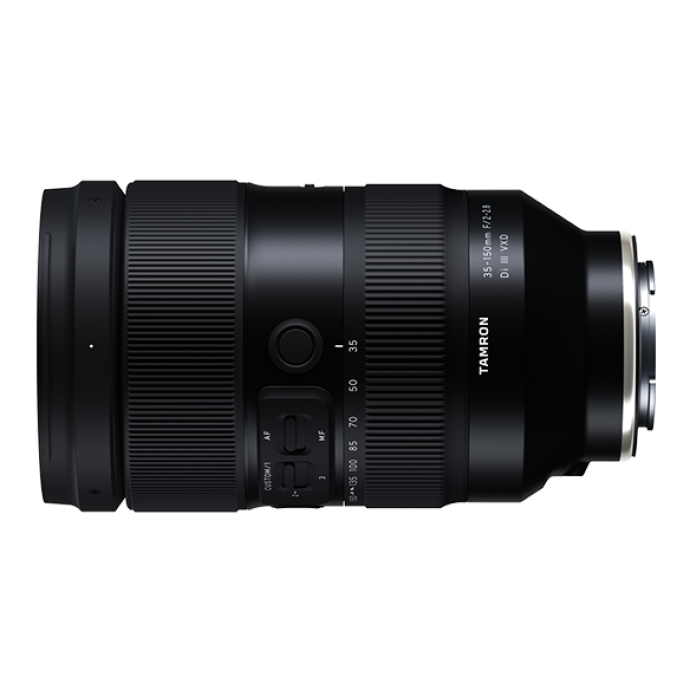
In late 2021, Tamron introduced a lens that immediately stood out in the fast-moving mirrorless market: the Tamron 35-150mm f/2-2.8 Di III VXD. At a launch price of $1,799, it arrived with a specification that felt almost purpose-built for working photographers who needed speed, flexibility, and fewer lens changes during real assignments. For wedding, portrait, and event shooters in particular, the idea was easy to understand: one lens covering a practical wide-to-telephoto range, with an unusually bright maximum aperture that starts at f/2 and extends to f/2.8.
That combination helped make the 35-150mm f/2-2.8 one of the most talked-about mirrorless zooms of its moment. Rather than following the familiar 24-70mm or 70-200mm template, Tamron proposed a different kind of professional workhorse—one aimed squarely at photographers who spend their day moving between environmental scenes, portraits, candid moments, and detail shots. Historically, it is a lens that reflects a broader shift in the mirrorless era: optics designed not just to match DSLR standards, but to rethink what an all-purpose professional zoom could be.

A New Kind of Fast Zoom
The headline specification tells the story. A 35-150mm zoom already covers a highly useful span for event and portrait work. At the short end, 35mm is wide enough for context, small groups, room scenes, and storytelling frames. Through the middle of the range, photographers have the classic portrait and documentary focal lengths that so often define wedding and event coverage. At the long end, 150mm gives welcome reach for tighter portraits, ceremony moments, speeches, and candid expressions captured from a respectful distance.
What made this lens remarkable at launch was not only that range, but the speed. An aperture of f/2-2.8 is unusually bright for a zoom covering this much ground. The wide-end f/2 maximum aperture gave shooters extra low-light capability and the potential for stronger subject isolation than typical standard zooms. Even as the lens zoomed toward the telephoto end, maintaining f/2.8 kept it in firmly professional territory.
In practical terms, that meant a photographer could move through an event with a single lens mounted for much of the day. During a wedding, for example, the same optic could plausibly handle preparations, portraits, ceremony coverage, reception candids, and details. That kind of convenience is not merely about saving time; it can also mean fewer missed moments and less sensor exposure during lens changes.
Why the 35-150mm Range Mattered
The lens’s appeal is easiest to understand in the context of real assignments. Traditional professional kits have often centered on a pair of zooms—typically one standard and one telephoto—or a mix of zooms and fast primes. Those combinations remain valid, but they also involve tradeoffs: more gear to carry, more decisions to make in the moment, and more opportunities to lose time switching lenses.
The Tamron 35-150mm f/2-2.8 suggested a different approach. By starting at 35mm instead of 24mm, Tamron gave up some ultra-wide coverage, but in return created a lens with a bright aperture and a notably broad upper range. For many wedding and event photographers, that is a smart compromise. Much of event storytelling happens between 35mm and short telephoto focal lengths, and the extension to 150mm is especially useful for compressing scenes and isolating subjects.
Seen historically, this lens belongs to a period when mirrorless systems encouraged lens makers to explore more ambitious optical formulas. The market was becoming more mature, and photographers increasingly expected native mirrorless lenses not only to be compact, but also to offer combinations of speed and versatility that had been less common in earlier generations.
Designed for Mirrorless Systems
The Di III designation marks the 35-150mm f/2-2.8 as a full-frame mirrorless lens. At launch, it was presented for Sony E, and the lens would also become available in Nikon Z mount. That alone is part of its historical importance. By the early 2020s, third-party lens makers like Tamron were playing an increasingly significant role in the mirrorless ecosystem, giving photographers more choices in high-performance optics beyond first-party lineups.
For Sony users especially, Tamron had already established a strong identity around practical, photographer-focused zooms. The 35-150mm f/2-2.8 fit that trajectory while also pushing it forward. It was not simply another alternative in an existing category; it effectively defined its own. For Nikon Z users, the lens’s eventual availability also underscored the growing demand for premium third-party options in a young but rapidly expanding mount.
VXD and the Needs of Working Photographers
The lens name includes VXD, Tamron’s designation for its Voice-coil eXtreme-torque Drive autofocus system. Around the release period, autofocus performance had become one of the decisive factors in mirrorless lens design, especially for assignment work. Wedding and event photographers need a lens that can move quickly between different subject distances, keep pace with fleeting expressions and gestures, and work confidently with modern camera tracking systems.
While any autofocus experience depends on camera body, shooting conditions, and subject matter, the inclusion of VXD placed this lens firmly in the class of optics intended for serious performance. That matched the audience Tamron was clearly targeting: photographers who need reliable speed, not just impressive paper specifications.
A Portrait and Event Specialist
Although the lens could serve many genres, its strongest identity at launch was as a wedding and event lens. The working title practically writes itself because the use case is so obvious. During wedding coverage, one lens that begins at 35mm and stretches to 150mm addresses many of the day’s most important visual needs. At 35mm, a photographer can capture scene-setting images and intimate documentary moments with context. Through the midrange, it handles natural portraits and interactions. At 150mm, it reaches across aisles, dance floors, and reception rooms without intruding on the moment.
Portrait photographers also had reason to pay attention. Much of the classic portrait range falls comfortably within this zoom, and the fast aperture gives room for attractive background separation. For photographers who like to vary framing quickly while maintaining rapport with a subject, a range like 35-150mm can feel liberating.
Even beyond weddings, the same strengths translate well to corporate events, editorial assignments, travel portraiture, and general people-focused photography. In that sense, the lens is best understood as a specialty tool with broad practical appeal.
Its Place in Tamron History
Tamron has long been known for identifying real-world photographic problems and proposing unconventional but useful solutions. The company’s history includes lenses that gained strong followings not because they followed tradition, but because they answered how photographers actually work. The 35-150mm f/2-2.8 Di III VXD is very much in that mold.
By 2021, mirrorless lens development had entered a more confident stage. Early concerns about system completeness were giving way to more specialized and ambitious products. The Tamron 35-150mm stands as an archival marker of that period: a lens that did not merely fill a catalog gap, but expressed a mature understanding of modern shooting demands. It also reflected the increasingly blurred line between convenience and professional performance. In earlier eras, an all-in-one zoom often implied compromise. Here, Tamron argued that versatility itself could be a premium feature.
Launch Context and Value
At $1,799 at launch, the 35-150mm f/2-2.8 was positioned as a serious investment, but also one that many working photographers could justify by the jobs it might simplify. For a shooter considering the cost of multiple lenses—and the operational complexity that comes with them—the value proposition was easy to see. This was not an entry-level convenience zoom. It was a purpose-built professional lens with a distinctive pitch: carry less, change lenses less often, and still keep access to fast apertures and highly practical focal lengths.
That pricing also signaled confidence. Tamron was not presenting the lens as merely a budget alternative; it was introducing a flagship-style optic intended to compete on capability and originality.
Looking Back
Seen from a historical perspective, the Tamron 35-150mm f/2-2.8 Di III VXD remains one of the more memorable lens launches of 2021. Its significance lies in how clearly it addressed a real photographic workflow, especially for weddings and events. Instead of asking photographers to adapt to a conventional lens category, Tamron delivered a product built around the rhythms of actual assignments.
For Sony E and Nikon Z users, it represented the kind of bold third-party innovation that helped define the mirrorless era. For portrait, wedding, and event photographers, it offered a compelling answer to an old question: what if one lens could do most of the day’s work without feeling like a compromise?
To explore the Tamron 35-150mm f/2-2.8 Di III VXD, compare Tamron lenses, or learn more about standout optics from the mirrorless era, visit Unique Photo—a trusted place to buy camera gear and dig deeper into photographic equipment history.