Compare the Tamron 20-40mm f/2.8 Di III VXD Lens for Nikon Z and Sony E with the LUMIX S 18-40mm on aperture, size and mount.
Start with Nikon Z, Sony E or L-Mount
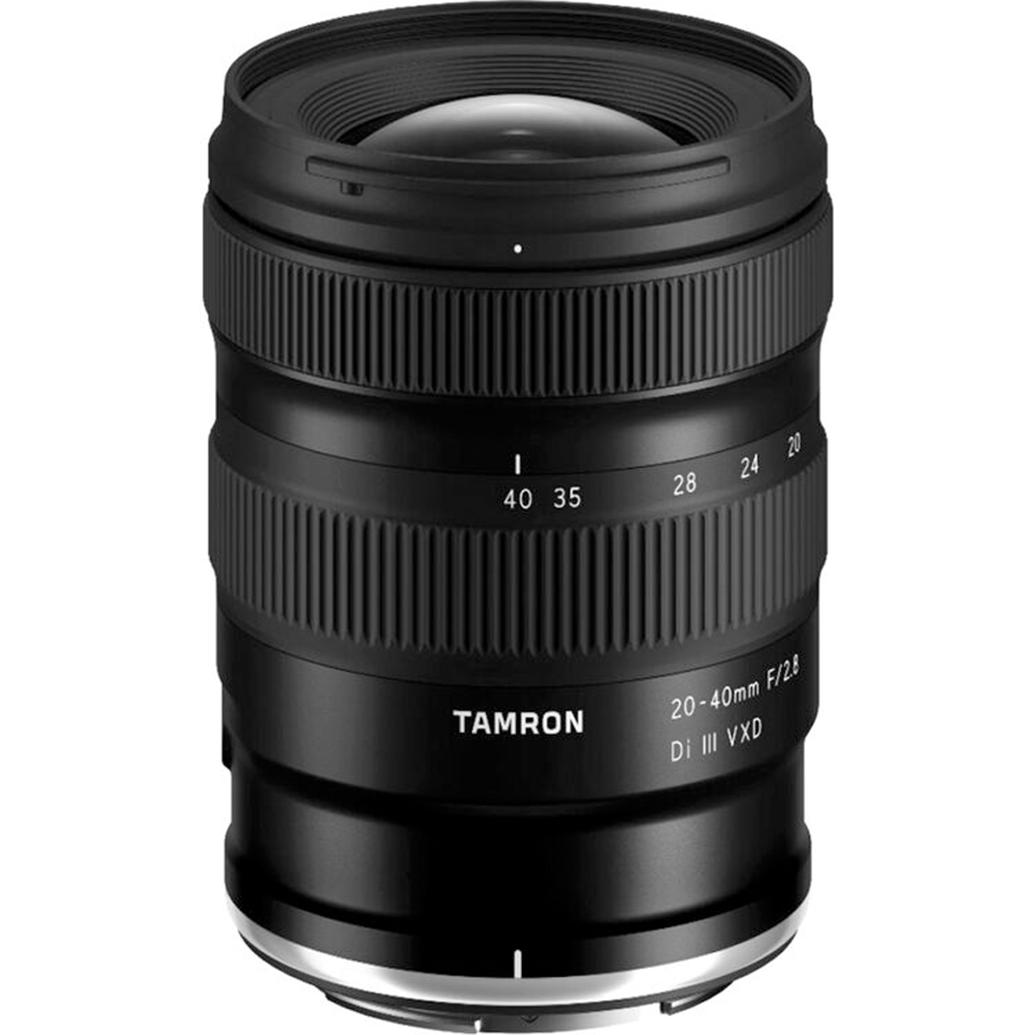
The Tamron 20-40mm f/2.8 Di III VXD Lens (Nikon Z) is a full-frame Nikon Z-mount zoom. The Tamron A062 20-40mm F/2.8 Di III VXD Lens for Sony E covers the same focal range with the same constant maximum aperture, but uses Sony E-mount. The Panasonic LUMIX S 18-40mm F4.5-6.3 uses L-Mount and trades aperture size for lower weight and a wider starting focal length.
These are not three interchangeable choices for one camera mount. For someone keeping an existing camera, compatibility sorts the options first. For someone comparing systems, the meaningful trade is between the Tamrons' f/2.8 aperture and Panasonic's smaller carrying load.
Specifications shared across all three lenses
Both Tamrons reach 40mm from a 20mm starting point. Panasonic reaches the same long end but starts at 18mm.
| Specification | Tamron Nikon Z | Tamron Sony E | Panasonic L-Mount |
|---|---|---|---|
| Mount | Nikon Z | Sony E | L-Mount |
| Focal length | 20–40mm | 20–40mm | 18–40mm |
| Maximum aperture | Constant f/2.8 | Constant f/2.8 | f/4.5 wide; f/6.3 tele |
| Weight | 385g / 13.6 oz | 365g / 12.9 oz | Approx. 155g / 0.34 lb, excluding caps |
| Length | 88.7mm / 3.5 in | 3.4 in | Approx. 40.9mm / 1.61 in, retracted |
| Filter thread | 67mm | 67mm | 62mm |
| Minimum focus distance | 17cm / 6.7 in | 6.7 in wide; 11.4 in tele | 0.15m at 18–21mm; 0.35m at 40mm |
| Diaphragm blades | 9 | 9, circular diaphragm | 7, circular diaphragm |
Constant f/2.8 versus the wider 18mm view
The Tamrons maintain an f/2.8 maximum aperture throughout their zoom range. Panasonic starts at f/4.5 at 18mm and reaches f/6.3 at 40mm. At the shared 40mm setting, f/2.8 is more than two stops wider than f/6.3. In the same lighting, that can support a faster shutter speed for moving people or a lower ISO when shutter speed stays fixed.
That is a practical difference for indoor photography. It also matters when zooming during video: either Tamron can stay set to f/2.8 throughout the zoom. With Panasonic, f/4.5 is available at the wide end but not at 40mm. Exposure settings may need to compensate if the lens starts at its widest available aperture.
Panasonic answers with 18mm coverage. On full-frame cameras, that takes in a broader view than 20mm, useful for buildings or rooms where stepping backward is not an option. None of these lenses extends beyond 40mm optically, so Panasonic's extra range is entirely at the wide end. The choice is more room in the frame versus a wider maximum aperture.
Weight, packing length and filter fit
The Sony E Tamron weighs 365g, versus 385g for Nikon Z. That is a 20g difference. Panasonic's approximately 155g weight, excluding caps, is less than half either Tamron's listed weight. For a camera carried on a strap for hours, that is a more substantial distinction than the difference between the two Tamrons.
Panasonic lists a retracted length of approximately 40.9mm. Read that as a packing dimension, not a shooting-length measurement. The Nikon Z Tamron measures 88.7mm long; the Sony E version is listed at 3.4 inches.
Both Tamrons accept 67mm filters, so existing filters of that thread size can carry over between versions. Panasonic takes 62mm filters. All three have fluorine coatings and resistant construction: Tamron specifies moisture resistance, while Panasonic specifies dust, splash and freeze resistance.
Close focus is not the same as life-size macro
Tamron lists a 17cm minimum focus distance and 0.26x maximum magnification for the Nikon Z lens. The Sony E version focuses to 6.7 inches at the wide end and 11.4 inches at the long end. Minimum focus distance is measured from the camera's image plane, not from the front of the lens, so it is not the clearance left between lens and subject.
Panasonic focuses to 0.15m at 18–21mm and 0.35m at 40mm. Its maximum magnification is 0.28x at 21mm. That is slightly higher than the Nikon Z Tamron's listed 0.26x, but neither figure represents 1:1, life-size reproduction. For small details, magnification tells more about how large the subject can appear in the frame than minimum focus distance alone.
Video features address different problems
Tamron describes the Nikon Z lens's VXD linear autofocus motor as fast and quiet. That version also has a 65° zoom rotation, meaning relatively little ring travel between 20mm and 40mm, plus customization through Tamron Lens Utility and Tamron-Link apps. The Sony E lens also supports autofocus.
Panasonic lists focus breathing suppression. Its purpose is to reduce changes in framing as focus moves, which matters during a visible focus transition in video. That is a different consideration from keeping the maximum aperture constant while zooming.
Neither Tamron includes image stabilization. A wider aperture can help support a faster shutter speed for still photographs, but it does not provide optical correction for camera shake during handheld video. Treat the f/2.8 aperture as an exposure tool, not as a substitute for keeping the camera steady.
Who should choose each version
- Nikon Z owners prioritizing f/2.8: Choose the Nikon Z Tamron for its constant aperture if indoor subjects or shutter-speed flexibility matter more than minimum carrying weight. It is $729 and available to preorder at Unique Photo.
- Sony E owners wanting a wide-to-normal f/2.8 zoom: Choose the Sony E Tamron for the same 20–40mm coverage and constant aperture in the appropriate mount. Its listed weight is 365g. It is $699.95 and in stock.
- L-Mount owners prioritizing portability and wider coverage: Choose the Panasonic for its approximately 155g weight and 18mm starting point. The f/4.5–6.3 maximum aperture is the trade-off, particularly at 40mm. It is $547.99 and in stock.
Prices at Unique Photo
- Tamron 20-40mm f/2.8 Di III VXD Lens (Nikon Z): $729.00 (preorder)
- Tamron A062 20-40mm F/2.8 Di III VXD Lens for Sony E: $699.95
- Panasonic LUMIX S 18-40mm F4.5-6.3: $547.99
Prices as of November 9, 2026. Browse more: Mirrorless Lenses, Tamron at Unique Photo.
Related reading: Tamron 20-40mm f/2.8 Di III VXD Lens Announced for Nikon Z.
Frequently asked questions
Does the Tamron 20-40mm f/2.8 come in Nikon Z and Sony E mounts?
Yes. There are separate Nikon Z and Sony E versions, both covering 20–40mm with a constant f/2.8 maximum aperture.
Does the Tamron 20-40mm f/2.8 have image stabilization?
Neither the Nikon Z version nor the Sony E version includes image stabilization.
Is the Panasonic LUMIX S 18-40mm a constant-aperture lens?
No. Its maximum aperture is f/4.5 at the wide end and f/6.3 at the telephoto end.
What filter sizes do these lenses use?
Both Tamron 20-40mm versions use 67mm filters. The Panasonic LUMIX S 18-40mm uses 62mm filters.
Is the Nikon Z Tamron 20-40mm f/2.8 available?
The Nikon Z version is available to preorder at Unique Photo for $729.