.png)
Technology is generally seen as advancement, however technology in photography can be seen as a crutch . New tech may make our lives easier, but in return comes lethargy...No intent to make, rather a better way to just take. An artist named Phillip Sterns decided that the medium needed a challenge and the results were fairly shocking.
"We are situated in a place where the photograph as an object has lost its primacy to the digital image, and the whole discipline of photography has undergone fundamental technological changes without much consideration for how this alters our theoretical understanding of the role of the digital photographic image in society and cultural (re)production. Following my work with digital cameras, I felt compelled to explore, or rather challenge the ontology of post-digital photography using extended techniques—bending, cracking and breaking the medium—to not only produce a medium specific work, but something that is an absolutely unique image/object."
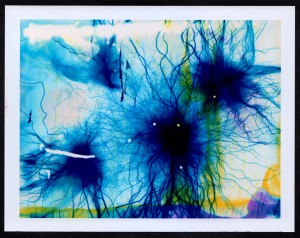
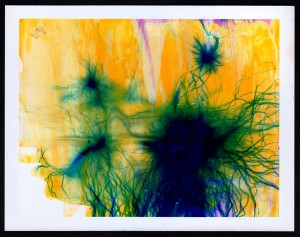
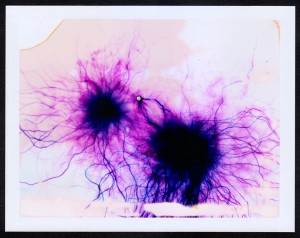
So how did he break the medium? By taking away the camera and instead creating images in a relatively unorthodox way. Leave it to science to challenge art. He began experimenting once seeing the similarities between instant color film (like Fuji FP100C) and the human eye; hence the "Retinal Pigment Epithelium" shtick. To further screw with the formula he used household cleaning supplies and high voltages of electricity to subsequently symbolize visual cleansing and the electronic impulses from the brain...Eh sounds kind of heady, I think he just thought it would be cool to screw up some film, but a long artist statement is just part of it I guess. While the idea of a photogram isn't necessarily new, making them on instant film with electricity and bleach is pretty innovative. Nonetheless, the results are pretty amazing. Science Rules. 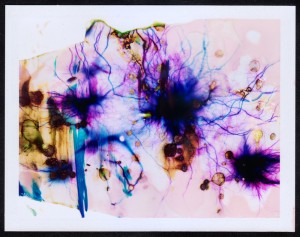
 Click here to see more work from Philip Sterns