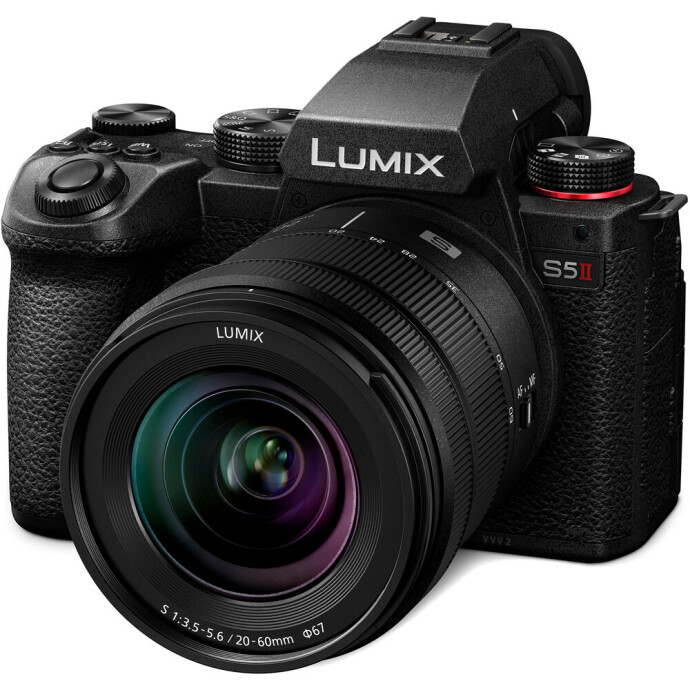
Panasonic’s January 2023 announcement of the Lumix S5 II marked one of the most consequential updates yet for the company’s full-frame mirrorless line. On paper, the camera arrived as a highly appealing continuation of the original S5 concept: a compact full-frame body, strong hybrid stills-and-video ambitions, and the versatile L-mount. But the headline feature was bigger than any routine generational refresh. With the S5 II, Panasonic brought phase-detect autofocus to the Lumix full-frame system, a long-awaited move that instantly made this release one of the most discussed camera launches of early 2023.
At launch, the Lumix S5 II entered the market at $1,999, pairing a 24.2MP full-frame PDAF sensor with advanced video capability including 6K/30p and 4K/60p. That combination positioned it squarely in the heart of the enthusiast and professional hybrid market, where creators increasingly expected one camera to handle high-quality stills, dependable autofocus, and serious video production without forcing major compromises.
A Turning Point for Lumix Autofocus
For years, Panasonic had built a strong reputation in video-centric camera design. The company’s Lumix bodies were widely appreciated for image quality, ergonomics, stabilization, and recording features, especially among filmmakers and content creators. At the same time, autofocus was often the most debated part of the Lumix story. Panasonic had long relied on its Depth From Defocus approach, which could work very well in many situations but remained a frequent point of comparison against the on-sensor phase-detect systems used by key competitors.
The announcement of the S5 II changed that conversation immediately. The inclusion of a 24.2-megapixel full-frame sensor with PDAF was not just another spec-sheet bullet point; it represented a strategic shift for the brand. For longtime Lumix users, it suggested Panasonic was directly addressing one of the biggest barriers to broader adoption among hybrid shooters. For those considering entry into the L-mount ecosystem, it made the S5 II a far more compelling proposition from day one.
Seen in historical context, the S5 II is significant because it joined Panasonic’s established video expertise with an autofocus technology many photographers and videographers had been requesting for years. It was, in essence, a signal that Lumix intended to compete more aggressively in the full-frame mirrorless mainstream rather than remain a more specialized choice for users willing to work around autofocus limitations.
What the S5 II Brought at Launch
Panasonic launched the S5 II with a set of core specifications that made its ambitions clear. The camera featured a 24.2MP full-frame PDAF sensor, giving it a practical resolution that balanced image quality, manageable file sizes, and broad appeal for hybrid work. This was not a camera chasing headline-grabbing megapixel numbers; it was built around versatility.
Video was naturally central to the story. Panasonic specified 6K recording at 30p and 4K at 60p, reinforcing the S5 II’s position as a creator-focused body. Those formats mattered because they aligned with real-world workflows: 6K offered room for reframing and oversampled delivery, while 4K/60p supported smooth motion and flexible editing choices for social, documentary, event, and commercial content.
The camera also arrived in the L-mount ecosystem, an important point in itself. By early 2023, L-mount had become a meaningful alliance-based system with lens support spanning Panasonic, Leica, and Sigma. That broader lens landscape gave the S5 II an advantage over cameras tied to smaller or less developed lens catalogs. Buyers interested in compact primes, fast professional zooms, cine-oriented options, or premium Leica glass could all view the S5 II as a gateway into a system with real depth.
At its $1,999 launch price, Panasonic aimed the S5 II directly at a highly competitive part of the market. Pricing matters historically because it helps define a camera’s purpose. At this level, the S5 II was not positioned as a niche flagship or stripped-down entry model. Instead, it arrived as a serious enthusiast and working-creator camera intended to win buyers who wanted strong all-around performance without jumping into a much higher budget tier.
Why the S5 II Mattered in 2023
By the time the S5 II was announced, the hybrid camera market had matured considerably. Buyers no longer judged cameras only by still-image quality or only by video specs. The expectation had become broader: a camera should be able to shoot high-quality photos, deliver polished video, autofocus reliably, and fit into efficient real-world workflows. In that environment, Panasonic’s move to phase-detect autofocus felt overdue to some observers, but also potentially transformative.
The S5 II mattered because it suggested Panasonic had listened carefully to the market while preserving the strengths that had already made Lumix attractive. Rather than abandoning its identity, the company appeared to be refining it. The release was especially important for solo shooters, wedding creators, documentary teams, and multimedia journalists—users who often need to move quickly between stills and video, and who benefit enormously from dependable autofocus behavior.
It also mattered for the broader perception of the Lumix S line. The original S-series launch had established Panasonic as a serious full-frame player, but the S5 II felt like a camera that could broaden the audience. It lowered the psychological barrier for buyers who admired Panasonic’s video tools but hesitated over autofocus. That is one reason the S5 II announcement resonated so strongly at release: it did not merely introduce a new body, it potentially removed a longstanding objection to the system.
The S5 II in Panasonic’s Lineage
Historically, Panasonic has often been at its best when identifying what modern creators actually need rather than simply chasing prestige specifications. The company built much of its reputation by delivering cameras that were practical, capable, and notably strong for video. The S5 II fit squarely into that tradition.
Its place in the lineage is especially interesting because it built on the approachable spirit of the original Lumix S5 while bringing in a technology shift substantial enough to redefine expectations. In camera history, not every successor is equally important. Some models offer incremental polish; others become remembered as pivot points. The S5 II belongs in the latter category because phase-detect autofocus changed how many users understood Panasonic’s future in full-frame mirrorless.
That does not mean the camera’s importance rests on autofocus alone. Its significance comes from the combination of features and timing. A 24.2MP full-frame sensor, strong video credentials with 6K/30p and 4K/60p, the flexibility of L-mount, and an aggressive $1,999 price all worked together to create a release that felt competitive rather than merely symbolic.
An Early Archival Verdict
Viewed from the perspective of its release period, the Panasonic Lumix S5 II looked like one of the most important camera announcements of 2023’s opening weeks. It represented both continuity and correction: continuity in Panasonic’s hybrid-first philosophy, and correction in the form of a long-requested autofocus evolution. That blend gave the camera unusual weight in the market conversation.
For photographers, the S5 II promised a full-frame imaging platform with modern autofocus expectations. For videographers, it reinforced Panasonic’s commitment to strong internal recording options and creator-friendly design. For the L-mount system, it provided fresh momentum and a body likely to attract users who previously might have stayed on the sidelines.
In historical terms, the S5 II is likely to be remembered as more than a routine update. It was the camera that signaled Panasonic’s willingness to adapt in a highly competitive era while preserving the qualities that made Lumix distinctive in the first place.
Learn More About the Lumix S5 II
If you’re exploring the history of Panasonic’s full-frame mirrorless system or considering the Lumix S5 II for your own stills-and-video workflow, it remains an important model to know. For current availability, compatible L-mount lenses, and expert guidance on Panasonic gear, Unique Photo is an excellent place to buy, compare, or learn more.