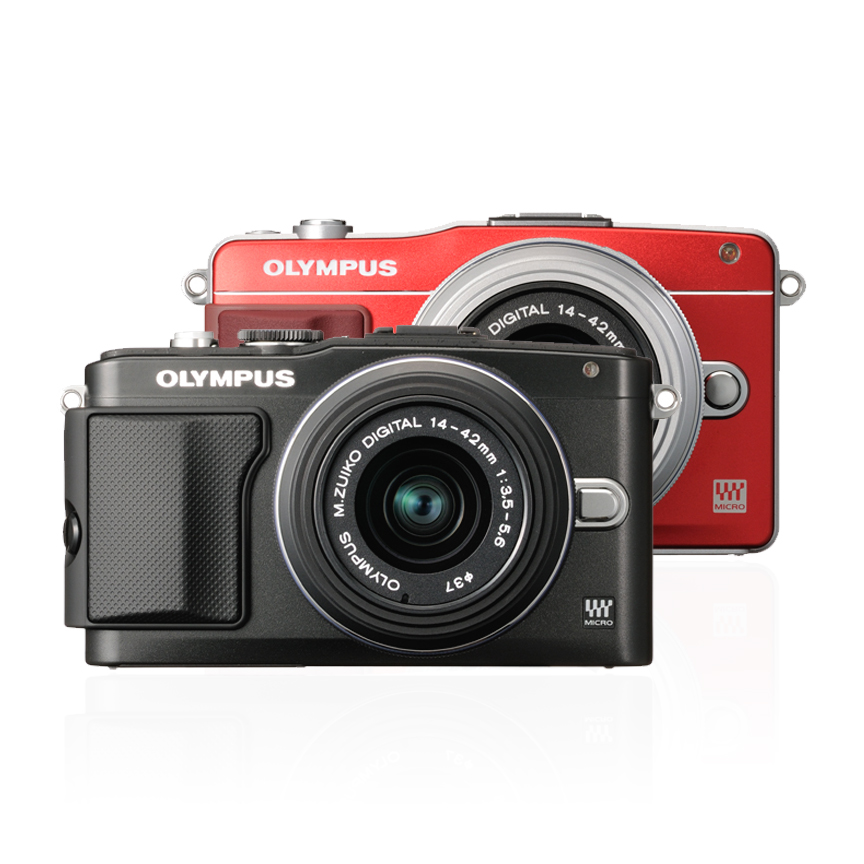
The Olympus Pen Series is a peculiar breed of camera. More often than not, "micro four thirds" is a big question mark for consumers even though it's been around for a while. Still the idea is relatively new in the grand scheme of things and it's an uncharted territory for both new and old photographers. So what's the big deal about micro 4/3 cameras and why would you want one? What's nice is that you'll have image quality that's superior to high-end point and shoots without the restraint of just one attached zoom lens. Like any niche, those that use the systems swear by them. You hear stories of pros switching from their big ol' DSLR to these much smaller, much lighter cameras. Unfortunately their appearance doesn't win over everyone...to the unknowing public, the size of your camera is in direct proportion to how much of a pro you are. While it's difficult to convince people otherwise, the images you take should do the talking despite the size of your camera. Olympus, a forerunner of micro four thirds cameras, hopes to do just this with their newest updates to the E-PL and E-PM lines. While continuing to create compact systems with powerful sensors, they have made a point to tighten up last years models with various performance enhancements. At first glance there isn't much of a difference between these two, but will the next generation of the PEN line be enough to win over the curiosity of both amateur and professional alike?

Micro Mount Olympus
The original four thirds system was intended to create a smaller interchangeable lens system. Since the sensors were larger than most 1/2.3" sensors found in point and shoots, this meant a compact body with much better quality images and smaller, lighter lenses (especially on the telephoto end). Chasing something even smaller, Olympus and Panasonic began eliminating the mirror/pentaprism design, hence the "mirrorless rangefinder" cameras. Olympus' Pen EP-1 was one of the first micro four thirds cameras and upon it's announcement the blogs were abuzz with excitement...Perhaps this was out of disappointment from the stagnant compact cameras market. MFT cameras were intended to fill the gap between high end compacts and APS-C. So why would you want a mirrorless camera? The idea is that you'll essentially pack lighter without having to sacrifice image quality. You also have the convenience of a wide array of lenses and with an adapter, you can even use some of your older lenses. Sounds promising, but unfortunately the draw backs were plentiful within the early micro four thirds cameras. The contrast-detect type autofocus was slow and ISO performance buckled in low light. Since there's no mirror/pentaprism type viewfinder, you had to rely on composing with the LCD or an electronic viewfinder, which people either love or hate. They're getting better, but I usually fall towards the latter. Like most new cameras, The E-PL5 and E-PM2 offer more megapixels on a the same size sensor, but the real selling point is improvement on all-around performance with a very feature-intuitive experience. The last part may be an attempt to hark on current trends to appeal to the consumer crowd, but is this a smart move?
These two cameras have the same 16MP sensor, 3 axis in-body image stabilization, Truepic VI image processor, 8FPS of Continuous shooting, AF with face/eye detection, and 3" touchscreen. If they take the same pictures, why would they make two models? Normally you can't judge a book by it's cover, but in this scenario the answer is on the outside.

Double Vision - Differences in Build Despite their names, the Olympus Pen Mini and Pen Lite aren't drastically unique from each other. If you were to put these cameras side by side, you probably wouldn't see much of a difference. From the front view, the only noticeable differences are the body styles, lens locks, and front grips. The E-PL5 has rounded edges to give it a more old school look, borrowing heavily from the OMD-EM5 (sans it's larger size and integrated viewfinder). The E-Pm2 has a more boxy appearance that reminds me of most modern point and shoots. Compared to the E-PL5's all metal body, the E-PM2 is a little lighter and has a smooth texture that makes it feel almost like a toy. The E-PL5 also has a mode dial and one additional button for zoom focusing and preview. Besides that, the live guide and power buttons are the only thing that have subtly shifted position.
You can start singing "one of these things is not like the other" when you compare backs. The E-PL5 has an articulated LCD screen, while the EP-M2 has a fixed one. Both screens are the same Hypercrystal 460,000 resolution LCD touch screen. With the exception of touch sensitivity, they've remained unchanged from the previous models, but the resolution is still pretty nice. The articulated screen isn't a conventional rotating/flip screen, it stops at various angles so that you can shoot from the hip or above to gain creative angles. At it's full extension, it stops at the 170 angle to give you a self portrait view. The screen automatically adjusts orientation so you won't be seeing an upside down view, but the top part of the camera seems to get in the way of the very bottom of the frame...forget about attempting this if you have the veiwfinder attached. The construction of the hinge is quite sturdy and didn't give me the sense that it would fall apart any time soon. One small pet peeve I had with the screen was that it had the tiniest of gaps from the body at its normal flat position. It's enough of a gap that it "gives" a little when you press on the screen, making a little tapping sound which can get annoying fast especially when you're messing around with the touch screen.
Other than that they are both a little heavier than the past models while practically remaining the same size. The E-PM2 wins in being the lightest of the two at only 9.49 oz. It's almost too light. They're both so light that I wasn't sure if I could get used to holding either of them for long periods of time. They're tiny and that's the point. This can be a plus for some, but in terms of grip I felt like I was at a loss. While the EM-2 is a little wider, its back rubber grip feels foreign to the thumb. In the same the E-PL5 might be stout, but it's screw on body grip is much more comfortable (to me at least). These are things to consider between the two when design is the difference of an additional $100.

Operation
I'm going to admit that I've never really had much of a chance to play around with the Pen Series aside from little trial with the OM-D E-M5 prior to having these new cameras being haplessly strung around my neck. By all means consider me a micro 4/3 newb if you will. As an advocate for trying new things (while maintaining skepticism) I tried to be open minded in spite of predestined speed bumps while becoming properly acquainted with this system. I expected them to operate kind of like a point and shoot, but maybe this was an improper assumption. I soon found myself flailing about, not knowing that I had to unlock the kit lens before it would let me shoot. Then I realized that the cap was still on, and I think that was the point I stopped associating these with point and shoots. Not that it takes an intensive crash course to learn how to operate them, but there's a bit of a learning curve that I wouldn't expect from such unintimidating cameras. To me it was one more step in the way of spontaneity. I was happy to have the mode dial on the E-PL5 because the menu system can be a little confusing with it's mix of using directional buttons, scroll wheel and touch screen to navigate. You would think it would be easier with touch control, but I often found myself using the scroll wheel to sift through the plethora of menus.
Normally I'm all about shooting manual, but I found myself missing dedicated controls to change exposure. It's easy to press all the wrong buttons and get caught up in menu hell, again taking time away from actually shooting. As blasphemous as it sounds, I stuck to aperture priority and got to snap more instead of wasting time fiddling around. It's a shame since this is half geared towards DSLR shooters, but I guess this is part of the hybrid experience. I found the LCD screen to be virtually lag-free which is always a positive thing since there's no traditional optical viewfinder. It's resolution is really brilliant for such a small system; not quite as nice as the OMD-EM5's (460,000 vs 610,000 dots) but still very good. A nice feature I found was the ability to use the touch screen to point focus and fire. This is a pretty effective way of utilizing touch screens and will help those with smart phones feel right at home. My only qualm with any touchscreen is that you'll be noticing a lot more smudges than the big nose print you're used to. Better keep a microfiber cloth handy.
Considering these two have a contrast detect type auto focus that is found in most point and shoots, it's expected that the AF would get confused in less than optimal lighting conditions. Like the previous models, it has 35 point auto focus with the ability to limit the amount to nine square, single or single small point. What Olympus had focused on improving was the overall speed of the AF and it definitely shows. Lag was definitely not an issue here. Another improvement on speed is the faster 8fps of continuous shooting opposed to the 5.5fps in the older models. This is a considerable jump that would be especially useful in sporting events, and doubled with a fast lens it could really make this a speed demon. They even improved the battery life which is now rated at a healthy 360 shots per charge. Surprisingly they haven't hopped on board of the Wi-Fi/GPS ready transfer train, instead opting for use of Eye-Fi or Toshiba FlashAir SD cards. Ultimately, Olympus' aim to improve performance was not a miss by any means.

Image Quality
So, the nitty gritty. Both cameras have the same 16MP 4/3 CMOS sensor and TruePic VI image processor. If it sounds familiar it's because they share similar specs with the acclaimed OMD-EM5. Knowing this, you can expect much of these two cameras. I'm a fairly nocturnal individual, so I find myself gravitating towards cameras that can keep up with my poor sleeping habits. Knowing that the prior pen cameras didn't perform well in low light, I decided to put the new guys to the test on a very foggy night at Asbury Park. I was loving the moody ambiance, but this is a nightmare in the noise and auto focus departments. Needless to say I expected the worst.
What I was welcomed with instead were some pretty stellar results. The fog did a pretty good job of confusing the hell out of the camera's auto focus (even on manual focus I was getting a little cross-eyed), but these cameras didn't disappoint me at higher ISOs. I found that image quality didn't suffer up to ISO 1600 which is pretty impressive. These newer cameras are reaching a higher standards that make older DSLR's look week in comparison. What it looks like is a sliding scale...having hi ISO range that goes up to 25,600 seems kind of pointless, but I suppose it's a standard to offer something that sounds impressive, even if it isn't necessarily practical. Shake will always be an issue with slower shutter speeds, but it's 3 axis image stabilization worked fairly well even if it doesn't have the 5 axis of the OMD-EM5. Colors can be a little suggestive when you're dealing with mixed lighting, but thanks to the image processor, I didn't get severely funky color renditions. Dynamic range was represented well and I found room for error in overexposing a bit. Needless to say these cameras don't struggle at all for your normal, everyday shooting. Overall they provide very well rounded image quality, but it definitely takes some fine tuning to get there.
On top of being able to take great stills, Olympus tried to offer a feature packed experience that can be done in-camera. Consider it a one stop shop. HD video is of course available, but confusingly these are only capable of 1080i...interlaced seems a bit quizzical when just about every modern smartphone can do progressive. Video wouldn't be a deal-breaker for me in this case as I wouldn't expect to make feature films with them, but if it's important to you it's something to consider. A nice feature is that you can do in-camera raw conversion so you can sidestep that whole process later on. Something kind of startling was the amount of "art" filters that were included. It's almost unavoidable at this point, but I think Olympus' idea of competing with Instagram is to offer as many creative filters to try and win you over. I find it kind of gimmicky, but I guess it's to appeal to whatever is hip and happening. There's other mild quirkiness like the included k-pop tunes you can listen to while in slideshow playback. Even more are available to download from their website if you were so inclined. While Olympus' idea of customization can be beneficial in the control aspect, some things just seem better on paper...

For more samples check out this Flickr set
Fin
I had a bit of a love/hate experience getting used to these cameras, but I'll admit that I have a new-found respect for the micro four third systems. I see it as an interesting alternative, but would I switch? Not necessarily right now. They might be getting more accessible in terms of price, but it's still a commitment. A big pro is the powerful sensor and the upgraded performance in auto focus and ISO performance. My major frustration was their designs, lack of full control and confusing menu setup. I just found myself with a much more positive experience with the OMD-EM5. Maybe it was because the OMD felt more like a traditional camera. It's a powerful film inspired camera that's built more rugged and has modern features like integrated electronic viewfinder that works surprisingly well. Is it fair to compare them? I think so now that it's little siblings have the sensors and speed to match. I figure why not have the additional controls if you're going to have a interchangeable lens system.
I wouldn't completely write off the mini and lite lines because they're powerful systems contained in relatively small package. There's a versatility that just can't be matched by most compact cameras. I think these cameras would be a good entryway for enthusiasts who are looking to get into the micro four thirds market. Unfortunately I feel they're flawed in that they can sometimes feel like complicated point and shoots. If I were to choose one it would definitely be the E-PL5 because of the additional range of control, articulated screen and a more solid feeling body. Is it worth the extra $100? It's a stretch, but if I were to invest in a new system I'd rather go with the better build.