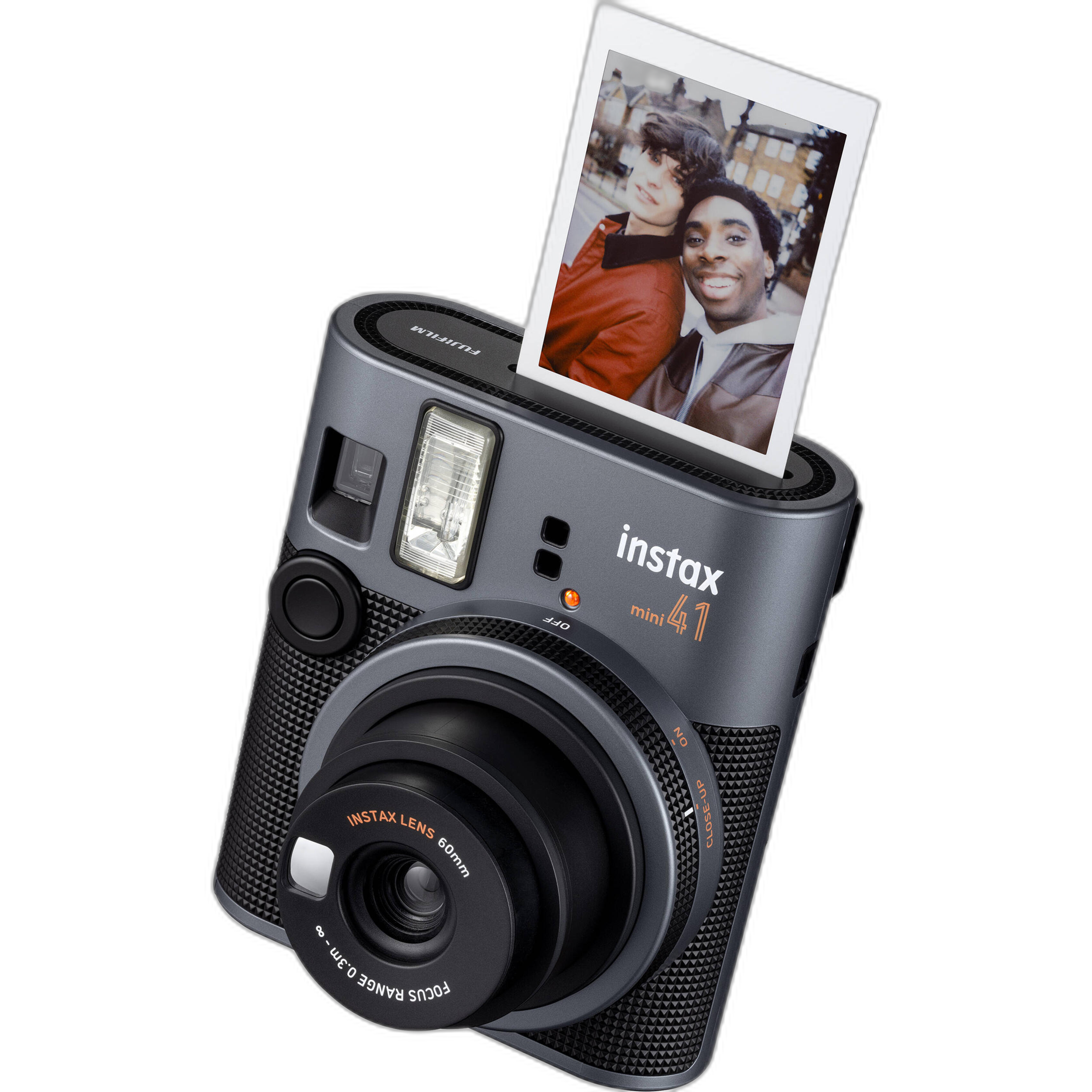
Fujifilm’s Instax line has spent years proving that instant photography is more than a novelty. In an era dominated by phone screens and endlessly shareable digital files, the appeal of a small physical print remains powerful. With the arrival of the Fujifilm Instax Mini 41 in 2021, the company leaned into that appeal with a camera that pairs the familiar convenience of the Instax Mini format with automatic exposure and a design language that nods to classic film-era styling. Seen from the perspective of its release period, the Mini 41 arrives as a camera clearly aimed at casual shooters who want instant results without sacrificing visual character in the object itself.
The Instax Mini 41 belongs to a long-running family of cameras that helped define modern instant photography for a new generation. Rather than competing on technical complexity, this model emphasizes accessibility: load a pack of Instax Mini film, point the camera, and let the automatic exposure system handle much of the work. At the same time, its retro-inspired exterior gives it a stronger visual identity than purely utilitarian instant cameras. For many buyers in 2021, that balance was likely the point. The camera is meant to be used, displayed, carried to gatherings, and shared as an experience as much as a tool.
A Familiar Instax Formula with Broader Appeal
By the time of this model’s release, Instax Mini film was already one of Fujifilm’s most recognizable and widely available instant formats. That matters because a camera like the Mini 41 depends not only on its feature set, but on the broader ecosystem around it. Instax Mini film had become synonymous with compact instant prints, social snapshots, travel souvenirs, and party photography. The Mini 41 steps into that environment with a straightforward proposition: a camera that keeps the process approachable while giving users a more refined aesthetic package.
That approach places the Mini 41 in a useful historical context. Instant cameras have often thrived when they reduce friction. The original appeal of instant photography was immediacy, and the modern Instax line revived that idea for younger users and returning film enthusiasts alike. The Mini 41 does not attempt to turn instant photography into a technical hobbyist exercise. Instead, it refines the beginner-friendly template that made Instax successful in the first place.
Classic Styling as Part of the Experience
One of the Mini 41’s most notable qualities is its retro design. In practical terms, styling does not change how film is exposed, but in a camera like this it absolutely changes how the product is perceived and enjoyed. Instant cameras are social objects. They are brought to birthdays, vacations, school events, family gatherings, and casual weekends out. A retro-inspired design helps the Mini 41 feel more intentional and less toy-like, even as it remains clearly geared toward ease of use.
That design choice also reflects a broader photographic trend of the late 2010s and early 2020s: the blending of nostalgia with convenience. Across the camera world, manufacturers recognized that users were drawn not only to image-making but to the rituals and aesthetics associated with photography’s past. The Mini 41 taps into that current by offering an object that visually recalls classic camera cues while functioning in a thoroughly simple, contemporary Instax manner.
For new photographers, the design may simply feel stylish. For longtime camera enthusiasts, it likely suggests a continuity with earlier eras of consumer photography, when cameras were everyday companions and prints were tangible keepsakes from the start.
Automatic Exposure Keeps It Simple
The core functional strength of the Fujifilm Instax Mini 41 is its automatic exposure system. This is an important inclusion because instant film offers little room for correction after the fact. Unlike digital capture, there is no deleting an underexposed frame and trying again at no cost. Automatic exposure helps reduce the guesswork, making the camera more dependable across a range of everyday situations.
For the target user, that means less time thinking about settings and more time concentrating on the moment. In social photography, that distinction matters. The best instant camera is often the one that is quick to operate and easy to trust. Automatic exposure supports that ethos by allowing the Mini 41 to react to changing lighting conditions without requiring technical knowledge from the photographer.
Historically, this kind of automation has been central to the success of mass-market cameras. As camera makers broadened their audiences throughout the late 20th century and into the digital era, automation became one of the key tools for making photography more inclusive. The Mini 41 continues that tradition. It is not designed to challenge the user with manual complexity; it is designed to make successful snapshots more likely.
Close-Up Mode for More Personal Pictures
Another defining feature of the Instax Mini 41 is its close-up mode. In the context of instant photography, close-up capability is especially meaningful because so many Instax pictures are made at personal distances. Friends pose shoulder-to-shoulder, travelers document meals and souvenirs, and creators use instant prints for journals, scrapbooks, and decorative displays. A close-up mode acknowledges those real-world use cases and helps the camera better match the way people actually shoot.
This feature broadens the Mini 41’s versatility beyond simple arm’s-length snapshots. It encourages a more intimate style of picture-making, whether that means portraits, detail shots, or small everyday scenes. For users discovering instant photography for the first time, close-up mode makes the camera feel less limited. For experienced Instax users, it adds convenience in situations that might otherwise be frustrating with a fixed-focus, general-purpose approach.
In a historical sense, close-up functionality also reflects how modern instant cameras evolved from novelty devices into more thoughtful lifestyle products. The more manufacturers understood the ways users incorporated instant prints into social and creative routines, the more these practical features became important.
Why Instax Mini Still Matters
The Mini 41’s use of Instax Mini film is not incidental; it is central to its identity. The format’s compact print size has long been part of its charm. Small enough to slip into a wallet, pin to a corkboard, tape into a notebook, or hand to a friend on the spot, Instax Mini prints encourage sharing in a direct and physical way. That tactile exchange is something digital imaging cannot fully replicate.
By 2021, this tactile quality was arguably one of instant photography’s greatest strengths. People were already taking more photos than ever before on phones, yet relatively few of those pictures became physical objects. Instax cameras succeeded because they turned photographs back into things: souvenirs, mementos, gifts, and personal artifacts. The Mini 41 reinforces that appeal by combining a familiar film format with a camera body that feels expressive in its own right.
Position in Fujifilm’s Instant Camera Legacy
Looking back, the Fujifilm Instax Mini 41 fits neatly into the company’s broader strategy of sustaining instant photography through approachable cameras with distinct personalities. Fujifilm understood that the success of Instax was never only about image quality in a conventional technical sense. It was about the total experience: anticipation, physical prints, social interaction, and product design.
The Mini 41 exemplifies that philosophy. It does not ask the user to become a technician. It asks them to participate in a photographic ritual that is immediate and rewarding. Automatic exposure lowers the barrier to entry. Close-up mode expands usefulness. The retro design gives the camera emotional and visual appeal. Together, those elements make it easy to understand why a model like this would stand out in the 2021 instant-camera landscape.
Final Thoughts
As an archival view from its release period, the Fujifilm Instax Mini 41 comes across as a well-judged evolution of the modern instant camera. Its strengths are clear and focused: Instax Mini film, automatic exposure, close-up mode, and retro styling. None of these features are meant to overwhelm the user with complexity. Instead, they support what instant photography does best—turning everyday moments into tangible prints with minimal delay and maximum charm.
For shoppers in 2021, that made the Mini 41 an appealing choice for parties, travel, gifts, and casual personal photography. For today’s readers looking back, it stands as a representative example of how Fujifilm continued to refine the Instax formula without losing sight of what made it compelling in the first place. To buy Fujifilm Instax cameras and film, or to learn more about the history of instant photography, visit Unique Photo.