Getting into photography is easy, but choosing your first camera can be similar to defusing a bomb with poorly translated directions. Just take a look at any photography forum...every other post is "I'm sort of new to photography, but I don't know which camera is right for me..." Most adventures usually come in three levels of difficulty: Beginner, Intermediate, and Advanced. Unfortunately, this isn't so much the case with cameras. Today's manufacturers are determined to create subcategories upon subcategories to create a product that can fill just about any niche. As if you didn't already had some sort of existential crisis going on, now you have to roll an 8 sided dice to foresee your fate in the photography world.
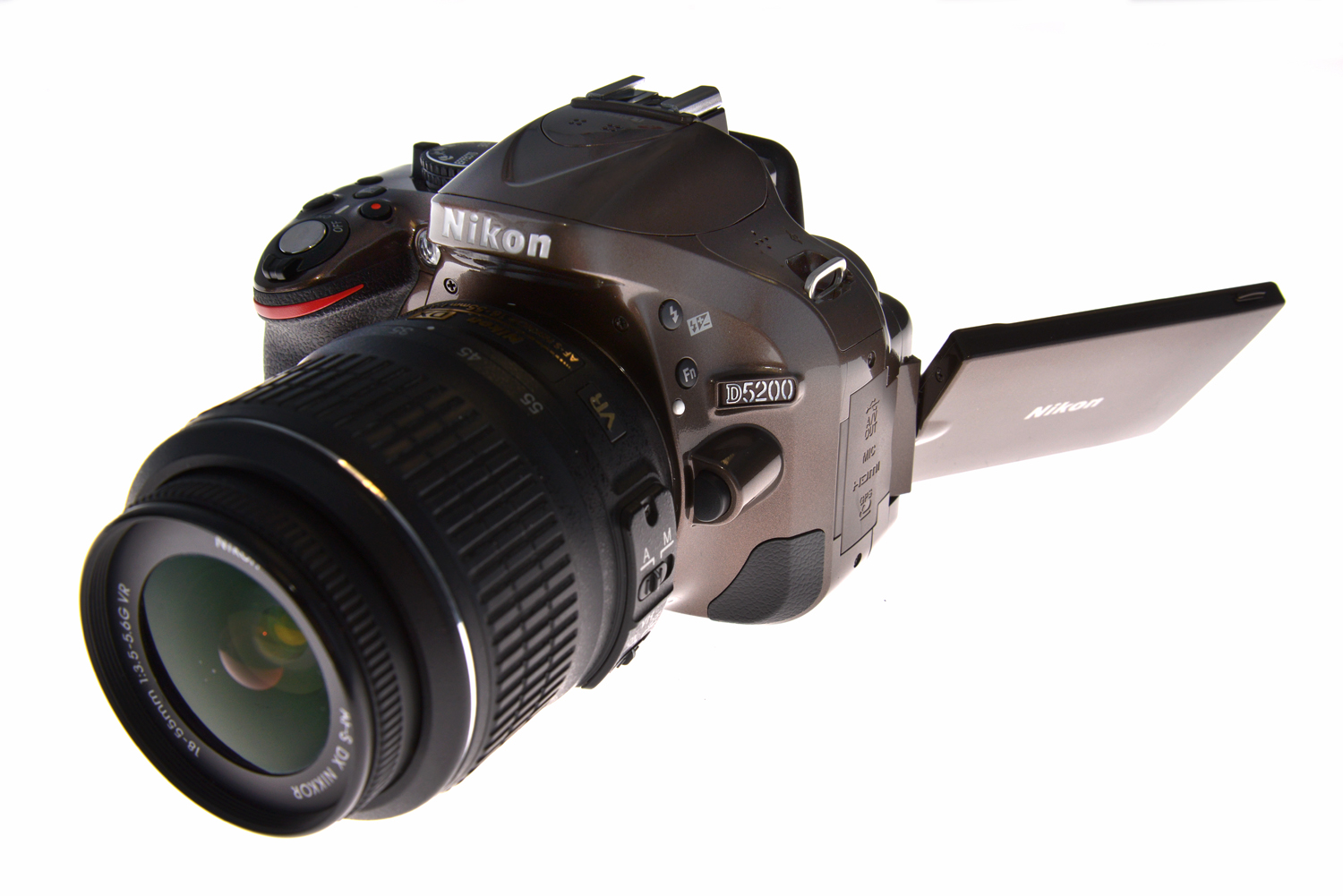
In Nikon's case there are a few entry level cameras that pick and choose various features from both higher and lower-end models. The new D5200, which I'll be reviewing here, is one of those curve ball mid-point stepping stones. Starting with the inclusion of the D5000 back in 2009, the progression up to this version current version has kept it up to date with our pixel peeping ways while maintaining its compact design, as well as it's trademark articulated screen.
In this review I'll go over the D5200's many features, how I think it fares in the real world and mostly if it's a solid buy. Some questions that come to my mind which I hope to address: Does skipping a solid base line camera for a few bells and whistles allow enough breathing room to grow as a photographer in a constantly changing market? Is it overkill for the beginner or will you want more in the not too distant future?
Specs
- Nikon DX-format CMOS sensor with 24.1 effective megapixels. (from 16.2)
- ISO 100 to 6400, expandable to Hi 1 (ISO 12800 equivalent) and Hi 2 (ISO 25600 equivalent)
- Multi-CAM 4800DX autofocus sensor module (Same as that used in the D7000) 39 focus points (from 11 points)
- EXPEED 3 Processor (from EXPEED 2)
- New 2016 pixel RGB metering sensor
- 921k-dot, wide viewing angle (170°), 7.5-cm (3-in.) horizontal-opening vari-angle LCD monitor
- In-Camera Stereo microphone, Full HD (1920 x 1080) D-Movie with selectable 60i/50i frame rate (from 30p)
- High-speed continuous shooting at approx. 5 fps (from 4)
- Newly designed GUI for ease of use

Build
Picking up the camera gives me a tinge of nostalgia...kind of like trying out the bike you first learned to ride. It's definitely smaller than the 5000 as I recall, and it makes me feel like I ate some sort of funny cake from Alice in Wonderland. I could be going crazy, but they did in fact make it a little smaller than the previous models. Luckily the size yields less weight, making it the lightest of the lot. If you're a beginner with one or two lenses, it really won't bog you down. This makes me raise my eyebrow in question of durability, but it's still very solid.
Those with tiny hands will feel at home. Unfortunately, I am accustomed to big clunkers with some heft to them. With my normal palm-centric grip, the tight squeeze forces my fingers to press up against the inner body of the camera, making my hand cramp up pretty easily. I found that I had to hold it mostly with my fingers, leaving my pinkie playing cliff hanger. The back thumb grip works nicely in balancing it all out and this is good considering most buttons are at the mercy of your right thumb.
I got the pleasure of trying out this "bronze" colored model... my discerning eye says its more of a shiny gunmetal brown than anything, so I quickly renamed it "glossy cocoa". Perhaps I'm being overly critical, but I think slapping a glossy coat on a camera body looks kind of awkward and doesn't do much for your credibility. At the risk of sounding like a superficial cranky old man, some traditionalists would have a hard time taking you seriously with a shocking fire engine red glossy DSLR. But hey, that's just me, I won't knock it because being bold can be a good thing too. To each their own. Aside from judging a book by it's cover, there's a difference in grip that I just couldn't warm up to. It probably won't slip right out of your hand like an expensive bar of soap, but there's a noticeable lack friction. My suggestion: Stick with black.
The button layout has been given the "if its not broke, don't fix it" treatment. Since the screens hinge is on the left, all the buttons are near the directional pad or on top near the shutter. The live view is still operable by flicking a switch near its gigantic mode dial and in order to record movies you press the little red button next to the shutter. The only real additions are a drive mode button and the built in mic on top of the pentaprism. There's only one wheel used for both shutter and aperture and the "i" button near the viewfinder is used to change most of the options on the fly.
One of it's distinguishing features that has been passed down from it's predecessors is it's fully-articulated screen which allows you to view the LCD from basically any angle you can think of...even angles for you creepers hanging from a tree trying to catch a shot of the elusive Tufted Titmouse. It's hinge, like the D5100, still swings open from the left, making it much more tripod friendly than putting it squarely in the middle like on the D5000. The build of the its hinge is pretty sturdy and doesn't allow the screen to loosely swivel around like a drunken pinwheel. Although it's still plastic, I don't get the feeling that it would snap unless you did something extremely stupid. Since the screen is fully articulated it can be flipped around to protect it from scratches. Nifty.
Overall it's a solidly designed camera that offers a light weight body without feeling shoddily made.

Operation
So how does the 5200 handle?
Once powered up, you're greeted with the newly designed GUI (graphical user interface). It sort of resembles that of a car dashboard, showing simulated dials for shutter speed, ISO and a visual representation of the aperture opening. Underneath is an AF grid, exposure meter, shot counter and various fine tune settings that you can change with the "i" button. Having something a little more visual like this is great especially for those starting out because 1) It's fairly large so you can easily sort out your settings 2) It gives you a sense of how each dial affects exposure and 3) It's not all that terrible to look at.
Considering this isn't a pro-oriented camera, there aren't as many designated buttons for changing things like ISO, Image Quality, White Balance...Instead you'll have to go into a small sub-menu to do your bidding. The "i" allows easy access on the go, which is fine for those who aren't constantly flipping between settings trying to test out a camera ;-) Most of the options are available without having to dive deep into the camera's Rolodex of a menu and that's just swell. If you've played with any recent Nikon, you'll feel right at home because not much has changed. One thing I found myself having to dig for was an easy way to change video quality... There is one customizable button, but you better choose wisely!
Ah, enough about boring button configurations, what about the shooting experience? I found The 5200 to be a really snappy camera. It's almost inherently simple to pick up and take great images without having to fuss about. As an amateur you could hypothetically slap on the little green button (auto mode) and just start snappin', but we all know that shooting on autopilot is generally looked down upon. You have a powerful tool in your hands...might as well make good use of it! If you do plan on using the camera to its full potential, you'll have ample amount of functionality to keep the manual shooter in you satisfied until they release some sort of 180MP extra-full frame camera. Like I said before, there's only one wheel so the limitation is that you trade off between shutter and aperture, but getting used to it is actually pretty easy. Compared to an entry level camera, you'll have an easier time shooing on manual mode...and in the same, having all the additional controls of the D7000 might be more than you bargained for at this point of the game. It has become a puzzle of what you need vs. what is practical, so every step on the totem pole has become ever-so-slightly incremental.
I said that this camera was snappy for a reason: At 5fps, it's only 1 frame per second less than the D7000 and does the job efficiently. If DX sensors have any advantage over some of the full frame models, it's the burst mode. This is great for fans of sports and wildlife photography where you rely on that spray and pray type of shooting. The need for speed is very much a selling factor in today's arms race of cameras. Luckily, they've given the 520o the same AF module as its big brother, the 39-point autofocus system from the D7000. Some argue that 39 points is overkill...if this gets you in a tizzy, you can dial them down to 11 points. All of them are mostly in the center but that's usually where all the action is, isn't it? The crop sensor makes good use of its 9 cross types more efficiently than the D600 did with all that extra frame. At that, the focusing itself is usually very quick, acquiring its target within a second. In low light, the contrast detect will have a tough time and search a little, without comprehensive scientific tests - somewhere around 2EV.
Live view: I found it to be pretty sluggish to be honest. It's not that the preview itself lags; things get a little less snappy after you take the picture. The shutter makes it's high pitched bird chirp mating call and then takes a few seconds to process/record even with fairly high speed cards. I know there's some sort of commentary in this about our inability to be satisfied by the future's idea of "fast", but Live View has become so common, it's kind of a shame that it slows the process of shooting down. Especially with a camera that totes a freewheeling LCD, you're going to rely on live view to get those creative shots, so slow live view can become a pain. Another thing that has been kind of making me nuts is that you can't change aperture while the camera is taking video. You won't get an accurate preview by adjusting settings without going back and forth...frustrating.
Typical to entry level cameras, the viewfinder covers 95% of the frame. Would it have been nice to have 100% view...maybe with an eye detection sensor? Sure, but we can't have it all. While we're at it: Would it be beneficial to follow the trend of including a touch screen? No, I think having a traditional LCD is just fine, maybe it's even a good thing because it would be one more distraction in the way of taking a picture.

Image Quality
Ah, the nitty-gritty and yet I'm lost for words in comparison to all the other nonsense I go through explaining menus. Laziness would merit the "the pictures speak for themselves" comment, but lets delve. Although it shares similar specs with the D3200, they actually have two different chips. Sony has been making many of the sensors in today's Nikons, but interestingly this one was made by Toshiba. How does the camera make use of its new sensor? I'd say very well. Right off the bat I can see better signal to noise ratio in many of the images taken at higher ISO's. Somewhere around ISO 800 noise starts to creep into the shadows, but it isn't terribly awful until after ISO 3200; pretty good for a crop sensor with so many pixels crammed onto it. Even at 6400, images are usable, but it couldn't hurt to use a little bit of post process scrubbing. Naturally when you push the camera to levels of Hi-1 and Hi-2, you're not going to get anything pretty... After a certain point the the signal recorded will just relay as noise, and we don't find that very visually appealing. Overall, the new sensor doubled with the EXPEED 3 processor seems to produce images that are cleaner in less than optimal situations.
 ISO 800-25600 - Click to enlarge
JPEGs that come straight out of the box look great, but advanced users will want to get most bang for their buck by shooting RAW. You can convert them with Nikon's ViewNX, Lightroom, or Camera Raw now that Adobe and Nikon seem to be playing friendly again. The big thing for people who stare blankly at the pixels of an image at 400% is dynamic range. I look at it this way: How does the sensor represent the extremes and how far can I push the image before it looks like crap. Many of the shots I took on my expedition in the muddy banks of Watchung were seeping with murky fog. Luckily I was able to boost up the shadows and recover highlights to make those images pop just enough without losing their doom and gloom. Going past 2 stops exposure either way in post doesn't make for a cleaner image, but still useful if you need to make modest edits.
Color representation is accurate in normal light. Auto white balance does its best, but still gets a little screwy in mixed lighting. Especially at higher ISOs, I noticed some harsh yellow color fringing in some of the highlights. Other than that the sensor does a good job at keeping colors true to what they actually are with normal use. Lastly, increased resolution means larger files. The images on maximum quality aren't as massive as something like a D800, but you're going to need bigger memory cards if you find yourself shooting RAW+ JPEG considering it only has one card slot.
Messing around video, they've added the jump to 1080i @ 60fps opposed to the 30fps limit from the 5100. Quality was really impressive with a nice fast lens and there wasn't as much aliasing problems as I've seen with the older model. Another advantage that this DX-sensor has over full-frames is the lessening of that weird jelly effect that full frame cameras are plagued with; Here, it's not so much of a problem. Same with the stills, after 1600-3200 you'll need to put a little work in to make it usable. Despite the camera having a stereo mic on top, the sounds weren't as impressive; you'll probably want an external mic if you're serious about quality.
Lastly, there's all those wacky effects available at your fingertips. You want a hokey night vision effect that's really a contrasty black and white filter...it's got you covered. You want a simulated tilt shift effect that makes things look "mini"...you bet your bottom it has it. You want a selective color filter? ::shudder:: Yeah, that's there too (and it works better than I'd like to admit). There's a lot to offer here other than the gimmicky stuff they hope you'll clap your hands at like a goofy seal. In-camera editing is available in case you want to do some quick edits on the fly: crop, brighten, contrast, conversion, color etc...You probably won't use them if you edit on your computer, but I can see this being helpful doubled with the WiFi adapter as it's a one stop shop.
To see more samples check out this Flickr set.

Overview
So where does it leave us? Here we have a very solid camera that's great for those who already know a little about photography. If you're stuck somewhere in the grey area of being a beginner and intermediate user, the D5200 is packed with enough features to keep you satisfied longer than a base-line entry level camera. Although many of these cameras seem comparable on paper, there's more to it than just numbers. As a whole you should expect the camera to live up to its statistical potential and fair long enough that it won't be obsolete in a few years. Perfect for you now, comfortable enough to grow with without feeling like you need more than lenses.
Like the end of a Jerry Springer episode, here's my final thoughts: I think it's a solid buy for those looking for more bang with a little more bucks, but you might want to consider a D3200 if you're an absolute beginner who's unsure that they want to pursue photography further than a kit lens. There's also the D5100 which is still a decent camera that you can get for a fair price (before they get phased out) with more to offer, falling a little short of image quality from this update. Hey, you can even swing for the fences with a D7000; A great semi-pro DX camera with more features than you can swing a stick at. Whichever way you go, I'd say focus on buying better lenses like a nice 50mm or 85mm. That's one great way get the most out of your camera...Not so much worrying about which has more megapixels.
The market has become so large and convoluted that customers don't know what's right for them...It's like having a memory card for every individual image you've ever taken. Safe to say: All bases are being covered these days, but its up to you to figure out what's under/overkill. With the D5200 we've seen the entry level and the step above get a make over, but what will the future have in store for this confusing mid-level market now that the prices of full frame cameras are encroaching on high-end crop sensor cameras? Are we getting an upgraded D7000 (update: bingo), or is the long awaited D300 successor coming this way? Grab some popcorn and clear off your camera announcement bingo card: 2013 has only just begun.
Thanks for reading and keep it tuned to the Unique Blog for more reviews, as well as the latest news on upcoming products.