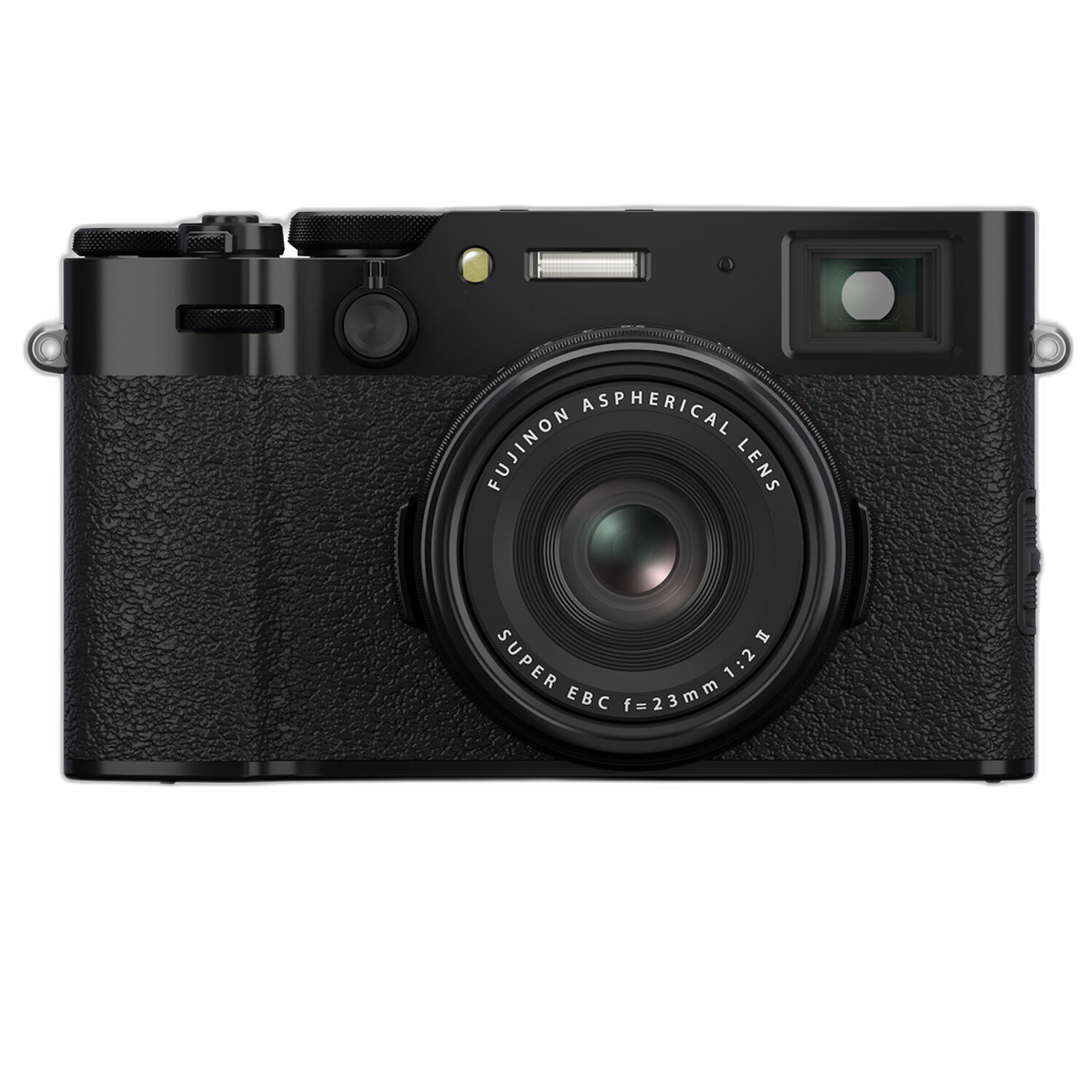
With the announcement of the Fujifilm X100V on February 4, 2020, Fujifilm refreshed one of the most beloved camera lines in modern photography. The X100 series had already built a loyal following among street photographers, travel shooters, documentary enthusiasts, and anyone drawn to a compact camera with classic styling and serious imaging power. But the X100V arrived with the sense that Fujifilm was refining not just a product, but a philosophy: a premium fixed-lens compact built around direct controls, a superb viewfinder experience, and image quality that invited photographers to carry it everywhere.
At launch, the X100V entered the market at $1,399, bringing with it a 26.1MP X-Trans 4 APS-C sensor and a 23mm f/2 fixed lens, a familiar field of view that approximates 35mm in full-frame terms. On paper, those fundamentals alone made it compelling. In practice, the camera represented the latest evolution of a line that had become central to Fujifilm’s identity.
A Landmark Update to a Modern Classic
By early 2020, the X100 name already carried weight. Since the original Fujifilm X100 debuted in 2011, the series had stood apart from most compact cameras by avoiding the race toward bigger zoom ranges or pocket-first minimalism. Instead, Fujifilm focused on the experience of photography itself. The X100 line offered tactile shutter speed and aperture controls, a hybrid optical/electronic viewfinder concept, and a fixed wide-normal lens that encouraged photographers to move, observe, and compose deliberately.
The X100V continued that tradition while arriving as a meaningful update for the series. The move to Fujifilm’s 26.1MP X-Trans 4 APS-C sensor aligned it with the company’s newer-generation imaging pipeline, bringing the camera into step with Fujifilm’s more current interchangeable-lens models of the era. For photographers already invested in Fujifilm’s color science and JPEG rendering, this was an especially important point. The X100V was not simply a style object or a nostalgic compact; it was positioned as a genuinely capable contemporary camera built around a mature and highly regarded sensor platform.
The 23mm f/2 Lens and the X100 Way of Seeing
Every X100 camera is defined in large part by its lens, and here the X100V remained faithful to the formula with a 23mm f/2 fixed lens. That focal length has long been at the heart of the camera’s appeal. Wide enough for street scenes, environmental portraiture, travel, and everyday storytelling, but not so wide as to feel specialized, it encourages a flexible and intuitive way of seeing. Many photographers consider this perspective one of the most natural focal lengths for documentary-style work.
The fixed-lens design is also philosophically important. In an era when many camera systems emphasized expansion and endless choice, the X100V doubled down on limitation as a creative advantage. With one lens and a compact form factor, the camera invited familiarity. Users could learn the angle of view deeply, anticipate framing instinctively, and become faster and more confident in the field. That has always been one of the X100 series’ greatest strengths, and the X100V arrived as a fresh expression of that idea.
26.1MP X-Trans 4 APS-C Sensor: Modern Performance in a Classic Body
The inclusion of the 26.1MP X-Trans 4 APS-C sensor was among the headline reasons the X100V mattered at launch. Fujifilm’s X-Trans sensors had already earned a reputation for delivering strong detail, pleasing color, and a rendering style that many photographers found distinctive. For the X100 audience, this sensor meant the camera could be seen not merely as a carry-everywhere companion but as a serious primary tool for many kinds of work.
The APS-C format gave the X100V an important edge over smaller-sensor compact cameras, particularly for users who cared about image quality, tonal depth, and the flexibility associated with a larger sensor. Combined with the fast f/2 lens, the camera was well positioned for available-light photography, portraits with environmental context, and everyday shooting where both portability and image quality mattered.
Just as importantly, the sensor update helped reinforce Fujifilm’s broader system coherence. Even though the X100V occupied a unique place in the lineup as a fixed-lens camera, it shared core imaging DNA with the company’s more advanced X Series bodies. That continuity made it especially attractive to existing Fujifilm users looking for a compact second camera without compromising too much on output.
Design, Identity, and the Fujifilm Appeal
Part of what made the X100V announcement resonate so strongly in 2020 was that Fujifilm had already cultivated a remarkably clear visual and ergonomic identity. The X100 cameras never hid their influences. Their rangefinder-inspired silhouette, top-plate controls, and restrained industrial design spoke to photographic tradition without becoming mere replicas of the past.
By the time the X100V appeared, this aesthetic had become central to the camera’s allure. It was a camera that looked like it belonged in a photographer’s hand, on a shoulder, or in daily life. It felt intentional. For some buyers, that kind of emotional connection might have been secondary to pure specification. For the X100 audience, however, it was often essential. Cameras in this line were not only tools; they were objects that encouraged use.
That matters historically. The X100 series helped shape the premium compact category in the 2010s by proving that design, handling, and photographic pleasure could be selling points just as significant as resolution or autofocus claims. The X100V inherited that legacy at a time when many compact cameras were disappearing from the market altogether. In that context, its introduction felt almost defiant: a high-end fixed-lens camera built for people who wanted to shoot for the joy of it.
Why the X100V Stood Out at Launch
A Clear Audience
The X100V was never meant to be for everyone, and that was part of its strength. It appealed to photographers who wanted a premium everyday camera, a travel companion with real image quality, or a quieter, lighter alternative to a larger interchangeable-lens kit. It also appealed to experienced shooters who appreciated the discipline and coherence of a fixed focal length.
A Distinct Place in the Market
In 2020, the premium compact category was far smaller and more specialized than it had been years earlier. Smartphones had already transformed casual photography, pushing dedicated cameras toward enthusiast and professional niches. The X100V responded not by competing on convenience alone, but by offering a photographic experience smartphones could not replicate: tactile controls, an APS-C sensor, a bright fixed lens, and the deliberate pleasure of composing with a purpose-built camera.
The Start of Something Bigger
From the vantage point of its announcement, the X100V already looked important. In hindsight, it would become even more significant. The model would go on to achieve an extraordinary level of popularity, broadening awareness of the X100 line well beyond traditional enthusiast circles. While no one at launch could fully predict the scale of its eventual cultural visibility, the ingredients were present from day one: a handsome body, strong core specifications, a trusted focal length, and a shooting experience that felt deeply considered.
The Historical Importance of the X100V
As an archival moment in Fujifilm history, the X100V stands as more than a routine product refresh. It marked the maturation of a concept that had already influenced camera design for nearly a decade. The X100 series helped keep the premium fixed-lens compact alive, and the X100V arrived as one of the clearest statements yet of why that category still mattered.
Its 26.1MP X-Trans 4 APS-C sensor, 23mm f/2 fixed lens, and $1,399 launch price placed it firmly in enthusiast territory, but the camera’s significance went beyond specifications. It represented a convergence of technology, design confidence, and photographic culture. For many photographers, it embodied the idea that a camera could be modern without feeling generic, and specialized without feeling limiting.
Final Thoughts
The Fujifilm X100V arrived in early 2020 as a refined, compelling, and unmistakably Fujifilm camera. It built on the heritage of the X100 series while bringing updated imaging credentials through its 26.1MP X-Trans 4 APS-C sensor, all centered around the enduring versatility of a 23mm f/2 fixed lens. At $1,399, it announced itself as a premium compact for serious photographers—one that respected tradition while embracing the present.
Today, the X100V is easy to recognize as one of the defining cameras of its era. For photographers interested in Fujifilm history, premium compact cameras, or the evolution of modern enthusiast design, it remains a landmark announcement. To buy Fujifilm gear or learn more about the cameras that shaped digital photography, visit Unique Photo.