
With the debut of Nikon’s full-frame mirrorless system on August 23, 2018, the company introduced more than a new camera mount. It unveiled a new chapter in the long history of NIKKOR optics. The Nikon Z mount arrived with major implications for lens design, roadmap planning, and the way photographers would think about Nikon’s future. For longtime Nikon users, the launch raised immediate questions: which lenses were available first, what kinds of photographers were being prioritized, how would existing F-mount lenses fit into the picture, and where was the lineup headed next?
This archival hub is designed to answer those questions by tracing the NIKKOR Z lens lineup in chronological context. Rather than treating the Z family as a simple list of products, it helps place each release into the broader story of Nikon’s mirrorless transition. The earliest Z lenses were not random introductions. They formed a strategic foundation: a standard zoom for everyday use, a fast normal prime to show optical ambition, and a portrait prime to signal serious intent. From there, the system expanded methodically into faster zooms, specialized primes, compact travel options, and high-end professional tools.
At launch, Nikon emphasized that the Nikon Z mount had been designed to support new optical possibilities. Even in the earliest period, this mattered as much philosophically as technically. The opening wave of lenses had the job of proving that the new mount was not simply an adaptation of the old SLR era, but a platform meant to shape Nikon’s next generation of image-making tools.
The Z-Mount Beginning: August 23, 2018
Nikon’s Z-mount system launched on August 23, 2018, alongside the company’s first full-frame Z-series cameras. The mount itself was central to the message. Nikon presented it as the basis for a fresh optical era, one that would allow lens engineers to pursue designs tailored specifically for mirrorless cameras. That point mattered because Nikon was not entering an empty field; it was entering a fast-developing mirrorless market in which lens ecosystems often defined long-term platform confidence.
For that reason, the initial Z lens releases and the published roadmap carried unusual weight. Buyers needed reassurance that Nikon was thinking beyond the first camera bodies. Professionals wanted to know whether the system would support demanding work. Enthusiasts wanted to know whether there would be practical everyday lenses. Existing Nikon users wanted to know whether the transition would be gradual or abrupt.
Nikon’s early answer was balanced. The company launched with a small but carefully chosen lens set and made it clear that the lineup would grow in stages. This was less about sheer quantity than about establishing credibility in key categories from day one.
The First Three NIKKOR Z Lenses
The original trio of NIKKOR Z lenses introduced with the system did an enormous amount of storytelling. Together, they suggested how Nikon wanted the Z mount to be understood: practical, aspirational, and serious about image quality.
NIKKOR Z 24-70mm f/4 S
If one lens represented the system’s practical starting point, it was the NIKKOR Z 24-70mm f/4 S. A standard zoom is often the lens that defines a new mount’s early usability, and Nikon wisely made sure its first general-purpose option covered a highly familiar focal range. For many photographers, this was the lens that made the new system immediately workable for travel, documentary, landscapes, portraits, and daily shooting.
Its role in the release history is especially important because it was the lens most likely to live on a camera full-time during the earliest months of the Z system. While fast primes can generate excitement, it is often the standard zoom that reveals whether a platform is ready for broad adoption. Nikon’s choice to place a 24-70mm lens at the center of the launch signaled maturity rather than experimentation.
Historically, this also fit Nikon tradition. Standard zooms have long served as the connective tissue of a camera system, bridging casual use and serious work. The Z-mount version carried that responsibility into mirrorless form.
NIKKOR Z 35mm f/1.8 S
The NIKKOR Z 35mm f/1.8 S was one of the clearest statements of Nikon’s ambitions for the new mount. A 35mm prime has long been one of photography’s foundational tools, valued for its natural perspective, versatility, and appeal across genres. By making a fast 35mm prime part of the first wave, Nikon showed that the system was not only for convenience but also for photographers who cared deeply about rendering, low-light work, and creative control.
In historical terms, the inclusion of a 35mm lens this early made perfect sense. The focal length has always occupied a special place in photojournalism, street photography, environmental portraiture, and travel work. It is one of the lenses that many photographers judge a system by. Launching it immediately suggested Nikon understood the habits and expectations of experienced users.
Just as importantly, the “S” designation helped frame the lens as part of the system’s premium identity. In the earliest Z period, that branding carried symbolic force. It suggested a top-tier branch of the lineup designed to demonstrate what the mount could do.
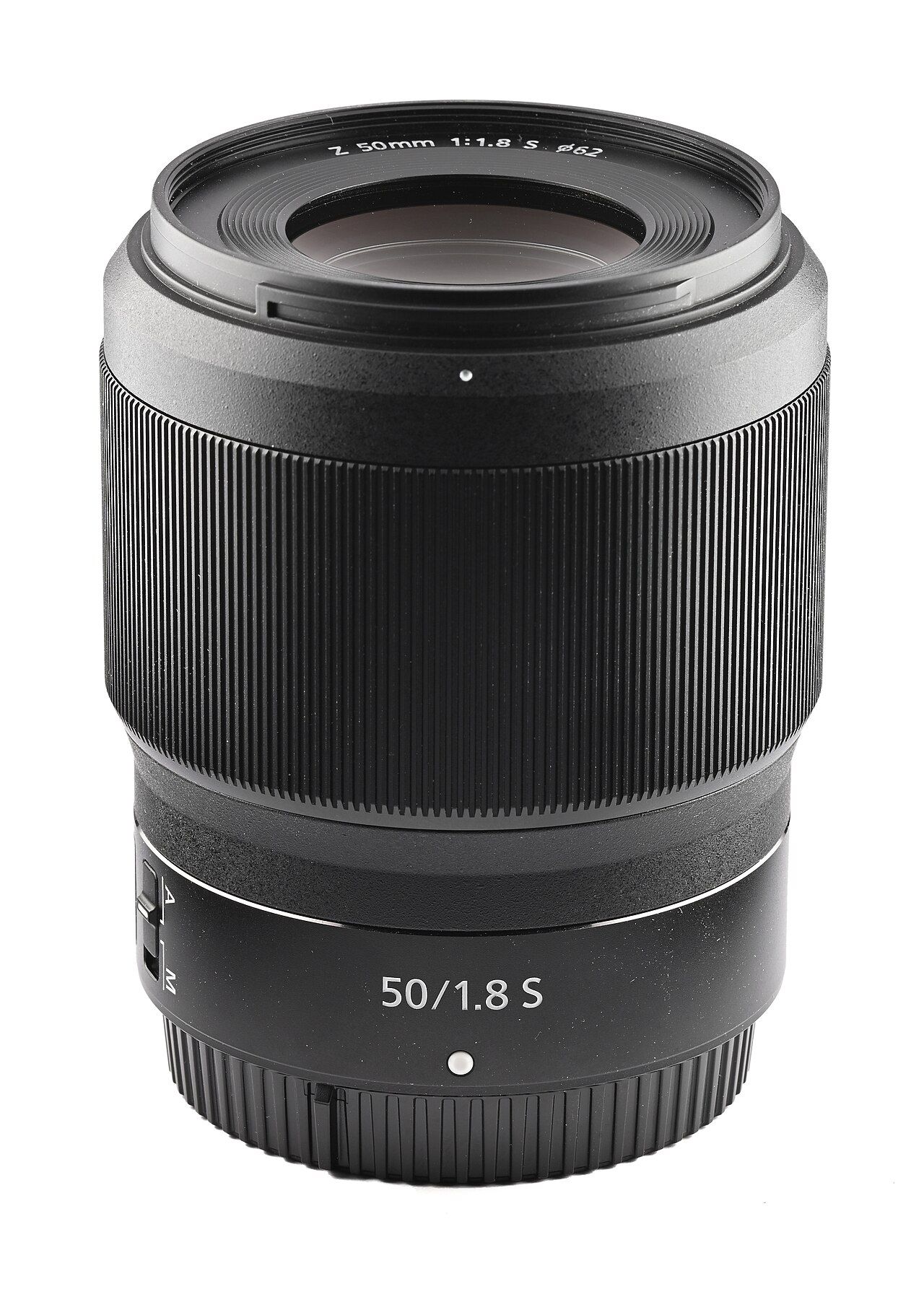
NIKKOR Z 50mm f/1.8 S
The third launch lens, the NIKKOR Z 50mm f/1.8 S, may have looked conservative on paper, but historically it was one of the most significant. The normal prime has always been a benchmark lens in camera-system history. It is often among the most common focal lengths, and because it is so familiar, photographers notice immediately when it stands out.
In the context of the Z launch, the 50mm f/1.8 S carried special symbolic weight. Nikon clearly wanted the lens to serve as a demonstration of the new mount’s optical promise. Choosing a 50mm prime for that role was no accident. Across photographic history, manufacturers have often used standard lenses to show off a new mount or optical formula because the category is so recognizable and easy to compare against previous generations.
For early adopters, this lens was more than a basic normal prime. It was part of Nikon’s argument that Z-mount lenses deserved to be evaluated on their own merits, not simply as mirrorless replacements for F-mount equivalents.
Why This First Trio Mattered
Seen together, the original three lenses were exceptionally well judged. The 24-70mm f/4 S gave the system an everyday backbone. The 35mm f/1.8 S appealed to photographers who wanted a fast, versatile prime. The 50mm f/1.8 S offered a classic focal length with prestige and technical significance. This combination allowed Nikon to address different audiences at once without spreading the launch too thin.
It also established an early pattern for the Z ecosystem. Nikon was not trying to fill every niche immediately. Instead, it was building confidence category by category. This incremental strategy is often a sign of a manufacturer thinking in decades rather than quarters. The most enduring lens systems rarely emerge all at once; they grow from a stable foundation.
The Early Roadmap: Reading Nikon’s Intentions
One of the most important parts of the Z-mount launch era was not a single lens, but the roadmap that accompanied the system. In the mirrorless market, published lens roadmaps became a crucial trust signal. Buyers wanted to know whether a new platform would remain limited or rapidly become comprehensive. Nikon understood this and framed the Z mount as a system with a clear future.
Even in its earliest roadmap form, the direction was easy to read. Nikon planned to build around recognizable pillars: standard zooms, fast primes, portrait lenses, wide-angle options, and professional-grade constant-aperture zooms. This was exactly what existing Nikon users needed to hear. It suggested that the Z mount would eventually support hobbyists, working professionals, and specialists alike.
Roadmaps matter historically because they reveal priorities. In Nikon’s case, the early Z roadmap suggested three parallel goals. First, provide practical everyday coverage so users could adopt the system now. Second, develop premium optics that showed the mount’s optical potential. Third, reassure professionals that the classic working focal lengths would not be neglected.
The First Expansion Phase: Building a Real System
After the launch period, the next challenge for Nikon was straightforward but substantial: turn a promising beginning into a functioning lens family. A mount does not become a mature system just because its first three lenses are strong. It becomes mature when photographers can build kits around it with confidence.
That meant expanding beyond the symbolic trio into a broader set of roles. Historically, this is where many camera systems reveal their character. Some develop from the edges inward, prioritizing exotic or halo lenses first. Others focus on staples and reliability. Nikon’s approach in the Z era was notably balanced. The company’s lens history suggested deep familiarity with what photographers actually carry and use, and the Z lineup began to reflect that steadily.
In broad terms, the early generations of NIKKOR Z releases advanced the system in several clear directions:
- More complete standard coverage: standard zooms and normal primes helped make the system practical for most users.
- Portrait and fast-prime growth: these releases signaled that the mount was not limited to general-purpose use.
- Professional zoom development: a mature system ultimately needs the zoom trinity and other workhorse tools.
- Specialized expansion: wide, telephoto, and niche optics help define a system’s seriousness over time.
That pattern is important to understand because the Z lens release history is not just a timeline; it is the story of Nikon moving from declaration to fulfillment.
Generational Character: What Changed as the Lineup Grew
From a historical perspective, the earliest NIKKOR Z lenses belong to a first generation defined by proof of concept. They had to demonstrate that the mount could support premium optics, practical everyday use, and the beginnings of a coherent system. Later releases shifted the conversation. Instead of asking whether Nikon could build a serious mirrorless lens lineup, photographers increasingly began asking how broad and how deep that lineup would become.
Generation One: Establishing Trust
The first generation was about trust. Nikon had to persuade users that adopting Z mount was not a gamble. This is why the launch lenses felt so deliberate. They covered central photographic needs without looking provisional or compromised. There was a sense, even in the launch period, that Nikon wanted its first Z lenses to feel like permanent members of the system rather than placeholders.
Generation Two: Filling Core Gaps
The next wave of development focused on rounding out the most obvious needs. Historically, this is where a lens system stops feeling like a debut and starts feeling like a platform. As more focal lengths and use cases are addressed, photographers no longer think only in terms of individual lens purchases; they begin planning complete kits. That is a major turning point in any mount’s history.
Generation Three: Professional Confidence
A lens lineup reaches another level when professionals can see their own work represented in it. For Nikon, that meant the continuing arrival of optics suited to events, portraiture, commercial work, reportage, and specialized shooting. At this stage, the Z mount’s identity broadens. It is no longer just Nikon’s mirrorless future in theory; it is a practical working system.
The Importance of the “S” Line in the Early Z Era
Any historical discussion of early NIKKOR Z lenses should acknowledge the importance of the “S” designation. In the release period, it was not merely a label. It played a branding role in Nikon’s effort to establish confidence around optical quality and system seriousness.
For readers looking back, the significance is clear. The S-line lenses helped define public perception of the Z mount. They told photographers that Nikon wanted mirrorless optics to be discussed in the same breath as the company’s best lens work. Whether attached to a launch prime or a foundational standard zoom, the S badge marked lenses that were central to the system’s image.
This mattered especially in 2018 because Nikon was introducing a new mount to an audience already familiar with decades of NIKKOR history. The Z platform needed both continuity and distinction. The S line helped provide both: continuity through Nikon’s reputation for lens-making, and distinction through a new mirrorless identity.
Z Mount and the F-Mount Legacy
No release-history hub would be complete without recognizing that the NIKKOR Z lens story began in the shadow of one of photography’s most established SLR ecosystems. Nikon users did not approach the Z mount as blank-slate consumers. They approached it with years, sometimes decades, of F-mount experience and expectations.
That context shaped the lens rollout. Nikon could not simply launch a few mirrorless lenses and assume everyone would start over. The company had to build a bridge between systems while also making the case that Z mount represented genuine progress. In the release period, this gave every new lens added meaning. Each one was not just another product; it was another step in the long transition from the DSLR era to the mirrorless era.
Historically, that is one reason the Z lens roadmap felt so important. It was a roadmap not only of products, but of confidence. It showed Nikon users how the company intended to carry its optical heritage forward without pretending the old system had never existed.
How to Read the NIKKOR Z Lineup Chronologically
For readers using this article as a hub, it helps to think of the Z-mount release history in layers rather than as a flat list.
Layer One: Foundational Lenses
These are the lenses that make a new mount usable from the beginning. In Nikon’s case, the launch trio belongs here. They gave early adopters a standard zoom, a classic documentary focal length, and a normal prime.
Layer Two: System Completion
This phase covers the additions that make a mount feel increasingly self-sufficient. As these lenses arrive, users no longer think of the system as young in a restrictive sense. They begin to see it as a growing home for multiple styles of photography.
Layer Three: Specialization and Refinement
Mature lens lineups eventually move from broad necessity to specialization. In this stage, releases do more than fill obvious gaps; they refine handling, broaden creative possibilities, and serve distinct professional or enthusiast needs. This is the phase in which a system’s personality becomes fully visible.
Why Lens Release History Matters
It is easy to think of lenses only as buying decisions, but release history offers something more valuable. It shows how a manufacturer understands photography itself. The order in which lenses appear reveals priorities. It indicates which users are being invited into the system first, which workflows are being supported earliest, and how a company balances technical ambition with practical needs.
In the case of Nikon’s Z mount, the early lens history shows a company trying to do several things at once: reassure longtime Nikon photographers, demonstrate confidence in a new mount, and establish a premium optical identity in a rapidly evolving mirrorless market. The launch trio and the roadmap together accomplished that unusually well.
Looking back, the release-period perspective is especially revealing. At the moment of announcement, the Z system was full of promise but necessarily incomplete. That incompleteness was not a weakness so much as a normal condition of a new mount. What mattered was whether the first steps made sense. Nikon’s did. The original lenses were strategically chosen, historically legible, and aligned with the company’s larger reputation.
Orienting Yourself Within the NIKKOR Z Family
If you are approaching the NIKKOR Z lineup historically, one helpful way to understand it is to ask what role each release played in the system’s development.
- Was it foundational? Launch lenses and early standards often exist to make the system viable.
- Was it declarative? Some lenses are statements about image quality or engineering ambition.
- Was it connective? Certain releases help existing users imagine moving from an older mount to the new one.
- Was it expansive? Later lenses open the system to new genres and more specialized work.
Using that framework, the first NIKKOR Z lenses become easier to place in context. The 24-70mm f/4 S was foundational. The 35mm f/1.8 S was both foundational and declarative. The 50mm f/1.8 S was strongly declarative, embodying Nikon’s desire to show what the new mount could represent.
A Launch That Set the Tone
Many camera systems are remembered less for their first body than for the tone set by their first lenses. In Nikon’s case, the Z mount opened with lenses that were practical without being timid and aspirational without being unrealistic. That balance gave the system credibility at a moment when credibility mattered most.
For photographers reading this from a historical point of view, that may be the most important takeaway. The NIKKOR Z lineup did not begin as a scattershot collection of releases. It began as a carefully staged statement of intent. The first standard zoom made the system approachable. The first primes gave it prestige and creative seriousness. The roadmap promised momentum. Together, they laid the groundwork for everything that followed.
Conclusion
The release history of NIKKOR Z lenses starts on August 23, 2018, but its significance reaches far beyond a single launch day. It marks Nikon’s transition into a new mount era and the beginning of a lens family designed to carry the NIKKOR name into the mirrorless future. The earliest releases were small in number but large in meaning, establishing the Nikon Z mount as a serious platform from the outset. As the lineup expanded, each new lens helped transform that initial promise into a more complete system.
For photographers, collectors, and Nikon historians, understanding this chronology makes the Z family easier to navigate. It clarifies why certain lenses appeared first, how Nikon built confidence in stages, and how the system’s identity developed over time. If you are exploring the NIKKOR Z lineup today—or looking back at its beginnings—Unique Photo is a great place to buy Nikon gear, compare lenses, or learn more about the history and evolution of Nikon’s mirrorless system.