If you love sweeping vistas, moody coastlines, or quiet trails and want your photos to feel as immersive as the moment you pressed the shutter, this guide is for you. We’ll cover the core composition techniques that make landscapes sing—and pair them with learning resources and tools from Unique Photo to help you practice smarter and shoot more intentionally.
Why Composition Matters in Landscapes
Great composition is what turns a good scene into a photograph that stops people in their tracks. It guides the viewer’s eye, creates depth, and communicates mood. Whether you’re a beginner learning the basics or a seasoned shooter leveling up your visual storytelling, mastering composition is the highest-leverage skill you can invest in.
Essential Landscape Composition Tips
- Rule of Thirds and Beyond: Start with thirds to place horizons and subjects off-center, then explore diagonals, golden triangles, and symmetry when the scene calls for it.
- Foreground–Midground–Background: Add something interesting in the foreground (rocks, flowers, textures) to anchor the scene and create depth.
- Leading Lines and Pathways: Rivers, fences, ridges, and shorelines can pull the viewer into the frame—use them to direct attention to your subject.
- Horizon Discipline: Keep horizons straight and position them high or low depending on whether the sky or the land is the hero.
- Scale and Story: Include a person, tree, or cabin to give the viewer a sense of size and distance.
- Light and Weather: Side light reveals texture; backlight and atmosphere add glow; storms and fog simplify busy scenes and enhance mood.
- Negative Space and Minimalism: Let empty sky, water, or snow breathe—simplicity can make the subject stronger.
- Long Exposures with Intention: Smooth water or streak clouds to simplify shapes and emphasize structure; keep a crisp anchor element for contrast.
- Crop and Aspect Ratio: Don’t be afraid to crop for impact—panoramas for sweeping vistas, verticals for soaring peaks and waterfalls.
- Previsualize: Move your feet, change height, try a vertical, and bracket compositions; the best frame is rarely your first.
Recommended Learning and Tools
NJCS: Composition and Photographic Communication with Shiv Verma (Lumix)

Build a solid framework for seeing and structuring images. This program focuses on reading a scene, visual weight, balance, and how to use design elements—including line, shape, and color—to strengthen your landscape compositions. Ideal if you want a concise, composition-first curriculum you can apply anywhere.
Macro and Landscape Photography at Duke Farms with Michael Downey

Hands-on field instruction at a location rich with leading lines, textures, and layered scenes. Practice foregrounds, depth, and lens choice in real conditions—plus macro techniques for intimate landscapes when grand vistas aren’t available.
Editing and Enhancing Landscape and Nature Photography with Photoshop
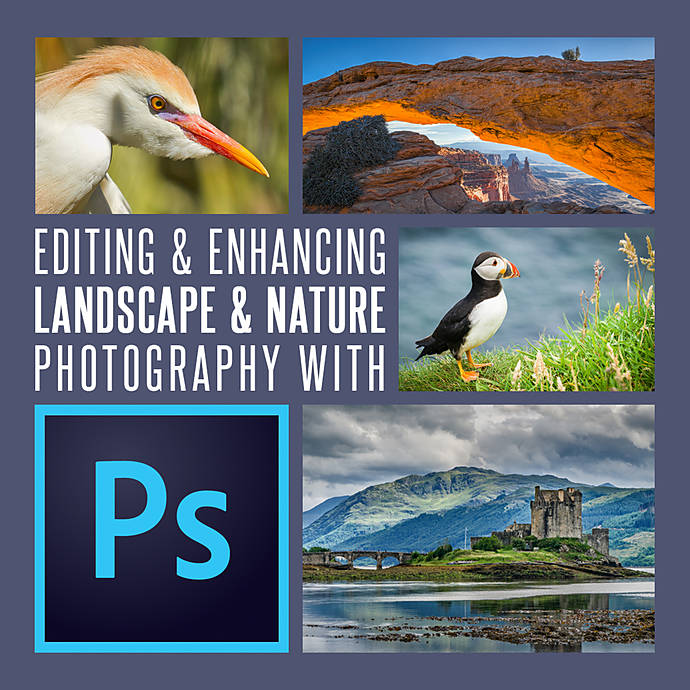
Post-processing is where you refine composition: leveling horizons, cropping for impact, dodging and burning to guide the eye, and local color/contrast to emphasize structure. This class helps you translate your field vision into a finished photograph.
UUOnline: Astrophotography 4-Part Series with Temu Nana (Session 2)

For nightscape shooters, composition changes after dark. Learn how to plan the Milky Way’s position, balance sky and foreground, and compose with light painting and star trails—skills that carry over to blue-hour and twilight landscapes.
Nikon D850 Guide to Digital SLR Photography by David Busch

If you’re a D850 owner, this guide helps you set up your camera to support good composition in the field—custom buttons for horizon level, grids, and focus modes that suit landscapes—so you spend less time fiddling and more time framing.
Tiffen 46mm Photo Essentials Kit/TPK1
Filters are powerful composition tools. A polarizer can cut glare and deepen skies to simplify tones; neutral density helps with long exposures that reduce visual clutter in water and clouds. Confirm your lens’s filter thread size and the kit contents to match your needs.
Zoom H6Essential Series 6-Track 32-Bit Float Handheld Recorder

Optional but inspiring: capture soundscapes for multimedia slideshows or keep voice notes about locations and compositions. Organized notes can make you more intentional on return visits.
Which Option Is Right for You? (Quick Comparison)
| Option | Format | Best For | Key Composition Skills |
|---|---|---|---|
| Composition & Photographic Communication (Shiv Verma) | Class / Seminar | Foundational theory you can apply anywhere | Visual weight, balance, line/shape, framing, storytelling |
| Macro & Landscape at Duke Farms | Field Workshop | Hands-on practice in real-world scenes | Foregrounds, layers, leading lines, macro compositions |
| Editing & Enhancing with Photoshop | Post-Processing Class | Refining frames after capture | Crop strategy, horizon leveling, tonal guidance, emphasis |
| Astrophotography Series (Session 2) | Online Session | Nightscape composition | Sky planning, foreground balance, light management |
| Nikon D850 Guide (David Busch) | Book | D850 owners optimizing field setup | Grid overlays, custom controls, stability and focus aids |
Our Pick
Field-Tested Composition Workflow
- Scout and Previsualize: Walk the scene; find a foreground anchor and your leading line.
- Stabilize: Use a tripod and enable your in-camera level for straight horizons.
- Refine Edges: Check the borders for distractions; reframe or wait for clean moments.
- Control Tonality: Use a polarizer or ND when appropriate to simplify contrast and motion.
- Commit, Then Polish: Capture variations; in post, crop decisively and guide the eye with light.
Quick Landscape Kit
- Learning: Composition & Photographic Communication (foundation) + Duke Farms (practice) + Photoshop Editing (polish).
- Tools: A filter kit like the Tiffen 46mm Photo Essentials Kit/TPK1 (verify size) for glare control and long-exposure creativity.
- Optional: Zoom H6Essential to collect field notes or ambient audio for multimedia presentations.
Conclusion
Strong compositions don’t happen by accident—they’re built with intent, practice, and a clear process. Start with a composition-focused class, reinforce with a hands-on workshop, then refine in post. Explore the recommended classes, book, and tools at Unique Photo to elevate your next landscape from a snapshot to a photograph you’re proud to print.