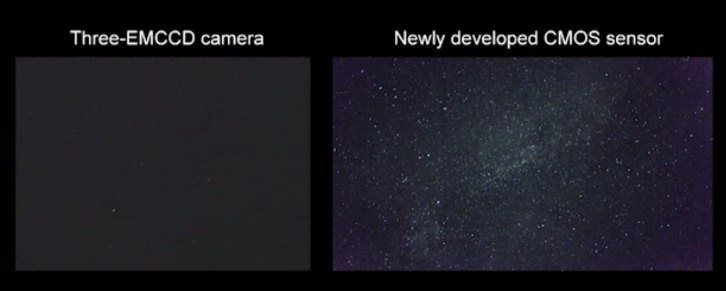

Canon have just arrived on the scene with an intriguing new kind of camera sensor. It's full-frame for one thing, but that's where any similarities to current cameras end. Each pixel in this full-frame sensor is roughly 7.5 times the size of corresponding pixels in, say, an EOS 1D-X. So what's the result? According to Canon, this video-specific sensor can see what others cannot, like a person's face lit by only a few incense sticks and a landscape lit only by a crescent moon.

Some "special technologies" are what allow the sensor to record data without the end result looking like a blizzard of noise. What results is eerily well-lit video in as little as 0.08 lux of light, which is a level at which a human eye struggles to interpret objects. Canon will be showing off this new technology next week at a security show in Tokyo, which seems to be relevant considering the implications this sensor could have in that field. Perhaps nature and wildlife documentaries could also be a big market for this low-light sensor.

It's hard to tell, at the moment, exactly how this sensor will be implemented. Canon really hasn't said much regarding the new technology, but we'll most likely be hearing more about it soon. Will we be hand-holding our cameras in ten years with only the ambient light of a lamp two rooms away? Read the entire press release here.