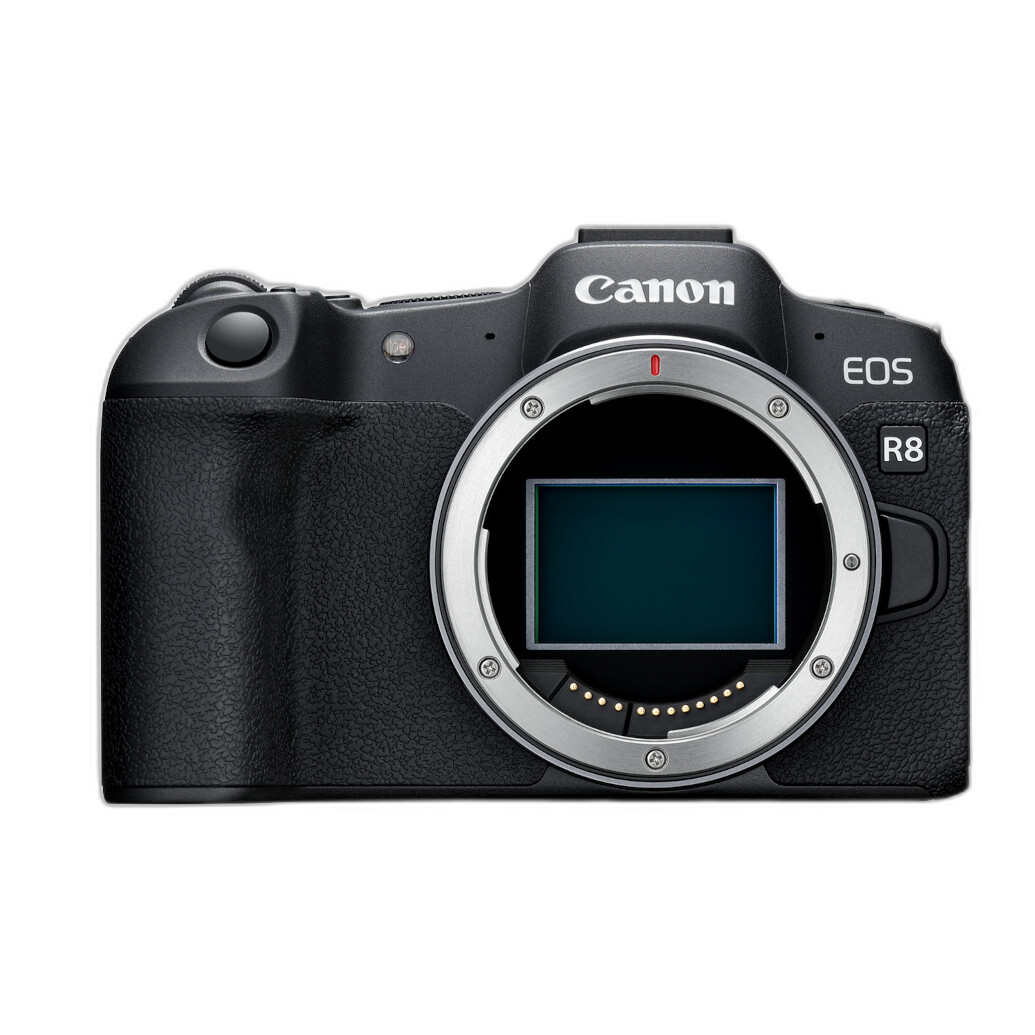
Canon has officially introduced the EOS R8, a new full-frame mirrorless camera positioned to bring much of the company’s latest imaging technology to a lighter, more accessible body. Announced on February 8, 2023, the R8 enters the Canon RF system with an appealing combination of portability, strong stills performance, and modern video features. At launch, Canon set the camera’s price at $1,499 USD, making it one of the more approachable entry points into the brand’s full-frame RF lineup.
What immediately made the EOS R8 notable at announcement was how closely it aligned with the imaging direction Canon had established in its higher-tier full-frame mirrorless bodies. In broad terms, the story around the R8 was simple and compelling: it delivered a 24.2MP full-frame sensor, 4K60 video capability, and Canon’s newer-generation RF ecosystem in a body that emphasized low weight and everyday usability.
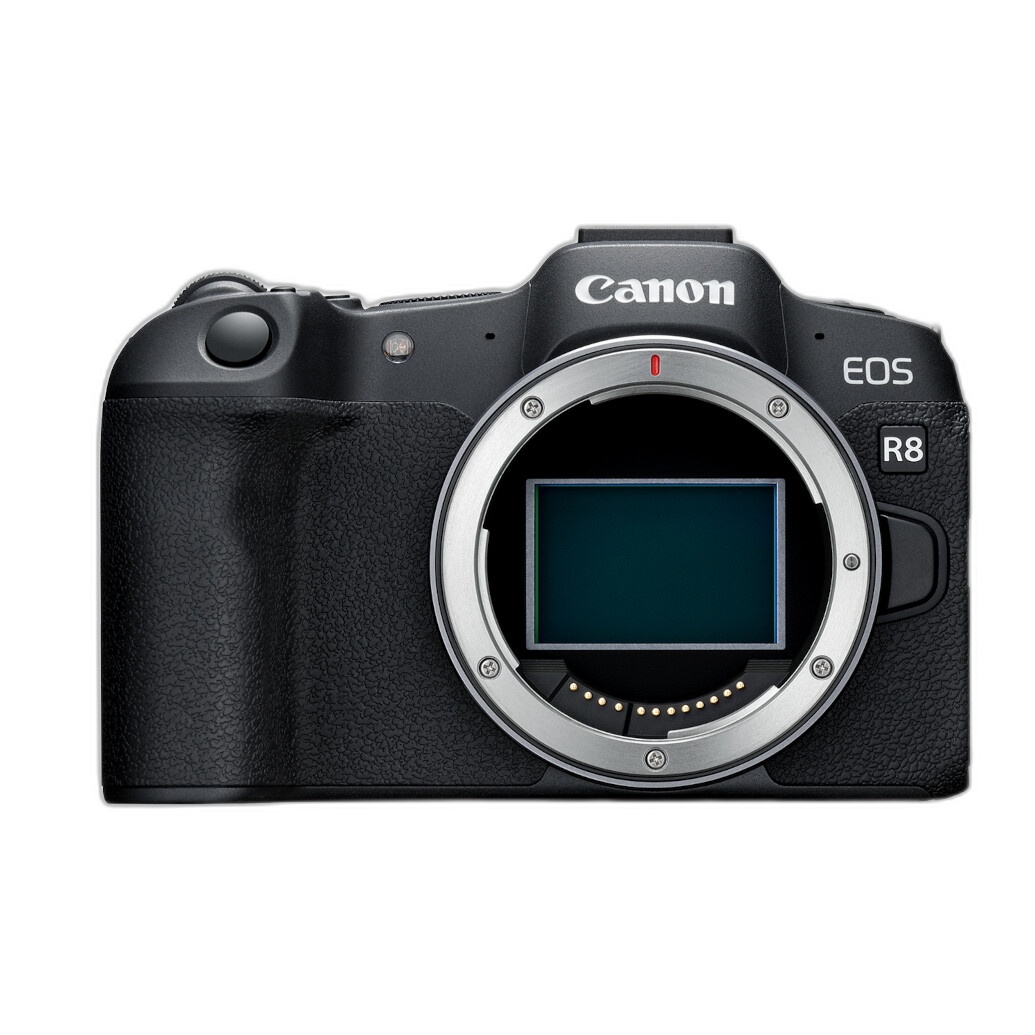
A New Lightweight Full-Frame Option in the EOS R Line
By early 2023, Canon’s EOS R system had developed into a broad platform spanning enthusiast, hybrid, and professional use. The EOS R8 arrived at an interesting moment in that evolution. On one side were more advanced and more expensive full-frame bodies; on the other were APS-C RF cameras aimed at users seeking smaller kits and lower cost. The R8 was announced as a bridge between those worlds, offering the visual appeal and imaging flexibility of full frame without the larger body or higher entry price often associated with that format.
That made the R8 particularly relevant for several audiences at the time of launch: photographers stepping up from APS-C, DSLR users considering their first mirrorless full-frame body, and hybrid creators who wanted high-quality stills and capable video in a compact package. Canon’s messaging around the camera strongly reflected this broad appeal. The EOS R8 was not framed as an ultra-rugged pro body, but rather as a modern, mobile full-frame camera built for versatility.
The Core Appeal: 24.2MP Full-Frame Sensor
At the heart of the EOS R8 is a 24.2-megapixel full-frame sensor. That resolution placed the camera in a highly practical sweet spot at the time of release. It was enough for serious photography work, including portraits, travel, documentary, events, and general commercial use, while also keeping file sizes manageable for day-to-day shooting and editing.
Canon has long understood that not every full-frame user is chasing maximum resolution. For many photographers, a mid-resolution sensor offers the right balance of detail, speed, workflow efficiency, and low-light flexibility. In the context of the EOS R8 announcement, that balance was central to the camera’s identity. Rather than competing on sheer megapixel count, the R8 was introduced as a camera designed to deliver strong all-around performance in a body that users would actually want to carry regularly.
Historically, this approach has often proven successful. Cameras that prioritize balance over specification excess can become long-lived favorites because they fit naturally into both enthusiast and professional-adjacent workflows. The R8’s sensor specification immediately suggested that Canon was aiming for precisely that kind of practical, everyday full-frame camera.
4K60 Video Broadens Its Hybrid Appeal
Video was another major part of the EOS R8 story at launch. Canon announced the camera with 4K60 capability, an important specification in 2023 for creators who needed modern video performance from a relatively compact stills camera. By that point, hybrid shooting had become an expectation rather than a niche requirement, and the R8 clearly reflected Canon’s understanding of that shift.
For content creators, videographers, and photographers increasingly asked to deliver motion alongside still images, 4K60 represented meaningful flexibility. It opened the door to smooth motion rendering, easier integration into contemporary production workflows, and more creative options than cameras limited to lower frame rates in 4K. In practical terms, that meant the EOS R8 could serve not only as a travel or family camera, but also as a useful tool for interviews, social content, behind-the-scenes work, and lightweight commercial production.
Within the context of Canon’s mirrorless development, the R8 reinforced a broader trend: advanced video functions were no longer reserved only for flagship or near-flagship bodies. Instead, they were becoming increasingly available in smaller, less expensive models. That democratization of features was one of the most significant camera-industry developments of the early 2020s, and the EOS R8 stands as a clear example of it.
RF Mount Access and System Growth
The EOS R8 uses the Canon RF mount, which by 2023 had become the foundation of Canon’s mirrorless future. This was a crucial part of the camera’s launch appeal. Buying into the R8 was not just about purchasing a single body; it was about entering a system that Canon was actively expanding across lenses, accessories, and bodies at multiple performance tiers.
The RF mount had already developed a reputation for combining strong optical ambitions with a growing range of options for different budgets and applications. For users considering the EOS R8 at launch, the mount represented both immediate versatility and long-term investment potential. A lightweight full-frame body paired naturally with compact RF lenses for travel and everyday use, but it could also take advantage of more specialized glass as a shooter’s needs evolved.
Historically, system context matters enormously when evaluating a camera announcement. Cameras do not exist in isolation, and Canon’s success with the R8 would depend partly on the strength of the RF ecosystem around it. In that respect, the R8 arrived at a favorable time. Canon had already made clear that RF was its long-term strategic platform, and the EOS R8 benefited from that momentum.
Pricing and Positioning at Launch
Canon announced the EOS R8 at a launch price of $1,499 USD. That figure was one of the most important aspects of the announcement. Pricing often determines whether a camera becomes merely interesting or genuinely disruptive within its category, and Canon clearly intended the R8 to attract attention from buyers who wanted full-frame image quality without climbing into a substantially higher bracket.
In the 2023 market, $1,499 placed the R8 in a strategically important position. It was premium enough to signal serious capability, but low enough to appeal to advanced enthusiasts, upgraders, and content creators building a kit with budget consciousness in mind. Framed another way, Canon was offering an entry into current-generation full-frame RF shooting that felt realistic for a larger segment of the market than many higher-end releases did.
This mattered for Canon historically as well. The company has long been strongest when it offers products that connect aspirational technology with broad usability. The EOS R8 fits squarely in that tradition. It did not attempt to replace flagship bodies, nor did it need to. Instead, it gave users a persuasive reason to move into the RF system or add a smaller full-frame body alongside more specialized equipment.
Why the EOS R8 Announcement Mattered
Looking at the announcement in historical context, the EOS R8 represented more than just another model number in the EOS R family. It embodied a larger industry pattern: the migration of highly desirable imaging features into smaller, more affordable cameras. That trend had been building for years, but by 2023 it was becoming one of the defining characteristics of the mirrorless market.
The R8’s combination of 24.2MP full-frame imaging, 4K60 video, and a comparatively approachable $1,499 launch price made it especially relevant to contemporary buyers. It was a camera that promised fewer compromises than many users had come to expect from lightweight bodies. For photographers, that meant a more portable path into full frame. For hybrid shooters, it meant a camera that could move more fluidly between stills and motion. For Canon, it meant strengthening the middle of the RF lineup with a model that felt modern, timely, and market-savvy.
Final Thoughts
As announced in February 2023, the Canon EOS R8 stood out as a smartly targeted addition to the RF system: a lightweight full-frame mirrorless camera built around a 24.2MP sensor, equipped with 4K60 video, and launched at an attention-grabbing $1,499 USD. In release-period terms, its appeal was obvious. It brought much of Canon’s newer full-frame mirrorless philosophy to a wider audience and reinforced the idea that high-quality hybrid imaging no longer had to come in a large or expensive package.
For photographers and creators researching this camera today as a historical release, the EOS R8 remains an important marker in Canon’s mirrorless timeline: a model that helped make full-frame RF shooting feel more attainable. To explore Canon cameras, RF lenses, and more archival gear coverage, visit Unique Photo—a trusted place to buy equipment or learn more.