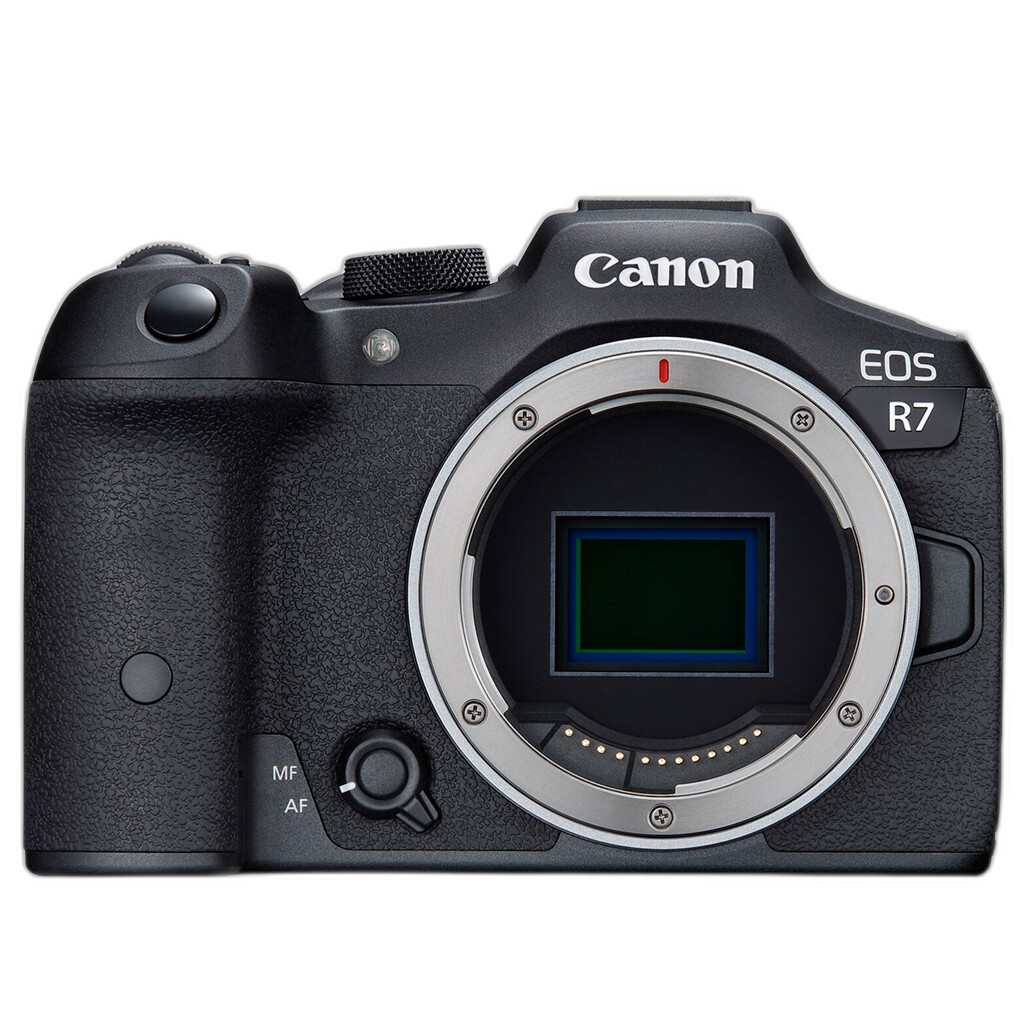
Canon’s EOS R system took an important step on May 24, 2022, with the announcement of the Canon EOS R7. Up to that point, the RF mount had been defined primarily by full-frame bodies, from enthusiast models to high-end professional cameras. The R7 changed that conversation immediately. Here was an APS-C mirrorless camera built around the RF mount, aimed squarely at photographers and hybrid creators who wanted speed, reach, and modern autofocus in a more compact and accessible package.
Historically, the EOS R7 mattered for more than its place in a spec sheet. It represented Canon bringing one of the company’s most popular sensor formats into its newest mirrorless ecosystem in a serious way. With a 32.5MP APS-C sensor, 30 fps burst shooting, 4K60 video, and a launch price of $1,499, the EOS R7 arrived as one of the most closely watched camera announcements of 2022.

A Major Moment for the EOS R System
When Canon introduced the RF mount in 2018, the system was clearly positioned as the company’s future. The early bodies and lens roadmap focused heavily on full-frame performance and on showcasing what the new mount could do optically. That made sense strategically, but it also left many Canon users wondering when APS-C would enter the picture.
The answer came with the EOS R7. In historical context, this was the camera that signaled Canon was ready to broaden the RF ecosystem beyond full-frame enthusiasts and professionals. APS-C had long been central to Canon’s DSLR lineup, especially for wildlife, sports, travel, and enthusiast photography. Bringing that format into RF was not a minor extension of the system; it was a foundational move.
The EOS R7 also carried some symbolic weight in its naming. For longtime Canon users, the “7” designation recalled the enthusiast-oriented EOS 7D line, cameras known for speed, responsiveness, and appeal to action photographers. While the EOS R7 was not simply a mirrorless 7D in direct one-to-one terms, the association was difficult to miss. At launch, many observers immediately saw it as a spiritual successor to Canon’s higher-performance APS-C tradition.
32.5MP APS-C: Resolution and Reach
At the core of the EOS R7 is a 32.5-megapixel APS-C sensor, a specification that positioned the camera as both detailed and versatile. For photographers who shoot wildlife, birds, motorsports, or field sports, APS-C has always offered a practical advantage: a narrower angle of view with telephoto lenses compared with full frame. In everyday terms, that means extra apparent reach without requiring larger, heavier, or more expensive super-telephoto glass.
That benefit was especially compelling in the RF era. With the EOS R7, Canon users gained an APS-C option that could pair with existing RF lenses and take advantage of that crop factor in situations where subject distance is a constant challenge. The 32.5MP resolution also suggested Canon was not treating this as an entry-level compromise body. Instead, the R7 was announced as a camera for users who wanted serious still-image capability, including room to crop further when needed.
For travel and outdoor photographers, the combination looked strong on paper from day one: high resolution, smaller overall system potential, and the flexibility of the RF mount. That mix helped the R7 stand out immediately in the conversation around mirrorless enthusiast cameras.
30 fps Burst Shooting and an Action-Oriented Identity
Perhaps the headline-grabbing performance figure at launch was the EOS R7’s 30 frames per second burst rate. That number made it clear Canon intended the camera to be taken seriously as a speed machine, not merely as a smaller-format companion to its full-frame lineup.
Fast burst shooting matters most when timing is unpredictable: birds taking flight, athletes changing direction, race cars entering a corner, or children in constant motion. By announcing the R7 with 30 fps capability, Canon positioned it for exactly those uses. It was a direct statement that APS-C in the RF mount could be fast, modern, and highly competitive in the enthusiast action space.
Historically, this point is important because Canon APS-C cameras had long been favored by users who valued responsiveness. The EOS R7 carried that legacy into mirrorless form. It suggested that photographers who had relied on Canon crop-sensor DSLRs for reach and speed now had a compelling route forward within the RF ecosystem.
4K60 Video for the Hybrid Era
By 2022, any major camera announcement had to be evaluated not only as a stills tool but also as a hybrid imaging platform. Canon clearly understood that, and the EOS R7 arrived with 4K60 video, making it attractive not just to photographers but also to content creators, multimedia journalists, and filmmakers who wanted a relatively compact camera that could handle both disciplines.
4K60 was a meaningful inclusion at this price level and in this class. It gave the camera broader appeal for those producing polished online video, behind-the-scenes footage, event coverage, educational content, and travel pieces. For users already invested in Canon color and ergonomics, the EOS R7 looked like an especially practical hybrid option.
Seen from the vantage point of its release period, this was part of a wider market trend: enthusiast cameras were expected to be capable in both stills and video, and companies that delivered a balanced package were best positioned to win attention. Canon’s announcement of the EOS R7 showed the company was committed to that dual-purpose reality even in APS-C.
RF Mount Expansion at a Key Price Point
The EOS R7 launched at $1,499, a figure that helped define its significance. It was not positioned as a budget body, but it was far more accessible than Canon’s premium full-frame RF cameras. That pricing made the R7 a potentially important gateway into the RF system for serious enthusiasts, as well as an appealing second body for existing Canon users.
Price matters historically because it often determines whether a camera becomes central to a system or remains more niche. At $1,499, the R7 landed in a zone where advanced hobbyists, aspiring professionals, and longtime DSLR users could realistically consider making the jump. It strengthened the case that RF was no longer only about flagship bodies and exotic lenses; it was becoming a broader platform.
For Canon users with EF and EF-S experience, the EOS R7 also represented continuity through change. Even though the mount itself was different, the camera’s format, intended user base, and performance emphasis felt familiar. It was new technology with a recognizable Canon logic behind it.
Why the EOS R7 Announcement Resonated
The reaction to the EOS R7 announcement was strong because it addressed multiple long-standing questions at once. Would Canon bring APS-C to RF in a serious way? Would that camera merely fill a gap, or would it offer performance that made enthusiasts take notice? Would the company create a body that served sports and wildlife shooters as well as hybrid creators? On paper, the EOS R7 answered yes to all three.
Its combination of 32.5MP, 30 fps, and 4K60 gave it a distinctly ambitious profile. Just as importantly, the camera’s existence helped complete the shape of the EOS R system. Full-frame bodies could demonstrate the mount’s high-end capabilities, but APS-C bodies like the R7 made the system feel more comprehensive and more realistic for a wider range of photographers.
There was also a broader industry angle. Mirrorless competition in the early 2020s was intense, and APS-C remained a meaningful category despite the prestige associated with full frame. Canon’s move showed that the company recognized APS-C not as an afterthought, but as an active, valuable format with specific strengths. The R7’s launch reinforced that idea.
An Archival Look Back
Looking back at the EOS R7 announcement from an archival perspective, the camera stands out as one of Canon’s most important midrange mirrorless releases of its era. It was a bridge between legacy expectations and future strategy: a fast APS-C camera in a modern mount, announced at a time when many users were deciding how and when to transition from DSLR systems.
It also demonstrated that the RF mount could support a wider variety of photographic priorities. Not every RF user needed full frame, and not every serious camera had to sit at the top of the price ladder. The EOS R7 helped make that case in a direct and convincing way.
For photographers interested in the history of Canon’s mirrorless evolution, the EOS R7 remains a pivotal model. It marked the moment APS-C truly arrived in the EOS R family with performance credentials that demanded attention. To explore Canon cameras and lenses or to learn more about the EOS R system, visit Unique Photo, where photographers can shop gear and stay informed on the tools shaping the medium.