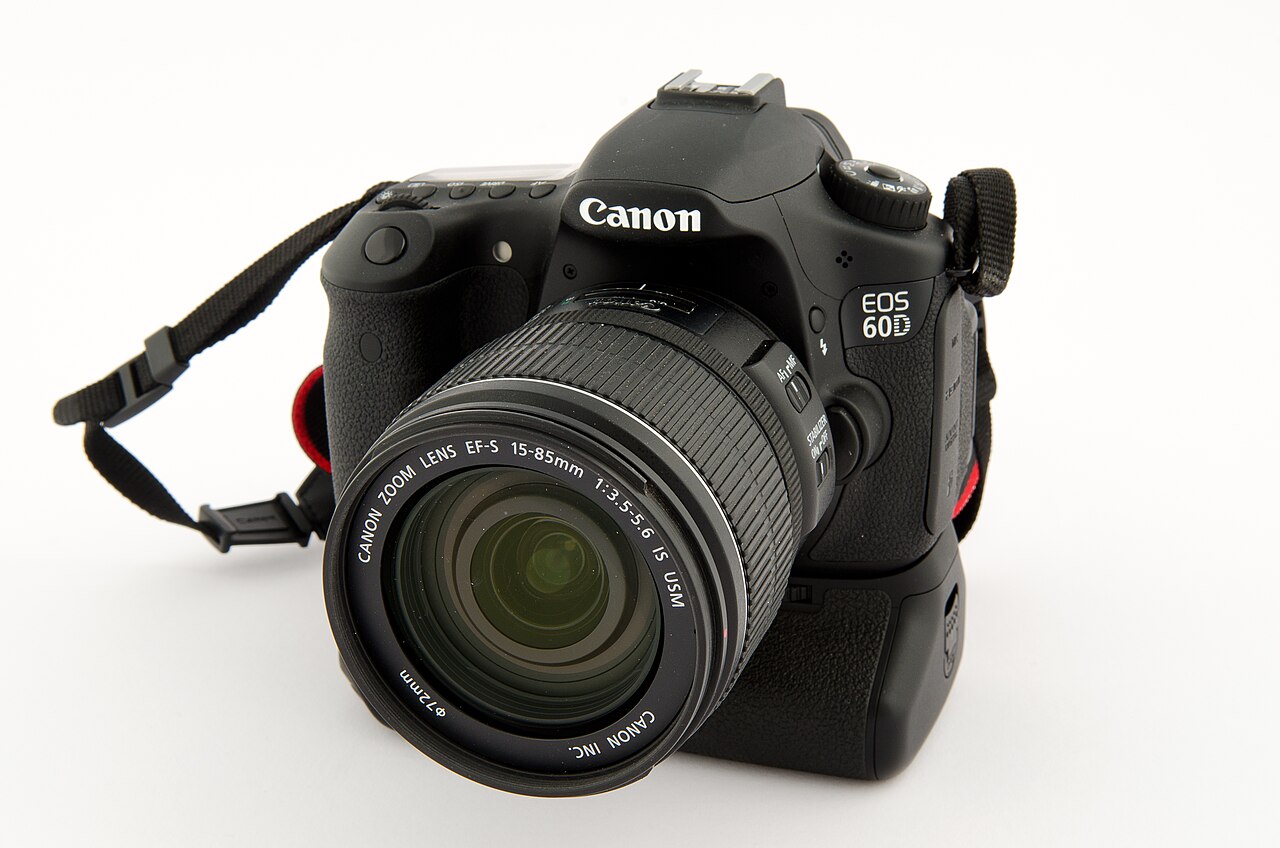
Canon’s EOS line has spent years defining the DSLR conversation, from entry-level Rebels to serious prosumer and professional bodies. With the arrival of the Canon EOS 60D on August 26, 2010, Canon introduced a camera that feels especially tuned to the moment: a feature-rich enthusiast DSLR built for photographers who wanted strong still-image performance, growing creative control, and increasingly, meaningful video capability in the same body. Positioned in the middle of Canon’s broad EOS family, the 60D arrives as a practical and forward-looking tool—one that speaks to advanced hobbyists moving up from simpler cameras as well as established EOS users looking for versatility without stepping into a higher price bracket.
At launch, the EOS 60D comes in at $1,099, and on paper it immediately makes its case. It pairs an 18MP APS-C sensor with 1080p video, uses the widely supported Canon EF mount, and introduces one of its most visibly modern touches: a fully articulating rear screen. At a time when DSLRs are becoming more than still cameras, that combination gives the 60D a distinctly hybrid identity.
A New Kind of EOS for the Enthusiast
The EOS 60D is notable not only for what it includes, but for what it represents in Canon’s lineup. This is an enthusiast DSLR shaped by changing expectations. Buyers in 2010 are no longer choosing cameras based solely on image quality and autofocus; they are also thinking about HD video, Live View usability, portability, and handling that supports experimentation from unusual angles. In that sense, the 60D feels less like a simple update and more like a response to how photographers are actually using their cameras.
The camera’s 18MP APS-C sensor places it in strong company for its class. That resolution gives users ample room for cropping, large prints, and detailed everyday shooting, while the APS-C format continues to offer a familiar blend of image quality, reach, and manageable system size. For Canon users already invested in EOS lenses, the 60D slots naturally into existing kits while offering an appreciable step up in capability for many upgraders.
The Articulating Screen Changes the Experience
The headline design feature of the EOS 60D is its articulating LCD. This may seem like a convenience on first glance, but in practical use it dramatically changes how a DSLR can be handled. Low-angle compositions, overhead shooting in crowds, tripod-based work, self-recorded clips, and creative framing all become easier and more intuitive. For photographers who have relied on optical viewfinders and fixed rear screens, this is one of those features that can quietly transform day-to-day shooting.
In Live View, the movable screen makes the camera far more flexible than many conventional DSLRs of its era. Product photography, tabletop work, macro setups, and video capture all benefit from the ability to position the display where it is easiest to see. For enthusiasts who are curious about expanding beyond traditional eye-level photography, Canon’s decision here feels significant.
1080p Video and the DSLR Hybrid Moment
Perhaps more than any other single specification, the inclusion of 1080p video marks the EOS 60D as a camera of its time. By 2010, the DSLR video movement is no longer a novelty. Independent filmmakers, multimedia journalists, event shooters, and hobbyists alike have begun to appreciate the cinematic possibilities offered by large-sensor cameras and interchangeable lenses. Canon has already played a central role in that shift, and the 60D extends that accessibility to a wider enthusiast audience.
What makes the 60D especially interesting is how naturally its articulating screen supports video use. A DSLR with HD recording is one thing; a DSLR with HD recording and a vari-angle display is another. That screen makes handheld shooting more practical, allows easier monitoring from difficult positions, and broadens the camera’s appeal to one-person crews and creators who may be shooting both stills and motion in the same session.
For many buyers, this blend is likely to be the 60D’s central appeal. It is not simply a still camera with video added as a bonus. It is a camera that acknowledges that a modern enthusiast may want to do both, and to do both with intent.
Built Around the Canon EF System
One of the EOS 60D’s greatest strengths is less about the body itself and more about the ecosystem around it. The camera uses the Canon EF mount, tying it to one of the most established interchangeable-lens systems in photography. For current EOS shooters, that means continuity. For new buyers, it means room to grow.
Whether the goal is a lightweight everyday zoom, a bright prime for portraits, a telephoto for sports and wildlife, or a specialized lens for macro or wide-angle work, the EOS system is one of the camera’s biggest practical advantages. The 60D benefits directly from Canon’s long lens history, and that makes it easier to recommend as a body that can stay relevant as a photographer’s interests develop.
This system compatibility also reinforces the 60D’s enthusiast positioning. A camera at this level should encourage growth rather than limit it, and the Canon mount gives owners a broad path forward.
Who the EOS 60D Is For
The EOS 60D appears aimed at a broad but clearly defined audience. For Rebel users ready for more direct control and a more substantial body, it offers an attractive next step. For experienced hobbyists who want a balance of stills performance, HD video, and flexible handling, it lands in a compelling middle ground. For travelers, family documentarians, and multimedia creators, it promises a camera that can cover many kinds of assignments without requiring a jump into a more expensive tier.
The launch price of $1,099 is central to that appeal. In the context of 2010’s DSLR market, pricing matters as much as features, and Canon seems to understand that an enthusiast camera has to justify itself not only with specifications but with versatility. The 60D’s spec sheet suggests exactly that kind of value proposition: serious enough to feel like a real upgrade, approachable enough to remain within reach for committed amateurs.
A Camera That Reflects a Turning Point
Looking at the EOS 60D historically, it stands as a revealing marker of where DSLR design was headed in 2010. It arrives at a time when categories are beginning to blur. The enthusiast DSLR is no longer just a smaller semi-pro still camera; it is becoming a genuinely multipurpose creative device. Resolution matters. Lens choice matters. But so do video features, Live View usability, and the ability to compose from unconventional angles.
That is why the 60D feels important. Its 18MP APS-C sensor gives it the image-making credibility expected from an EOS DSLR. Its 1080p video gives it contemporary relevance. Its articulating screen gives it a practical identity all its own. And its place within the Canon EF ecosystem gives it long-term flexibility that many buyers will value just as much as any headline feature.
In short, the Canon EOS 60D debuts as a thoughtful enthusiast camera for a changing era—one built for photographers who still care deeply about the craft of still images, but who increasingly want a DSLR that can do more.
Final Thoughts
The Canon EOS 60D enters the market as one of the more interesting enthusiast DSLRs of 2010, not because it chases every possible specification, but because it balances the right ones. It brings together resolution, HD video, lens-system strength, and a genuinely useful articulating display in a package that feels tuned to real-world use. For many shooters, that will make it one of the most versatile EOS options in its class.
For collectors, historians, and photographers revisiting this period in Canon’s lineup, the 60D remains a meaningful example of the DSLR hybrid transition. To learn more about classic Canon gear or to shop current cameras and lenses, visit Unique Photo.