The first time I was asked to shoot architectural images was by a local custom home designer who had seen some of my product work and was interested in seeing what I could bring to the table. We sat down at a pub to discuss the they type of work he did and showed me his portfolio of blueprints, 3-D design plans, and some rough photos of the homes. Immediately, I was impressed by the quality of craftsmanship involved in his work.
That night, I checked out Houzz.com, a site he had mentioned that highlights design concepts for interiors and exteriors. The site categorizes design ideas by style (contemporary, traditional, etc), location, type of locale (bedroom, kitchen, exterior, etc.) and uses hi-res images to depict each design. Site-members are then able to post comments linked directly to the image. For instance, if you (as a user) like a particular backsplash in an image, you can click it and leave a comment directly on that. Other members can then see that comment as a clickable highlight on the photo. This feature allows the architects responsible for each design to directly correspond with members who are interested in how they did it, what gave them inspiration, or allowing them to hire that architect. Likewise, the photographers that shot the images are then linked and allow direct contact from interested architects or homeowners. All in all, it's a very communal site that seems to really benefit all parties. The beauty of it, literally, is that almost every image on the site is shot by professional photographers and they are all stunning. This site has become my go-to for quality check on my images.
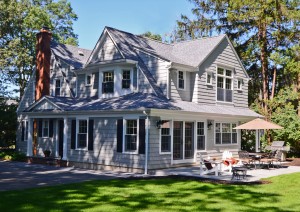
I learned a lot from our first shoot. I prepared all of my gear the night before. Cleaned lenses, charged batteries, stocked up on AA's for my speedlight, even strapped an 8 ft step ladder to the roof of my Jeep in case I needed a little more elevation. I'm shooting a D7000 and a variety of lenses, typically a Tokina 12-24 f/4, a 35 1.8 and in some cases a 70-200 2.8 when the situation arises. I didn't have access to a tilt shift lens for that job, so I made a note to double check my levels and horizons constantly. I did wind up needing the ladder to avoid planar distortion of the top of the house. However, I did note that my tripod was too short to use from the 8 ft ladder, so I used gaffer and duct tape to rig the tripod directly to the ladder. This helped quite a bit. The home was situated on a small tree-shaded lot, and the renovation I was shooting was on the back of the home, so I was shooting mostly from the side and rear. However, the sunlight was coming directly at a 45 degree angle onto the corner I was shooting. The side of the home received direct light, through the trees, while the back received full on direct sunlight. This made the shoot really difficult. I did my best, but the side of the building was sporadically covered in harsh blotchy shadows, while the rear was fully washed with light. The result left my images of the side and rear appearing to be two entirely different shades of gray. The client didn't notice, but I did, and this brought me to my first rule when shooting architecture.
Scout your light.
Before shoots now, I always contact the client to get an idea of exactly what kind of look they are going for with the images, and determine whether it's something that benefits from an early morning, mid day or evening/night shot. Then, I contact the property owner directly, usually about two weeks prior to shooting, to ask them to take visual notes over the next two weeks regarding when the natural light looks the best. I'm also clear to describe what I'm looking for. I typically like to shoot with the Sun at a 45-60 degree angle to the front of the building, camera rear, during daytime, or at dusk with the sun setting behind the home. Also, be aware of your physical whereabouts. A home directly facing North, will get little to no direct sunlight, while a home facing South will be bathed in light all day. East gets the sunrise. West gets the sunset.
Through the course of doing this more often, I made a list of several other rules for myself to follow.
Always check weather forecasts.
And keep up to date on them. Forecasts change, and you need to know when they do. The beauty of shooting architecture is that the subject really isn't going anywhere, so I find that client's who are genuinely very interested in high quality images are generally very understanding with regard to rescheduling based around weather. I try to shoot on Mostly Sunny, or Overcast days. Overcast you might ask? Yes, because a consistent grey sky does wonders for shadows. What I avoid, is obviously poor weather like rain/haze, because it can't possibly add to the image for most of my work (albeit I'm open to it if the need arises - maybe a haunted house, or something of that sort) and I also avoid Partly Cloudy days. Why? Because nothing is more frustrating than your main light source continuously changing. That's like shooting the entire day in bracket mode, but with the exposure values always being random. No thank you.
Add. Remove.
Often times, when I arrive at a home to shoot, the owners have arranged it pretty well. At least pretty well to their eyes. I go in with a little more scrutiny.
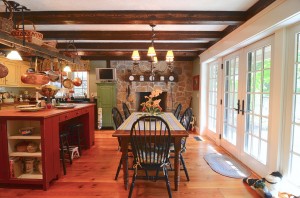
At my first job, I walked in and was wowed by the kitchen. It looked gorgeous and the physical items in it just gave it that homey feel. I was able to snap one image before my client walked in and tore it apart. He hid the microwave, towels, little ornaments. Suddenly, it felt quite stale. I gave my opinion openly that I liked the way it was, but was careful to allow the client to arrange it the way he saw fit. I shot the rest of the kitchen images that way, and when I went home, was not surprised to find that I loved the original image. So, I included it in my proofs to the client, and lo and behold, that was the final kitchen images selected. Also, luckily, that gave me plenty of objects to work with later if I needed to composite the kitchen to look more or less filled.
On the other hand (during the same job) the living room was cleaned and organized pretty well, but the coffee table had children's books on it, and the entertainment center had toys on a shelf, and a bobblehead on top of the flat screen tv. Those all had to go. As much as it looks fine to a casual visitor, when someone is scrutinizing images on a professional level for an architect, keeping the images crisp and uniform and professional is of utmost importance.
Move.
Just because you set your tripod up and frame a shot, doesn't mean that 4 inches to the left won't result in a better image. These shoots take time, and you really need to slow down and ensure that the image you're taking is the right one. My first job took 2 hours from arrival to departure, and I left thinking that was about right. My next home took 4 and a half. Since then, I've shot some that have taken me all day.
Particularly with interiors, small incremental movements can make a huge difference. Look beyond your subject or focal point and decide whether things in the foreground and background are distracting. If so, can you move a little bit left or right, forward or backward to avoid them clashing? Sometimes it's literally a few inches in any direction with the lens and things start opening up or dis-aligning and creating an aesthetic balance within the frame. Be careful of windows, especially at higher apertures. Objects outside can destroy the overall vibe of an image, and editing through windows can sometimes be a real pain.
Revisit remedial math.
Geometry. Keep your eyes peeled for it. The eye naturally is more attracted to the resolution of shapes, or the continuity of repeating form in an image. For example, the doorway, table, windows, wall decor may very well all be rectangular, so play into that and try to frame your image to gently arrange each into the shot, but be careful. Overlapping geometry can seem cluttered.
Wider isn't always better.
Don't get me wrong. My 12-24 is my typical go to lens for this sort of work, but surprisingly, I'm typically closer to the other end of the zoom range on that lens. People have a tendency, when shooting architecture, to crank back to the widest option of their zoom range and start composing haphazardly. Yes, you get a lot of space to work with. But what good is that? What are you adding? Often times, the side of a desk or wall unit, or photos on a wall. At wider focal lengths lens distortion becomes increasingly apparent. Vertical and horizontal lines start to bend. Furniture elongates or flattens and the sense of depth becomes skewed. When framing a shot, I usually determine where I want the focus of my image to be and I zoom all the way in on it and then adjust so that the angle on my focus is exactly the way I want it, then I slowly zoom out, keeping an eye on what comes into the frame and determining if it's necessary. If it is, do I need to fit it in entirely? Or can the rest of it be implied by seeing a portion of it? Large furniture, wall art, and floor space can be implied.
Lighting is everything.
Whether you're shooting an interior or an exterior, getting the lighting right is key.
For exteriors, depending on the tone of the shot, I arrange my lighting to be off-center lighting which allows me to capture slight shadowing to avoid blowing out textures, but to still fully light the structure. On extremely bright days, I'll shoot with a neutral density filter if necessary, and I try to use foliage to frame shots to darken the outsides of the image to avoid complete highlighting of the image. This effect is like adding a vignette to focus attention on the architecture and cause it to pop rather than seeming washed out.
For evening/night shoots, I turn on all of the lights inside and wait for the ambient natural light to match the artificial light. I bracket those exposures with three exposures, about 2/3 stop in increment. This gives me some leeway later during post. As it gets darker, I continue shooting, but bring a flashlight and speedlight. I use the flashlight to light specific objects/areas in the frame individually, while I alternate using the speedlight with a wireless trigger to remotely backlight specific objects/areas, particularly the underhangs of porches, the backs of foliage near the building, and rooflines to bring some separation from the sky. I expose the sky fairly under exposed so I have a lot to work with later for compositing. Then I put the best images together in post using Photoshop CS5 and do my final tweaking in Lightroom 3.
For interiors, I turn on all of the lights, then use a speedlight or monolight (depending on size of room) through a white translucent umbrella, or bounced into a silver lined umbrella to fill. I do this on low power, and just to give some fill while still matching the artificial light already in place. You don't want to blow out the room, you want it to still feel warm and natural. I shoot with exposure bracketing, again, but at about a 1/3 stop increment, just to pick up details in furniture and offset any odd lighting effects in corners. Again, be aware of any sort of windows, mirrors, reflective surfaces when introducing your own additional lighting. It has a tendency to pop into images, often times only noticeable in post.
Lastly, Slow down
I can't stress enough how all too often, photographers show up to paid jobs and rush. Perhaps it's the pressure of the presence of a client, or the nerve of getting something wrong, but if you rush you're only going to make more mistakes.
I could really go on forever about this, but perhaps it would be better to save those for more in depth discussions at a later date. Until then, following these rules should help you shoot architecture with a little more awareness and create smart, marketable images.