Sharp landscape images are the result of smart settings, steady technique, and a clear plan. Whether you’re shooting grand vistas or intimate scenes, this guide from the team at Unique Photo covers the best camera settings and field practices to consistently capture crisp, detailed landscape photographs.
Best camera settings for sharp landscape photos
If you want a quick starting point, use these dependable baseline settings and then refine on location:
- Aperture: f/8–f/11 for maximum lens sharpness and depth of field
- Shutter speed: As fast as needed to freeze foliage movement; slower only if wind is calm or you’re smoothing water with a tripod
- ISO: Base ISO (ISO 64/100) for clean files with maximum detail
- Focus: Single-point AF or manual focus; focus at or near the hyperfocal distance
- Stability: Tripod + 2s self-timer or remote; turn off IS/VR/IBIS when on a solid tripod
- File type: RAW for maximum latitude and optimal sharpening in post

What aperture is best for landscapes?
The sweet spot for most modern lenses is f/8 to f/11. At these apertures you’ll balance front-to-back sharpness with minimal diffraction softening. If you need extra depth of field for very close foregrounds, stop down to f/13–f/16, but test and review at 100% to ensure diffraction isn’t robbing detail. Alternatively, use focus stacking to keep everything tack-sharp without resorting to very small apertures.

How to use hyperfocal distance for sharp landscapes
Hyperfocal distance is the focus distance that maximizes depth of field so everything from roughly half that distance to infinity appears acceptably sharp. An easy field method:
- Set aperture to f/8–f/11.
- Use single-point AF and focus about one-third into the scene or on a subject at the estimated hyperfocal distance.
- On mirrorless cameras, use focus magnification and peaking to confirm fine detail on your focus target.
- Take a test shot and check critical edges (foreground textures and distant ridgelines) at 100%.
Want hands-on practice? Unique Photo’s Macro and Landscape Photography at Duke Farms with Michael Downey is a great field experience to refine your focusing technique.

Shutter speed tips for sharpness in wind and water
- Calm conditions: 1/15–1/60 sec is fine on a tripod for static scenes.
- Light breeze in foliage: Aim for 1/60–1/125 sec to avoid leaf blur.
- Strong wind: 1/250–1/500 sec or higher; raise ISO if needed to hold aperture.
- Smoothing water: Use ND filters to slow shutter to 1/2–2 seconds for texture, or 5–30+ seconds for silky water; ensure the tripod is rock-solid.
Best ISO for landscape photography
Keep ISO at base (typically ISO 64/100) for maximum dynamic range and micro-contrast. If the scene or wind demands a faster shutter, increase ISO gradually. Expose to protect highlights; it’s easier to lift shadows from a clean, low-ISO file than to rescue blown highlights.
Tripod technique and stabilization settings
- Use a sturdy tripod; avoid raising the center column.
- Disable lens IS/VR/IBIS when locked down to prevent feedback blur (check your manual; some systems auto-detect tripods).
- Trigger with a 2-second delay, electronic first curtain shutter (EFCS), or a remote release.
- Weight the tripod hook and shield the setup from wind with your body.
Lenses and filters for tack-sharp landscapes
Prime lenses are often bitingly sharp, but today’s high-quality zooms are exceptional too—stop down to the lens’s sweet spot (f/5.6–f/8 on many wide and standard zooms). For filters, quality matters: a well-made circular polarizer and solid ND/soft grad will not compromise sharpness. Avoid cheap, uncoated “protective” filters that can reduce contrast and introduce flare.
Night landscape settings for sharp stars and scenes
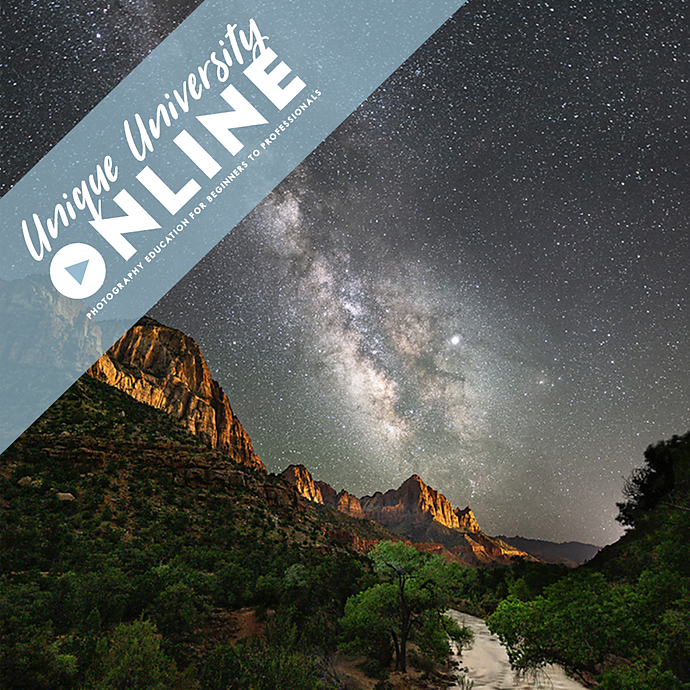
For astro landscapes, prioritize fast apertures and precise manual focus:
- Aperture: f/1.8–f/2.8 (or your lens’s widest usable aperture)
- Shutter: Typically 10–20 seconds for static stars on wide lenses; adjust to minimize star trails
- ISO: 1600–6400 depending on aperture and sky brightness
- Focus: Use magnified live view on a bright star and focus for the smallest point of light
For blue hour cityscapes and twilight seascapes, return to f/8–f/11 at ISO 100 and let shutter lengthen on the tripod. To dive deep into night techniques, check out UUOnline: Photographing the Nighttime Landscape with Roman Kurywczak through Unique Photo.
In‑camera settings that influence sharpness
- Shoot RAW for flexible, high-quality sharpening later.
- Use low or neutral picture styles; in-camera sharpening doesn’t affect RAW but can influence your preview.
- Turn on highlight warnings and use zebras to guard against clipping.
- Enable EFCS or electronic shutter to reduce mechanical vibration when possible.
- Long Exposure Noise Reduction can help in multi-minute exposures; test both ways to see what works best for your workflow.
Post‑processing to maximize landscape sharpness
A great file becomes a great photograph in post. Recommended workflow:
- Apply lens profile corrections and chromatic aberration removal.
- Use capture sharpening (mild deconvolution) to restore sensor and lens acuity.
- Add midtone contrast (Texture/Clarity) sparingly and locally.
- Use mask-aware sharpening on edges while protecting skies and water.
- Finish with output sharpening tailored to print size or web resolution.
Want to refine your finishing? Unique Photo’s Editing and Enhancing Landscape and Nature Photography with Photoshop class will elevate your sharpening, contrast control, and color work.
Field checklist: how to get sharp landscape images
- Mount on a sturdy tripod; turn off stabilization.
- Set f/8–f/11 and base ISO; choose a shutter speed to freeze any movement.
- Focus near hyperfocal; confirm with magnified live view.
- Use 2s timer/remote and EFCS; shield from wind.
- Bracket if dynamic range is extreme.
- Review at 100% and refine focus/exposure as needed.
Learn and practice with Unique University
Nothing replaces guided practice. Unique Photo’s Unique University offers hands-on and online programs to help you master sharpness in any light:
- Macro and Landscape Photography at Duke Farms with Michael Downey — hone field technique and focusing discipline.
- Photographing the Introspective Landscape with Salvatore Vasapolli — refine composition and detail awareness.
- CS: For the Love of Landscapes with Roman Kurywczak (Tamron) — gear setup, lens choices, and real-world demos.
- UUOnline: Photographing the Nighttime Landscape with Roman Kurywczak — the sharpness essentials after dark.
- Editing and Enhancing Landscape and Nature Photography with Photoshop — finish with professional-grade sharpness.
When it’s time to share your ultra-sharp work, consider creating a keepsake with the MediaClip Small Landscape Book with a Printable Cover, available from Unique Photo.
Conclusion and internal linking suggestions
Consistent sharpness comes from a reliable baseline (f/8–f/11, base ISO, tripod, precise focus) and the know-how to adapt for wind, water, and night conditions. For more learning, gear, and printing, visit Unique Photo in-store or online.
Suggested internal links to help readers take the next step:
- Tripods & Supports
- Remote Shutter Releases
- Circular Polarizers and Neutral Density Filters
- Ultra-Wide & Standard Zoom Lenses for Landscapes
- Telephoto Lenses for Compressing Vistas
- Camera Cleaning & Maintenance
- Unique University: Landscape & Night Photography Classes
- Photo Printing & Books (MediaClip Small Landscape Book)