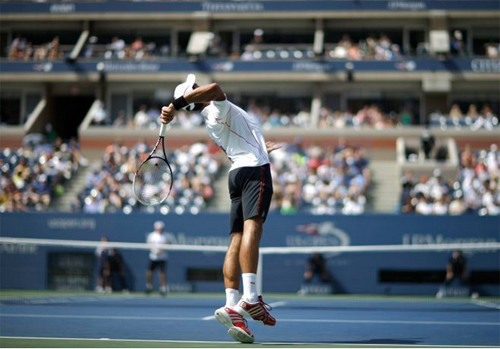
With the US Open just concluded full vigor, many of us would have surely attempted to capture our favorite tennis stars in action. However, at times this task is harder than it seems to the naked eye. Several acclaimed sports photographer too have claimed in the past, that after having shot every sport they can think of, tennis is still the hardest sport to shoot. In fact, there are many detailed books on tennis photography to help readers and budding photographers improve the quality of the pictures they capture. Here are a few vital tips that should prove beneficial while endeavoring to take that perfect picture during a tennis match.

Photo credits - Clive Brunskill
1. Go Long: Remember to always use a long lens for shooting tennis events. “The preferred length,” stated acclaimed sports photographer Chris Nicholson, “is the equivalent of a 300mm lens on a 35mm camera. Because the light sensors in Digital SLRs are smaller than a frame of 35mm film, lenses effectively magnify more, so a 200mm lens is the equivalent on those cameras.” One more benefit of long-range lenses is that they effectively blur the background. Also remember to use swifter lenses, particularly those with lower f-stop values, for two essential reasons. “One is,” said Mr. Nicholson, “You need fast shutter speeds to shoot tennis action. The other is, low f-numbers add to the artful blur, which you want because tennis backgrounds are busy (other courts and players, grandstands or other camera-toting parents). Using a long lens helps you isolate the player and keeps all of those other distractions out of the shot.”

Photo credits - Clive Brunskill
2. Allow a Blow Out: Since tennis matches are usually played during daytime, the glistening sun coupled with the players' white attire could create a ruckus with your camera's light meter. If you have the tendency to opt for automatic exposure while capturing your pictures, the shadows emitted from the hats or visors of the players could give them the appearance of donning a black mask. According to Mr. Nicholson, “ The face is the most important thing.” So what you need to do is to fix the meter for the face and keep it locked on that position. This is achieved by choosing the manual shooting mode or selecting the “AE lock” feature, which enables you to fix the auto exposure position. If you already know the player, then you could even shoot a close-up of his or her visage before the match commences, keep the exposure locked on this particular shot, and then make the necessary adjustments afterward. Once you start shooting tennis matches in this fashion, you needn't even bother if the player is back lit. “Just open up a stop and a half, and allow the highlights to blow out,” says Mr. Nicholson. “It’s a great way to deal with someone who has a visor.” According to him, shooting with back light is also a great way to capture some spectacular effects, and it's even possible to observe the fuzz blowing off new balls when they are just introduced in a match.
3. Don't Quit: Sports in general are not solely about winning. In the same vein, sports photography is not just about capturing the action in the arena. Especially in tennis, when the point is completed, it's imperative that your camera remains focused on the player. This is sure to pay rich dividends, because after lengthy and crucial points, the athletes are sure to react vehemently, whether in ecstasy or disappointment, and what's even better is that the players aren't overtly mobile during their reactions after a point. This is the time when you get to capture their raw emotions and actions such as joy, yelling, smashing of rackets, pumping of fists, arguments with the chair umpire, and tears of triumph or defeat. Such emotions reveal more about the match than any number of pictures depicting their backhands, serves and volleys, forehands, winners, or unforced errors. Most importantly, you shouldn't lose hope if your initial attempts at tennis photography are not up to the mark. Simple mistakes like lowering your camera after each point - even though you know that it's necessary to keep shooting to capture the players' reactions – are bound to happen.

Photo credits - Darron Cummings
4. Neglecting the Background: Always be aware of the background in which you are shooting. Sometimes, while capturing sporting events, it's possible for even professionals to forget this minor yet vital detail. So much of effort and concentration is applied on following and shooting the sporting action itself that we tend to neglect the appearance of the background. Now committing this error in tennis is nothing short of sacrilege. Bustling crowds garbed in light garments, bleacher railings, isolated racket bags, towels, water bottles, ball boys, and other factors can all contribute to spoiling the background of your tennis images if you do not pay proper attention. In order to avoid such a scenario, you should zero in on an angle that enables you to aim at the back-screen at all times. The smooth and level surface of the back-screen is sure to merge well with your photographs than any other background at a tennis arena.
5. Waiting to See the Ball: It might be difficult for most of us to believe this, but ask any professional sports photographer and he's almost certain to tell you that timing photographs during tennis action is not as simple as it appears to be. The ball actually speeds across the court at such high velocity, that if you pause to observe it in your camera's screen, chances are that the real photo will be missed. Mr. Nicholson says, “One of my favorites is to watch for the player’s muscles to move as he or she is about to swing. That will tell you that the player sees the ball coming, so you’ll know it’s coming, too. Then fire the shutter—fast!” For this purpose, he suggests that you develop an appropriate timing method that would assist you in judging the exact moment to press the shutter button. Another thing that you need to do is utilize your camera's LCD to play back and observe your timing. This would help in assessing if you're exposing your picture earlier or later than required, so that the necessary alteration could be employed before the next shot. Follow these simple tips, and within no time you should be easily able to capture the ball in every shot you take.
Like in any other photography assignment, tennis photography is also about working hard at perfecting your shots and be willing to put in the long hours till your skills start improving. Tennis is without question, the most difficult sport to shoot, and hence, needs perseverance, along with certain tricks of the trade.
Featured Image Photo Credits - David Goldman