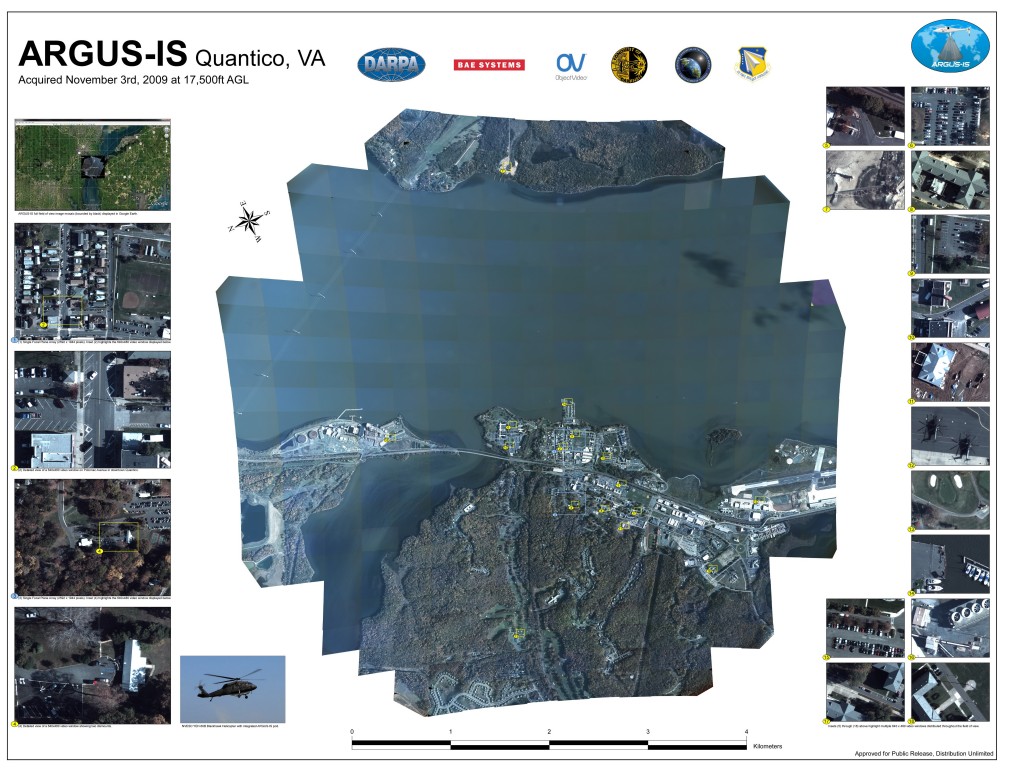
It seems that Rockwell's 80's anxiety translates pretty well in today's CCTV society, but maybe the proverbial eye in the sky is a little more powerful than previously thought possible. How does a 1.8 gigapixel sensor on a surveillance drone sound? Meet the ARGUS-IS: The world's highest resolution surveillance platform brought to you by DARPA. The entire system is an array of 368 microcameras (hence it's mythology-inspired name) that can be focused via 4 telescopic lenses on the ground.

This bad boy attaches to an unmanned aerial vehicle (like the appropriately named Predator) and has the capability to capture 12fps of HD Video with high enough resolution to see something as small as a seagull flying from about 17,500 feet in the sky. Each 5MP microcamera takes a picture that is stitched together to form an image that can cover roughly 15 square miles...or basically half of Manhattan.

Here's how the camera's Persistics software looks...and it's straight out of any sci-fi movie. Let's Enhance. Don't forget about the much coveted zoom, which can identify and target up to 65 individual moving subjects as small as 6-inches.
Sounds frightening and amazing at the same time. It also sounds too good to be true.
According to the NOVA video, all of the data being recorded adds up to 1,000,000 TERABYTES a day...Pardon all the ellipses, but that would be an exabyte and that's a whole lotta data to be transmitted wirelessly from that far away.
My math isn't spectacular, but 1.8 billion pixels @ 12 fps is somewhere around 600 gigabits per second, resulting with about 6,000 terabytes of video a day. This doesn't take into account all the other metadata this camera might collect to track subjects, but 1 million terabytes sounds like something PBS threw out to flabbergast people...or insult the few who constantly question everything. Even with something like a military-made 100gbps wireless network, they wouldn't be able to stream all that data live.
Before we all start screaming about how wrong everyone else is, perhaps we should take into account the amount of compression going on. According to this article, it seems like they've figured out an algorithm that can compress the video data enough without having to use 1000's of hard drives or loosing fidelity.
ARGUS-IS can generate several terabytes of data per minute, hundreds of times greater than previous-generation sensors. “Until now, we had no practical way to store that much data,” says Jones. “With Persistics, we have an innovative method to compress the equivalent of thousands of hard drives to just a few drives.”
Whether or not this is all feasible is up in the air (zing), but it leaves us to question what purpose such powerful surveillance would really serve. My guess: Nothing good. Not to get into a debate about privacy vs. safety, but isn't it awfully unsettling to know that there's always someone keeping track of you at all times?