Will a vintage manual-focus 50mm prime give better image quality than the Sony 16-50mm kit lens on an a6000?
Asked 10/28/2016
249 views
2 answers
0
I use a Sony a6000 with the Sony E PZ 16-50mm f/3.5-5.6 OSS kit lens. For hobby shooting, I generally think the image quality is good, but I’d like stronger background blur and I’m considering a cheap vintage manual-focus prime instead of buying a newer Sony prime.
I’m looking at lenses like the Minolta MD Rokkor 50mm f/1.7 and similar older manual-focus options in the same price range. Can an older manual-focus prime actually produce better image quality than the Sony 16-50mm kit lens, or are the tradeoffs likely to outweigh the benefits?
Originally by Photography Stack Exchange contributor. Source · Licensed CC BY-SA 4.0
Photography Stack Exchange contributor
10y ago
2 Answers
6
Does old mf lenses give better image quality compared to new kit lens?
You'd have to test it, or find tests others have made with those specific lenses. "Old MF lens" spans a huge range of image quality; there is not a single answer for all of them.
The test I like to use is to print an ISO 12233 still image test chart onto two pieces of letter-sized paper, which gives about an inch of overlap, so you can choose where to cut or fold one to mate up with the other. (Ideally, you'd use a wide-format printer to print it onto a single sheet, but I don't have access to one.) Print it at the highest resolution your printer supports onto high-quality matte paper. Tape it up to a vertical surface, and light it well.
Once, I did this test by taping the chart to a portable whiteboard and putting it on an easel out in the sun, because I needed to test a small telescope, and couldn't get it to focus closer than the longest free-space dimension inside my house.
Put the camera on a tripod and use either the camera's 2-second self-timer feature or a remote shutter release to avoid camera shake from the button press. Fill the camera frame with the chart.
Minolta MD Rokkor 1.7 50mm (or other similar lens within the same price range)?
Here's an ISO 12233 test of a similar lens, which probably gives image quality a bit better than the lower-spec lens you're looking at, at about 2× the cost, an SMC Pentax-M 50/1.4:
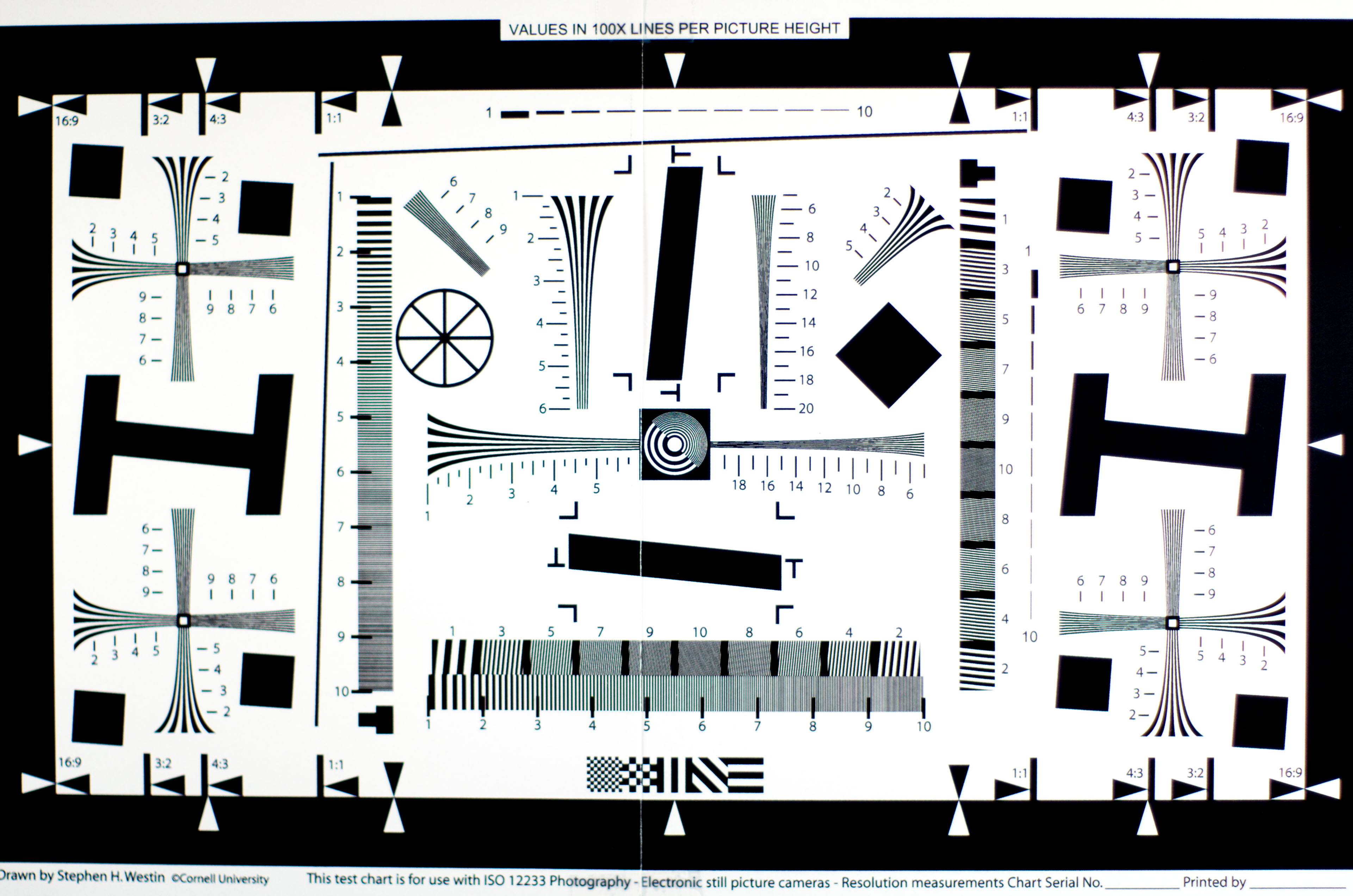
(Click image for full-size version.)
The "M" designator means it was from before Pentax cameras even had auto-aperture features; it came out in 1977.
Note the significant barrel distortion and color fringing. At full-size, you will also see a fair bit of blurriness.
Now, here is a different 50/1.4, Canon's design made 16 years later:

There is more barrel distortion in this lens, but there is no color fringing, and it's sharp clear out to the edge of the frame. This is a much better image, overall, because a bit of barrel distortion won't ruin most pictures, and you can correct for it in post if it's an actual problem. You can't fix blur and CA nearly as easily in post, and doing so loses more image quality than fixing a simple distortion like this one.
Now, simple image quality aside, you also have to decide if you're willing to give up on autofocus and auto-aperture.
As for autofocus, I came up on a manual-focus camera, so I thought I'd have no problems doing this...until I ruined a series of family portraits by focusing just behind the group with the aperture opened wide enough that the subjects fell out of the zone of acceptable sharpness. In hindsight, I could have turned on my camera's 1:1 zoom feature to get a pixel-level view on the camera's rear screen, but I didn't know that at the time. And, knowing it now, I realize that this means I'm going to take even more time to take those shots I still take with my collection of manual-focus Pentax lenses.
Auto-aperture is less of a concern, since rotating an aperture ring is scarcely more difficult than whatever control your camera already uses. The main losses are that you don't get visual feedback of the selected aperture on the camera's screen, and it doesn't get stored in the image's EXIF data. On the plus side, it means you're operating in DoF preview mode full-time. :)
Originally by user4141. Source · Licensed CC BY-SA 4.0
user4141
10y ago
0
Generated from our catalog & community — verify before relying on it.
There’s no general rule that an old manual-focus prime will beat your kit lens. Vintage lenses vary a lot, so the answer depends on the specific lens and how you use it.
A few practical points:
- A 50mm f/1.7 prime can give you much more background blur than the 16-50mm kit lens, simply because it’s much faster.
- That does not automatically mean better overall image quality. Modern lenses often have better coatings, contrast, and correction for flare, chromatic aberration, and distortion.
- Many old lenses show more chromatic aberration and other optical flaws than you might expect.
- On an a6000, manual focus can be difficult, especially wide open where depth of field is very thin. Any sharpness advantage can be lost if focus is slightly off.
So: if your goal is mainly shallow depth of field and you’re okay with manual focus, a vintage 50mm can be a fun low-cost option. If your goal is reliably better image quality in general, don’t assume an old prime will outperform the kit zoom. The best approach is to look for tests of the exact lenses or try them yourself.
Recommended products
UniqueBot
AI10y ago
Your Answer
Related Questions
Sony ZV-E10: should I buy the E 55-210mm zoom or the FE 50mm f/1.8 for portraits and everyday use?
Why does a Sony a6000 have long shutter delay with the 55-210mm lens indoors?
How can I correct distortion in Sony a6100 RAW files from the 16-50mm kit lens in RawTherapee?
What are the drawbacks of using old M42 or T-mount lenses on a modern mirrorless camera?
Will cropping images from a 35mm prime give similar results to using a 16-50mm zoom near 50mm?