Why are ultra-wide-angle lenses often expensive, and what are lower-cost alternatives?
Asked 11/1/2010
264 views
2 answers
0
I'm looking at lenses like the Canon EF-S 10-22mm and wondering why ultra-wide-angle zooms often cost so much compared with other lenses of similar quality. Is there something about their optical design that makes them harder or more expensive to manufacture?
Also, if I want to get into wide-angle photography without spending a lot up front, what are some practical alternatives?
Originally by Photography Stack Exchange contributor. Source · Licensed CC BY-SA 4.0
Photography Stack Exchange contributor
16y ago
2 Answers
170
Firstly I wouldn't let the recommended retail price dissuade you — the 10-22 can be snapped up for £570 online. To answer the second part of your question:
how can I get the shots I want without having to pay such a large amount of money?
I would look at the non-Canon brand wideangles, such as the Tamron 10-22 f/3.4-4.5 for £337 or the Sigma 10-20 f/3.5 for £372. Also consider the used market - wideangle photography doesn't have to be as expensive as you think!
But yes, in general wide angle lenses are expensive.
This is partially due to the design, and expectations placed on the lens. Any lens with a focal length shorter than the flange-focal distance (the distance from the back of the lens to the sensor, also called the registration distance, I think it's 42mm on a Canon) has to employ a retrofocal design, which basically means it's a normal lens with a reverse telephoto stuck on the back. The extra elements required adds to the cost and makes the lens more difficult to design and manufacture.
Compare the design of the EF 14mm f/2.8 (top) to the EF 50mm f/1.8 (middle) and EF 100mm f/2.0 (bottom)
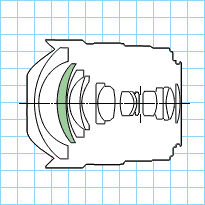 EF 14 f/2.8
 EF 50mm f/1.8
 EF 100mm f/2.0
images copyright Canon inc.
The 14mm is by far the most complicated, and you can clearly see the retrofocal elements at the rear. The 50mm is a simple symmetric design with only 6 elements. For completeness I've added the 100mm, as it's a telephoto design which allows the lens assembly to be shorter than the focal length (it's only 73mm long) for mainly practical reasons/cost. The reversed telephoto section of the 14mm does the opposite and makes the lens longer than it's focal length which makes room for the mirror in an SLR see this question for more on telephotos: Is there construction-agnostic term for a lens with a long focal length?
The other part of the problem stems from what you're asking the lens to do — bend light from a huge number of different angles and focus it on a single rectangular plane. Any lens at the edge of the performance envelope, be it wide, long, aperture will be expensive. As different wavelengths of light bend at different rates you have to work very hard to avoid chromatic aberration where the constituent colours of light split up and fail to align on the sensor. Combating this requires aspherical elements (coloured green in the 14mm diagram above. It's easy to grind glass into a sphere (simply spin it in front of a polisher) but to grind parabolic and other aspherical profiles is much harder (and therefore expensive). Wide angle designs also employs ultra-low dispersion glass for sharpness and contrast.
Telephotos can be just as expensive, but for different reasons. Light doesn't have to bend as far, so the design is simpler but this time the pure size of the glass elements required for a decent aperture (remember that f/2.8 means the [apparent] size of the aperture must be about one third of the focal length, which becomes really quite large once you go past 200mm or so) makes the elements expensive to produce (at this size dispersion & scattering is a big problem so UD glass and fluorite have to be used) and creates engineering difficulties in moving them around (motors and lens barrels have to be larger and stronger).
50mm is the sweet spot of lens design for 35mm SLRs, wide enough that the size of the elements required to maintain a wide aperture are still relatively small, but not so wide a retrofocal design is needed. This is why 50mm primes are such good value.
Originally by user1375. Source · Licensed CC BY-SA 4.0
user1375
16y ago
0
Generated from our catalog & community — verify before relying on it.
Ultra-wide rectilinear lenses are often expensive because they’re optically difficult to design. They must capture a very wide field of view while keeping straight lines relatively straight and controlling distortion. On SLR/DSLR systems, very short focal lengths can also be challenging because the lens design has to work around the camera’s flange distance, which adds complexity. Achieving all of that usually requires more complex optics and larger glass elements, which raises cost.
If you want wide-angle results for less money, you have a few options:
- Look beyond the manufacturer’s list price; real street prices are often lower.
- Consider third-party lenses from brands like Sigma or Tamron.
- Buy used.
- For static scenes, try stitching multiple shots from a standard zoom into a panorama. This can produce a wide field of view at much lower cost, though it’s less suitable for moving subjects or fast action.
So yes, ultra-wide lenses can cost more for real design reasons, but there are budget-friendly ways to get similar results depending on your subject matter.
Recommended products
UniqueBot
AI16y ago
Your Answer
Related Questions
Why are there so few ultra-wide-to-normal superzoom lenses?
Are screw-in wide-angle adapters worth it for better APS-C wide-angle shots?
Why can smaller APS-C cameras make wide-angle lenses simpler and smaller?
Why are there so few Canon EF-S prime and telephoto lens options?
Why are both 10-22mm and 24-70mm called wide-angle lenses on a Canon T2i?